CCME.NEWS, covering the regional and global HVACR industry with an unwavering commitment to providing in-depth news and analyses on policy, business and technology
· Masdar’s twelfth Annual Sustainability Report shows continued progress in key areas, with the company delivering record 62% portfolio capacity growth, increasing its global footprint
· Report highlights leadership in sustainable finance and widespread investor confidence in long-term strategy and ESG credentials
· Masdar deepens commitment to talent development and inclusion, with women comprising 20% of its management team
Abu Dhabi, UAE – August 20, 2025: Abu Dhabi Future Energy Company PJSC – Masdar, has released its 12th Annual Sustainability Report which highlights how the company strengthened its position as a global clean energy leader last year, delivering record portfolio capacity growth and increasing its global footprint through major acquisitions in Europe and the United States.
Masdar’s Sustainability Report highlights the company’s continued progress in key sustainability areas, including environmental performance, social impact, ethical business practices, and workforce diversity. It also reinforces Masdar’s leadership in sustainable finance, with the expansion of its green bond program in 2024.
Masdar achieved a record portfolio growth of 62 percent last year, with its operational, under construction and advanced pipeline capacity reaching 51 gigawatts (GW), more than halfway to the company’s 2030 target of 100GW. Total capacity for operational and under construction projects almost doubled to 32.6GW, with operational projects generating 29,225 gigawatt-hours (GWh) of clean electricity, avoiding 15.5 million tonnes of carbon dioxide equivalent.
Landmark acquisitions fueled Masdar’s growth in 2024. With its strategic expansion in Europe, Masdar acquired Greece’s TERNA ENERGY for a total enterprise value of €3.2 billion. Masdar also acquired a 50 percent stake in Terra-Gen, one of the largest independent renewable energy producers in the United States. Terra-Gen’s portfolio will play a key role in driving Masdar’s global capacity growth. The investment will also accelerate collaboration between the US and the UAE in alignment with their strategic energy partnership for reliable, affordable and sustainable energy. In the Iberian Peninsula, another core European market, Masdar expanded further by acquiring Saeta for US$1.4 billion and securing a 49 percent stake in a 2GW operating solar portfolio from Endesa S.A.
Mohamed Jameel Al Ramahi, Chief Executive Officer, Masdar, said: “As Masdar continues to evolve as a global clean energy leader, 2024 marked a defining chapter in our journey, as we expanded our presence in key global markets, strengthened our financial credentials and drove initiatives that reflect our commitment to responsible growth and inclusive progress. As a global investor, developer, and operator we are delivering impact at scale across key geographies and helping to shape the future of clean energy. We will continue to drive innovation in the clean energy sector and reinforce our position as a partner of choice for governments and communities across the globe.”
Masdar’s second green bond issuance, in July 2024, was again met with strong global demand, being 4.6 times oversubscribed, reaffirming widespread investor confidence in the company’s long-term strategy and ESG credentials. Masdar also received a credit rating upgrade to AA- from Fitch Ratings and an ESG Entity Rating of 2 from Sustainable Fitch, with a 71/100 score, reflecting the company’s good ESG performance and the green nature of its assets.
Aligned with its focus on diversity, inclusion, and leadership development, Masdar is committed to promoting a strong female representation in management, with women now comprising 20 percent of its management team. It is also steadfast in its approach to empowering local communities through sustainable urban development and inclusive energy access initiatives across its projects.
Beyond power generation, Masdar’s projects create jobs in local communities, support economic growth, and protect wildlife ecosystems. As an example of Masdar’s commitment to biodiversity, the company is utilizing Identiflight AI technology at its Zarafshan wind project in Uzbekistan, helping to protect bird species through advanced flight pattern monitoring and risk reduction, marking the first such deployment in Asia.
To view Masdar’s 2024 Annual Sustainability Report, please click here
-ENDS-
Contacts:
For media inquiries, please contact: press@masdar.ae
For more information please visit: https://www.masdar.ae and connect: facebook.com/masdar.ae and twitter.com/masdar
About Masdar
Masdar (Abu Dhabi Future Energy Company) is one of the world’s leading clean energy companies. Masdar is advancing the development and deployment of solar, wind, geothermal, battery storage and green hydrogen technologies to accelerate the transformation of energy systems and help the world meet its net-zero ambitions.
Established in 2006, Masdar has developed and invested in projects in over 40 countries with a combined capacity of 51 gigawatts (GW), providing affordable clean energy access to those who need it most and helping to power a more sustainable future.
Masdar is jointly owned by TAQA, ADNOC, and Mubadala, and is targeting a renewable energy portfolio capacity of 100GW by 2030 while aiming to be a leading producer of green hydrogen by the same year.
Farhan Juratli of Dubai Holding conducts a comparative lifecycle analysis of District Cooling, VRF and DX systems for a 1,000-villa UAE development
Abstract
This 30-year lifecycle assessment compares three cooling strategies for a 1,000-villa development in the UAE, each villa designed for a peak load of 25 RT (Refrigeration Ton), which equals an aggregate of 25,000 RT:
1. Variable Refrigerant Flow (VRF) systems charged with R-410A (GWP 2.088), with a specific charge of 1.8 kg/RT and a measured seasonal energy intensity of 1.2 kWh/TRh
2. Direct Expansion (DX) split units, also using R-410A but at a higher specific charge of 2.0 kg/RT, operating at an average 1.7 kWh/TRh.
3. A District Cooling Plant (DCP) rated at 12,500 RT, sized based on a rigorously validated 50% diversity factor (25,000 RT × 50% = 12,500 RT). This figure is grounded in the author’s eleven-year operational experience with a reference villa community, where the measured coincident peak never exceeded 50% of the total connected villa load – attributable to non-simultaneous occupancy across villas, staggered peak cooling demands even in occupied homes and the fact that a portion of residents are typically away on vacation during the hottest months (July-August).
Two refrigerant pathways are evaluated for the DCP’s centrifugal chillers:
· R-134a (GWP 1,430), the incumbent HFC option, and
· R-1233zd(E) (GWP ≈ 1), an ultra-low-GWP, non-flammable HFO replacement
Using UAE-specific grid-emission factors, tariff structures and capital-cost benchmarks, the study quantifies embodied refrigerant carbon, 30-year operational emissions and net-present-value lifecycle economics. Findings confirm that District Cooling delivers the most favourable environmental and financial outcomes under either refrigerant scenario, with the R-1233zd(E) option virtually eliminating refrigerant-related greenhouse-gas emissions while achieving the lowest total cost of ownership.
1. Introduction
Increasing global environmental and regulatory pressures necessitate rigorous evaluation of cooling system selection based on comprehensive lifecycle metrics. VRF and DX systems, traditionally favoured due to modular flexibility, entail substantial refrigerant inventories and environmental implications. In contrast, centralised DCP solutions leverage thermal energy storage (TES), load diversification and advanced chiller technology, significantly reducing refrigerant charge per unit capacity and lifecycle emissions. This technical analysis quantifies these advantages, evaluating distinct refrigerant technologies and configurations in District Cooling, VRF and DX systems.
2. Methodology and technical assumptions
· Total villas: 1,000 units (each 25 RT peak)
· Aggregate VRF/DX capacity: 25,000 RT (no diversity)
o VRF: 1.20 kWh/TRh (variable-speed compressors, high-ambient correction factors)
o DX: 1.70 kWh/TRh (fixed-speed compressors, air-cooled condensers, typical efficiency in high-ambient conditions)
o DCP: 0.85 kWh/TRh (centrifugal compressors, water-cooled condenser, advanced controls)
· Refrigerant GWPs (IPCC AR4):
o VRF/DX: R-410A (GWP = 2,088)
o DCP Option 1: R-134a (GWP = 1,430)
o DCP Option 2: R-1233zd(E) (GWP ≈ 1)
· Grid emission factor: DEWA (0.40 kg CO₂/kWh)
· Capital cost:
o VRF: AED 8,000/RT
o DX: AED 5,500/RT
o DCP (including TES and network): AED 10,000/RT
· Electricity tariff: AED 0.30/kWh
3. Embodied Carbon: Refrigerant lifecycle impacts
Metric
VRF R-410A
DX R-410A
DCP R-134a
DCP R-1233zd(E)
Refrigerant Charge (kg/RT)
1.8
2.0
0.9
0.9
Total Refrigerant Mass (kg)
45,000
50,000
11,250
11,250
Refrigerant GWP
2,088
2,088
1,430
~1
Embodied CO₂-e (kg)
93,960,000
104,400,000
16,087,500
11,250
Centralised DCPs significantly reduce embodied carbon compared to VRF and especially DX systems, with ultra-low-GWP refrigerants maximising environmental advantages.
4. Operational energy performance and carbon emissions
Operational carbon emissions over 30 years are critically assessed using efficiency variations:
Parameter
VRF
DX
DCP (both refrigerants)
Annual energy consumption (GWh)
37.5
53.125
26.56
Annual operational CO₂-e (kg)
15 million
21.25 million
10.625 million
30-year operational CO₂-e (kg)
450 million
637.5 million
318.75 million
Both DCP refrigerant scenarii yield identical energy performance, significantly outperforming VRF and DX systems.
5. Comprehensive lifecycle carbon comparison
Scenario
Embodied CO₂-e (kg)
Operational CO₂-e (30 years, kg)
Total Lifecycle CO₂-e (kg)
Reduction vs. DX
DX (R-410A)
104,400,000
637,500,000
741,900,000
Baseline
VRF (R-410A)
93,960,000
450,000,000
543,960,000
197,940,000
DCP (R-134a)
16,087,500
318,750,000
334,837,500
407,062,500
DCP (R-1233zd(E))
11,250
318,750,000
318,761,250
423,138,750
Lifecycle modelling conclusively shows District Cooling’s substantial carbon advantage over VRF and DX systems.
6. Economic evaluation
Detailed economic modelling considers initial investment, maintenance, refrigerant replacement and disposal, and operational electricity expenses:
Cost Component
VRF
DX
DCP (both refrigerants)
Economic Advantage vs. DX
Total Capital Cost (AED)
200 million
137.5 million
125 million
12.5 million
Annual Electricity Cost (AED)
11.25 million
15.94 million
7.97 million
7.97 million annual saving
30–Year Electricity Cost (AED)
337.5 million
478.125 million
239.1 million
239 million lifecycle saving
DCP offers substantial economic advantages throughout its lifecycle compared to VRF and DX systems.
7. Cooling load cut-off analysis for villa projects
Villa developments typically have high occupancy and marketability, making optimal cooling system selection critical. Assessing design cooling loads and load profiles is essential. In the author’s expert opinion, District Cooling may not always be preferable for villa projects with a total design cooling load under 5,000 RT due to large-capacity chiller inefficiencies at lower capacities. Specifically, when total DCP capacity falls below approximately 2,500 RT (connected load with 50% diversity), chiller efficiency decreases. For a DCP serving around 2,500 RT, an optimal solution involves installing three smaller water-cooled screw or centrifugal chillers, each rated approximately 900 RT, providing a total installed capacity of about 2,700 RT. Such configurations maintain high part-load efficiencies, enhance redundancy, optimise lifecycle performance and reduce operational risks.
8. Conclusion and strategic recommendations
This technically detailed lifecycle analysis demonstrates a robust case for centralised District Cooling, clearly surpassing VRF and DX systems in lifecycle emissions, operational efficiencies and financial performance. Stakeholders are advised to adopt centralised District Cooling solutions integrated with advanced refrigerant technologies, ensuring optimal environmental, economic and regulatory alignment for future developments in the UAE.
The writer is Associate Director – District Cooling, Dubai Holding; and Judicial Engineering Expert, UAE Ministry of Justice. He may be contacted at Farhan.Juratli@dhle.ae
As manufacturers, it is important to commit to ESG principles, thereby reimagining how cooling systems are designed, manufactured and experienced, says Tugrul Kumal of Hisense
In the UAE, where summer temperatures often soar above 45 degrees C, air conditioning provides more than just comfort; it enhances our daily functionality, health and productivity. As the country continues to grow and invest in future-ready infrastructure, sustainability has become a national and consumer priority. As manufacturers, it is important to commit to ESG principles, thereby reimagining how cooling systems are designed, manufactured and experienced.
Today, the air conditioning industry stands at a defining moment. From transitioning to lower-impact refrigerants to enhancing energy efficiency, and to building smarter, more connected systems, manufacturers are being challenged and inspired to embed sustainability in every part of the process. And as demand for cooling grows, so, too, does the opportunity to make a meaningful impact.
Tugrul Kumal
A new generation of refrigerants
For decades, refrigerants like hydrofluorocarbons (HFCs) have been the industry standard in air conditioning systems, thanks to their effectiveness and chemical stability. However, many of these substances carry global warming potentials (GWP) that are thousands of times greater than carbon dioxide. When leaked into the atmosphere, or disposed of improperly, they contribute significantly to climate change, despite being used in products designed to make daily life more comfortable.
Today, the industry is making a deliberate and meaningful shift to next-generation refrigerants that offer a much smaller climate footprint. These newer substances still provide the cooling power consumers expect, but with a fraction of the environmental impact. Reducing the GWP of refrigerants is one of the most straightforward and high-impact ways to curb emissions from the cooling sector.
This transition is not just about swapping one gas for another. Each refrigerant behaves differently, meaning that systems must be carefully engineered to operate safely and efficiently under new pressure and performance conditions. It requires investment in R&D, adjustments to manufacturing processes, and new training methods for installation and maintenance teams.
Despite the complexity, this evolution is gaining traction. Manufacturers are already rolling out systems equipped with these lower-impact refrigerants, and consumer awareness is growing. In markets like the UAE, where cooling demand is non-negotiable, the adoption of climate-friendlier solutions can make a significant difference in emissions over time.
By embracing these newer refrigerants, the industry is not only complying with emerging regulations but also actively contributing to a more sustainable future, proving that innovation in comfort can, and should, go hand in hand with environmental responsibility.
Built-in safety for modern environments
As new refrigerants are introduced, safety standards are evolving, too. Modern systems are now equipped with multiple safeguards: Leak detection sensors; automatic shutdown features; and integration with alarms or ventilation systems, when thresholds are exceeded. In some cases, refrigerant recovery mechanisms activate during faults or power failures to prevent escape into the environment.
These measures help ensure that new technologies meet both environmental and operational expectations, especially in residential and commercial spaces, where safety and peace of mind are paramount.
A crucial lever
Energy efficiency is another crucial lever in reducing cooling-related emissions. Today’s high-performance systems are engineered to use less power through advanced compressors, improved internal airflow design and intelligent temperature regulation. Some models can reduce energy consumption by up to 30%, which matters in a region where cooling can account for more than 70% of residential electricity use during peak months.
In turn, this efficiency helps lower utility bills for consumers and reduces strain on the grid, which is especially important as the UAE continues to grow and diversify its energy portfolio.
Digital controls, smarter use
Technology is also changing the way users interact with their cooling systems. Wi-Fi-enabled controls, mobile apps and smart home integrations allow users to manage their cooling remotely, automate schedules and track energy usage in real time.
Artificial Intelligence is taking this a step further. Newer systems can learn user preferences and adjust cooling automatically based on occupancy patterns, weather forecasts or even time-of-day energy pricing. This kind of intelligent automation not only maximises comfort, but helps reduce unnecessary energy consumption, making sustainable living effortless.
This connectivity enables more conscious consumption and reduces energy waste, while giving users more flexibility and convenience in their daily lives. When consumers are empowered with insights and control, sustainability becomes more intuitive.
Towards a cooler, more conscious future
The shift towards greener cooling is not a trend, it’s an operational imperative. From refrigerant innovation to intelligent energy use, every part of the system is being rethought to serve both people and the planet better.
For the HVAC industry, that means continued investment in R&D, alignment with evolving safety standards, and collaboration with governments and consumers to accelerate adoption. For consumers, it means making informed choices that reflect both comfort needs and environmental responsibility.
The UAE, with its strong climate commitments and appetite for innovation, is well-positioned to lead this transformation. The tools are already in place. The next step is scaling impact, so that cooling becomes part of the climate solution, not just a response to it.
The writer is Deputy Director for MENA, Hisense White Goods Sales – Brand & OEM. He may be contacted at tugrul.kumal@hisense.com.
Premium Story
Why District Cooling is at the centre of urban resilience
As global temperatures soar and cities face growing cooling demands, District Cooling emerges at the centre of sustainable urban solutions, offering energy efficiency, reduced carbon emissions and resilience for the Middle East’s rapidly expanding urban landscape, says H.E. Ahmad Bin Shafar, CEO, Empower
Climate change stands as the defining challenge of our era, placing the world at a critical crossroads. In 2024, global temperatures hit an all-time high, about 1.55 degrees C above pre-industrial levels, driven by over a century of fossil fuel consumption and unsustainable use of energy and land.
H.E. Ahmad Bin Shafar
The consequences are stark. Extreme weather events are increasing in frequency and severity, impacting economies and communities worldwide. According to the Emergency Events Database (EM-DAT), 2024 witnessed 393 major climate-related disasters, resulting in economic losses exceeding USD 242 billion, claiming more than 16,000 lives and affecting over 167 million people.
Recent scientific evidence from The Intergovernmental Panel on Climate Change (IPCC) has confirmed that human activity is entirely responsible for this unprecedented warming trend, while the World Meteorological Organisation (WMO) warns of an 80% probability that at least one year between 2025 and 2029 will surpass 2024 as the warmest year on record.
The world is in a race to decarbonise. Yet, every year, traditional air conditioning systems add to peak electricity demand, straining power grids and driving carbon emissions higher. The question is not whether we need cooling; the question is: Can we cool without heating the planet further?
For the Middle East, these global realities translate into mounting challenges. Rising temperatures and sustained urban growth are driving demand for cooling solutions at an unprecedented pace. In this context, District Cooling has emerged as a strategic response—delivering measurable benefits in energy efficiency, emissions reduction, and sustainability alignment.
Why District Cooling matters now
Cooling is among the largest contributors to electricity consumption and greenhouse gas emissions globally. There is an urgent need to adopt efficient cooling systems and reduce reliance on conventional air conditioning. District Cooling provides a strategic solution, particularly in warmer climates, offering a more sustainable alternative for space cooling. It can consume up to 50% less energy than traditional systems while significantly reducing
carbon emissions. Its adoption supports national and regional sustainability targets and aligns with the UAE’s Net Zero 2050 Strategy. The UAE is positioning itself as a global model for advancing low-carbon, innovative solutions that respond to climate challenges, ensure resilience in meeting future demand and safeguard the environment for generations to come.
District Cooling is an innovative, reliable and energy-efficient solution. Unlike conventional air conditioning systems designed for individual buildings, a single District Cooling plant can serve thousands of customers across multiple buildings. These plants also have a considerably longer lifespan, typically 30-40 years, compared to a maximum of 15 years for traditional systems. In addition to meeting the cooling requirements of all applications, District Cooling delivers greater efficiency while reducing operating and maintenance costs. It also adds value to buildings by freeing up significant space while reducing vibration and noise problems.
Globally, the momentum for District Cooling is growing. The market was valued at approximately USD 26.79 billion in 2024 and is projected to reach USD 28.35 billion in 2025, with a compound annual growth rate of 7.87% through 2032. This expansion is being driven by increasing demand for sustainable cooling solutions in cities and urban areas, particularly amid the record-breaking heatwaves experienced worldwide in 2024 and 2025. Against this backdrop, Empower has emerged as a key player in advancing the transition to energy-efficient cooling solutions, supporting regional sustainability goals as well as long-term climate resilience.
The writer is the CEO of Empower. He may be reached through writing to Noura.Jamal@empower.ae
These two vital aspects consideration when it comes to selecting refrigerants for high-ambient conditions, says Dr-Eng. Jean de BERNARDI OF Honeywell Refrigerants
The GCC region countries face a unique cooling dilemma. Cooling is traditionally powered by refrigerants with a high Global Warming Potential (GWP), such as R-410A and R-134a; in that context, the regional HVACR sector is now under pressure to evolve. International agreements, like the Kigali Amendment to the Montreal protocol, combined with local sustainability and net-zero goals, are accelerating the shift towards low-GWP alternatives.
This article analyses how the refrigerant transition is unfolding in the GCC region, with a particular focus on the evolving roles of R-410A and R-134a replacements in high-ambient conditions.
Regulatory drivers and market pressure
The refrigerant transition in the GCC region is driven by a mix of international and regional greenhouse gas emission-reduction goals:
Kigali Amendment: All GCC region countries have reached a consensus to proceed with ratification and shown commitment to HFC phase-down schedules starting from 2024 to 2028, requiring a gradual reduction of high-GWP refrigerant usage over 30 years. UAE was the first country in the region to ratify the Amendment.
National Strategies: The UAE’s Net Zero 2050, Saudi Arabia’s Vision 2030 and Qatar National Vision 2030 all include targets to raise the bar on energy efficiency standards and green building codes.
Local Authorities: All National Ozone Unit Offices, under the respective Ministries of Environment in the GCC region, and others, like MoIAT (UAE), SASO (Saudi Arabia) and GSO (GCC-wide standards organisation), are devising plans to enforce refrigerant usage regulations, often ahead of actual Kigali phase down enforcement timelines.
Still, while policy can be clear, enforcement could be uneven. This creates a dynamic market environment, where proactive OEMs and property developers may gain competitive advantage by future-proofing their HVAC systems early.
To bridge the gap between manufacturers and regulators, the HVACR industry in the GCC region, led by AHRI, has formed a Refrigerant Transition Working Group of leading manufacturers and chemical companies. The group collaborates to support and guide authorities in regulating new refrigerants and updating codes and standards.
Why pressure matters
One of the most critical properties when selecting a refrigerant for hot climates like the GCC region is its operating pressure. Refrigerants must maintain acceptable suction and discharge pressures in HVAC systems to ensure low leakage rate, efficient heat exchange, compressor durability and safety. High-ambient temperatures naturally increase the head pressure in the system. Refrigerants with inherently high operating pressures may push the limits of existing compressors, piping and heat exchangers, requiring stronger materials, higher safety factors and increased energy consumption.
Conversely, refrigerants with low pressure will reduce volumetric cooling capacity. They will also get access to much better systems’ efficiency – they are not only more efficient from a thermodynamic perspective but also their low pressure enables new fields in high-efficient compression technology, like oil-free turbo compressors, whose specificity is to operate with low pressure refrigerants.
Balancing pressure characteristics is, therefore, key to optimising performance in desert climates from a refrigerant standpoint and also from the technology that the refrigerant can enable to serve.
Why critical temperature matters
The critical temperature of a refrigerant is the point above which it cannot be condensed into a liquid (trans critical), regardless of pressure. In the GCC region’s extreme temperatures, refrigerants with low critical temperatures struggle to condense efficiently, leading to poor system performance and increased compressor stress. Adding technology in the refrigeration cycle could eventually enable the trans critical systems to operate (like CO2), but never to perform as efficiently as a well-designed sub critical system in high-ambient conditions. Simply put, there is no magic in science.
Selecting refrigerants with a critical temperature comfortably above peak ambient levels – ideally close to 80 degrees C – is crucial to maintaining sub-cooled liquid conditions and reliable cooling cycles. This parameter becomes especially important in air-cooled rooftop units, chillers, and VRFs exposed to direct solar gain.
Opting for a high critical temperature refrigerant is also a guarantee to still get sufficient cooling capacity and efficiency when temperatures are getting over 50 degrees C. This could be reflected in the high-ambient codes testing conditions being developed in the region.
The future of R-410A: R-32 & R-454B in the Gulf
R410A, once the workhorse refrigerant for split systems, chillers and VRFs, is under phase-down pressure globally due to its high GWP (~2088). In the GCC region, where most new residential and commercial buildings rely on R-410A-based systems, the transition strategy is especially critical.
There is no solution that would reduce GWP, keep compact (cost effective) and efficient systems and would be non-flammable. In this impossible equation, the result is that the future to replace R-410A will be the slightly flammable (A2L) option. In that regard, local standards, building codes and service training initiatives should adapt to this new classification, as has been the case in Europe and the United States.
At this stage, two refrigerants are emerging all around the globe: R-32 and R-454B. Both have very interesting properties – like trans critical 5 degrees C to 6 degrees C above R-410A – and will certainly co-exist for a while.
R32: The mainstream but not universal option
– GWP: 675 (68% reduction versus R-410A)
– Pressure: +0.5bar versus R-410A @ Tcond = 65 degrees C
– Performance: High energy efficiency and proven record in moderate ambient conditions
– Main considerations:
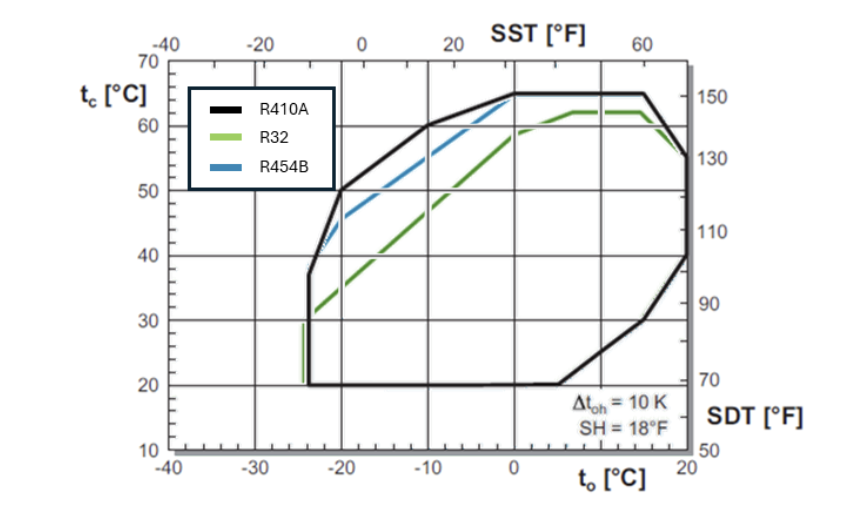
· Limited compressors operating envelope linked to a high discharge temperature at high pressure ratio operating conditions, which could lead to mitigation technologies, like liquid or vapour injection in the compression process. This poses technical constraints in high-ambient GCC region climates, where additional condenser sizing and airflow could be required (see figure 1).
· Dedicated system and components design modifications are needed to transition from R-410A and benefit from performance and safety, especially in VRF and rooftop applications.
R-454B: The contender favoured globally (especially in the EU and the United States) as the long-term, drop-in replacement for R-410A in unitary systems.
– GWP: 466 (78% reduction versus R-410A)
– Pressure: -4.3bar versus R-410A @ Tcond = 65 degrees C, very favourable for compressor efficiency
– Performances: Up to eight per cent SEER increase versus R-410A, as reported by several major OEMs – Main considerations:
· Close properties to R-410A, which enables a fast transition to low-GWP refrigerants with less re-design effort for equipment manufacturers.
· Lowest flammability profile to replace R-410A: Difficult to ignite, low burning velocity and low heat of combustion, which makes it easy to apply, safety-wise, to replace R-410A in occupied spaces.
Figure 1: R-32 versus R-410A and R-454B in the same scroll compressor (shortest operating envelope)
Outlook in the Gulf: In the short term, R-32 will dominate new-builds due to availability and OEM support. However, R-454B will offer a more balanced long-term solution, pending regional testing and OEM engagement in the GCC region
The Future of R-134A: Which alternatives work for the Gulf?
R-134A has been widely used in chillers, water-cooled systems, and automotive applications across the GCC region. With a GWP of 1,430, its phase-down is a major concern, especially in commercial buildings and District Cooling plants.
All around the globe, there is a need for three scenarii: A fast solution to reduce GWP while keeping the same systems (A1 in retrofit or new); a solution to stay with A1 but drastically reduce GWP in new systems and, potentially, some retrofits; and an ultimate solution for ultra-low GWP in new systems. This is what R-513A, R-515B and R-1234ze will provide.
R513A (HFO blend): Easy transition, ideal for retrofits
– GWP: ~630 (56% reduction versus R-134A)
– Pressure and Performance: close to R-134A
– Main considerations:
· A1 classification: No need for building codes changes in the GCC region
· Drop-in compatibility with all existing R-134A systems
· Already present in commercial chillers in the GCC region
R-515B (HFO Blend): Lowest GWP & A1 to replace R-134A
– GWP: ~300 (79% reduction versus R-134A)
– Pressure: -4.5bar versus R-134a @ Tcond = 65 degrees C
– Performance: Much higher than R-134a and like R-1234ze, when used with oil-free turbo compressors (see Figure 2)
– Main considerations:
· A1 classification: No need for building codes changes in the GCC region
· Drop-in compatibility with many R-134A systems (case-by-case analysis)
· No significant temperature glide: Works well in flooded applications
· Lower pressure means oversized systems or additional sub-cooling to compensate for the loss in cooling capacity versus R-134a systems, but very low running costs and associated CO2 emissions compared to R-134A available chillers
R1234ze (pure HFO): The ultimate solution
– GWP: ~1 (99% reduction versus R-134A)
– Pressure: -4.5bar versus R-134A @ Tcond = 65 degrees C
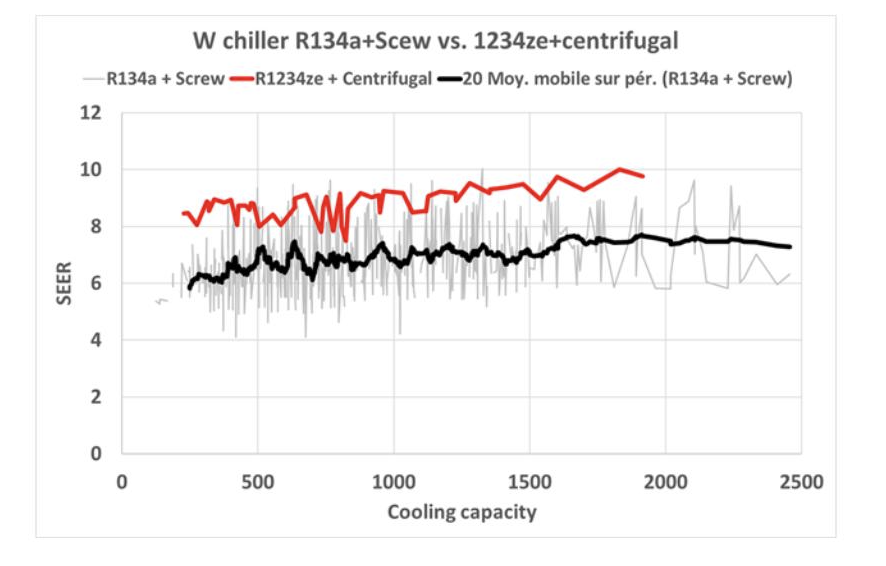
– Performance: Much higher than R-134A, in general, and +20%, when used with oil-free turbo compressors (Figure 2: Red curve)
– Main considerations:
· Non-flammable for transportation, handling and storage, but A2L classification in the running application
· No temperature glide: Perfectly suited for flooded applications
· Lower pressure means oversized systems or additional sub-cooling to compensate for the loss in cooling capacity versus R-134A systems, but very low running costs and associated CO2 emissions compared to R-134A available chillers
Figure 2: R-1234ze versus R-134A chillers SEER (EUROVENT database)
Outlook in the Gulf: A tiered strategy will likely emerge R-513A for retrofits or short-term regulatory compliance R-515B for safer A1-class low-GWP replacements R-1234ze for long-term futureproof systems with environmental certification targets
With these scenarii, a transition from screw to oil-free turbo compressors is expected, essentially for the associated efficiency breakthrough that drives lower CO2 emissions.
Industrial Gases (non F-Gas chemical refrigerants, most often referred to as ‘Natural Refrigerants’): Lifecycle analysis matters
While HFOs are leading the refrigerant transition in the world in most of the regions and applications, Industrial Gases are gaining ground in selected applications:
R-744 (CO₂): Used in cascade systems and supermarkets in the UAE; high pressure and heat rejection challenges remain in 45°C+ weather, when used in trans-critical booster architecture
R-717 (Ammonia): Still dominant in large cold storage and industrial refrigeration installations in the GCC region
R-290 (Propane): Being tested in small AC units, though A3 flammability limits widespread adoption
When selecting such Industrial Gases, it would be good to get into the details when comparing to the latest technologies offered by HFO-based systems.
Just to illustrate this, Honeywell performed a Lifecycle Assessment to highlight the Total Cost of Ownership (TCO) and the Total CO2 emissions (TEWI) over the 20-year lifespan of a 600kW Medium Temperature industrial chiller installed in Riyadh. The comparison was made between a state-of-the-art Ammonia screw chiller and the latest R1234ze oil-free turbo chiller: Even though the usual belief is that the Ammonia chiller is ‘unbeatable’, the R1234ze chiller is reaching 35% better TCO and 40% lower CO2 emissions, mainly related to better efficiency, under Riyad’s climatic conditions.
Implementation of low-GWP refrigerants: Challenges in the GCC region
Despite growing awareness, several obstacles are slowing the refrigerant transition in the GCC region:
Building Code mismatch: Flammable refrigerants (A2L, A3) are still restricted or unregulated in many local jurisdictions for applying in public areas High-ambient performance: Many low-GWP refrigerants show reduced efficiency above 50 degrees C, affecting compressor durability and cooling output Technician Readiness: The current HVAC workforce is largely untrained in handling flammable or high-pressure alternatives Commercial Offering: International OEMs still put forward HFC products in their catalogues, waiting for a pull from the market to open their new refrigerants’ portfolio (R-454B, R-515B, R1234ze)
Outlook and recommendations
The future of refrigerants in the GCC region hinges on strategic alignment among policy, technology and local climate realities. R-32 and R-513A will likely dominate in the short term, while R-454B, R-515B and R-1234ze may offer more sustainable long-term paths, when performance in high-ambient conditions will become a priority.
To accelerate the transition, GCC region countries should:
§ Harmonise building codes for A2L refrigerants
§ Invest in technician-certification programmes
§ Pilot regional testbeds for new refrigerants in harsh climates
Cooling in the Gulf is a climate necessity, but how it is done could position the region as a model of sustainable innovation.
Dr-Eng. Jean de BERNARDI
The writer is Technical Director for Honeywell Refrigerants in EMEA. He may be contacted at jean.debernardi@honeywell.com.
Premium Story
Masdar reports record 62% portfolio capacity growth in 2024
Company’s 12th Annual Sustainability Report highlights global expansion, sustainable finance leadership and workforce diversity
ABU DHABI, UAE, 20 August 2025: Abu Dhabi Future Energy Company (Masdar) has released its 12th Annual Sustainability Report, highlighting record portfolio capacity growth of 62% in 2024 and the expansion of its global footprint through acquisitions in Europe and the United States. Making the announcement through a Press Release, Masdar highlighted its continued progress in key sustainability areas, including environmental performance, social impact, ethical business practices and workforce diversity. Through the report, it also reinforced its leadership in sustainable finance, with the expansion of its green bond programme in 2024.
Masdar said it achieved a record portfolio growth of 62% last year, with its operational, under-construction and advanced pipeline capacity reaching 51 GW, more than halfway to the company’s 2030 target of 100 GW. The company said the total capacity for operational and under-construction projects almost doubled to 32.6 GW, with operational projects generating 29,225 GWh of clean electricity, avoiding 15.5 million tonnes of carbon dioxide equivalent.
Masdar said its global expansion was supported by landmark acquisitions in 2024. With the company’s expansion in Europe, Masdar acquired Greece’s TERNA ENERGY for a total enterprise value of EUR 3.2 billion. Masdar said it also acquired a 50% stake in Terra-Gen, one of the largest independent renewable energy producers in the United States. Terra-Gen’s portfolio will play a key role in driving Masdar’s global capacity growth, the company said. The investment will also accelerate collaboration between the United States and the UAE, in alignment with their strategic energy partnership for reliable, affordable and sustainable energy, the company added. In the Iberian Peninsula, another core European market, Masdar said it expanded further by acquiring Saeta for USD 1.4 billion and securing a 49% stake in a 2 GW operating solar portfolio from Endesa S.A.
Mohamed Jameel Al Ramahi, Chief Executive Officer, Masdar, said: “As Masdar continues to evolve as a global clean energy leader, 2024 marked a defining chapter in our journey, as we expanded our presence in key global markets, strengthened our financial credentials and drove initiatives that reflect our commitment to responsible growth and inclusive progress. As a global investor, developer, and operator we are delivering impact at scale across key geographies and helping to shape the future of clean energy. We will continue to drive innovation in the clean energy sector and reinforce our position as a partner of choice for governments and communities across the globe.”
Masdar said its second green bond issuance in July 2024 was again met with strong global demand, being 4.6 times oversubscribed, reaffirming widespread investor confidence in the company’s long-term strategy and ESG credentials. Masdar said it also received a credit rating upgrade to AA- from Fitch Ratings and an ESG Entity Rating of 2 from Sustainable Fitch, with a 71/100 score, reflecting its good ESG performance and the green nature of its assets.
Masdar said that aligned with its focus on diversity, inclusion and leadership development, it is committed to promoting a strong female representation in management, with women now comprising 20% of its management team. The company said it is also steadfast in its approach to empowering local communities through sustainable urban development and inclusive energy-access initiatives across its projects.
Beyond power generation, Masdar said, its projects create jobs in local communities, support economic growth and protect wildlife ecosystems. As an example of its commitment to biodiversity, the company said it is utilising Identiflight AI technology at its Zarafshan wind project in Uzbekistan, helping to protect bird species through advanced flight pattern monitoring and risk reduction, marking the first such deployment in Asia.
Premium Story
HTMS reports 13% energy reduction at DKSH Malaysia cold storage facility
Company says its Maxwell heat-transfer fluid is projected to save 600,000 kWh annually
DUBLIN, Ireland, 19 August 2025: HT Materials Science (HTMS) said it implemented its Maxwell heat-transfer fluid at a pharmaceutical cold storage facility operated by DKSH Malaysia. Making the announcement through a Press Release, HTMS said the installation has resulted in significant energy savings, operational improvements and system performance. According to HTMS, this has positioned the project as one of Southeast Asia’s most effective commercial HVAC retrofits to date.
HTMS said Maxwell is created by suspending sub-micron particles of aluminium oxide in a base fluid of water or glycol; it is a non-toxic, fully recyclable additive that enhances heat transfer in industrial HVAC systems. The company added that Maxwell improves heat transfer and reduces energy consumption while increasing system capacity. For the DKSH Malaysia project, adding Maxwell led to a 13% reduction in the chiller’s energy consumption, for a projected annual savings of 600,000 kWh and a payback period of 2.1 years, HTMS claimed. The installation, HTMS said, was procured and engineered by Tri Quantity, an energy management and audit company based in Malaysia.
HTMS said that based on energy savings alone, the payback period for the project is projected at just over two years. It’s a welcome innovation for a facility with strict temperature and humidity needs and regulations, as installing Maxwell requires no system downtime. In addition to energy savings, DKSH expects reduced wear and tear on the facility’s HVAC equipment, longer system lifespan and lower maintenance costs due to reduced scaling and improved fluid dynamics, HTMS added.
Thomas Grizzetti, CEO, HTMS, said: “This installation demonstrates that smart, science-driven HVAC technologies can deliver immediate cost savings and long-term sustainability benefits. We’re proud to partner with forward-thinking companies like Tri Quantity and DKSH, who are helping to set the standards for energy efficiency in large-scale commercial facilities.”
Joel Solomon, Head, Supply Chain Management, DKSH Malaysia & Brunei, said: “This initiative not only strengthens our operational efficiency but also reaffirms DKSH’s commitment to sustainable, future-focused business practices.”
This project provides a compelling blueprint for how commercial facilities can unlock measurable energy gains through smart retrofits, HTMS said. The results, the company said, are applicable across industries including logistics, education, retail and data centres. HTMS contracts include performance guarantees, with minimum savings thresholds and annual reconciliation.
Grizzetti added: “What makes this so compelling is the speed at which results materialised. Within weeks, we saw verified energy savings – demonstrating just how accessible and impactful these upgrades can be for building operators anywhere in the world.”
Premium Story
ASHRAE shares resources to address Legionella risk
Society urges proactive water management to combat Legionella risks in buildings
ATLANTA, Georgia, United States, 8 August 2025: The American Society of Heating, Refrigerating and Air-Conditioning Engineers (ASHRAE) has expressed its growing concern surrounding the recent clusters of Legionnaires’ disease cases, specifically in New York City and parts of Ohio. Making the announcement through a Press Release, the society emphasised its role in providing guidance on Legionellosis risk management to support public health and building safety.
According to ASHRAE, Legionnaires’ disease, a serious form of pneumonia caused by Legionella bacteria, is most commonly associated with water systems where water is not adequately monitored or treated. ASHRAE said that following periods of heavy rains and flooding, there is an increased risk of the disease due to potential contamination of water sources and disruptions to water systems. Flooding can mobilise Legionella bacteria-rich biofilms in water systems, leading to higher bacterial loads and potential colonisation of the built environment, ASHRAE said. While the disease has been known for decades, recent outbreaks have underscored the importance of consistent, comprehensive water management practices in facilities of all sizes and types, ASHRAE added.
To assist building professionals, public health officials and facility managers in managing this risk ASHRAE said it offers two key resources:
● ANSI/ASHRAE Standard 188-2021, Legionellosis: Risk Management for Building Water Systems, which establishes minimum risk management requirements for the design, construction, commissioning, operation, maintenance, repair and expansion of building water systems. ASHRAE said the resource is written in enforceable language, the standard is designed to facilitate integration into building codes and public health regulations.
● ASHRAE Guideline 12-2023, Managing the Risk of Legionellosis Associated with Building Water Systems, which serves as a companion to Standard 188, offering practical, system-specific guidance on reducing the risk of Legionella growth and transmission. ASHRAE said the guideline addresses common sources of exposure, including potable water systems, decorative fountains, whirlpool spas, cooling towers and humidifiers. Additional sections cover US water treatment regulations related to incoming water quality, Legionella monitoring and personal protective equipment (PPE) considerations.
Bill McQuade, President, ASHRAE, said: “Healthy buildings depend on comprehensive water management strategies. As concerns about Indoor Environmental Quality and public health continue to grow, it’s vital that building owners and operators have access to proven, science-based resources like ASHRAE Standard 188 and Guideline 12. These tools are designed to support safer environments through practical and preventive measures related to water quality and legionella risk mitigation.”
ASHRAE said that the recent outbreaks highlight the ongoing need for vigilance in managing both public water distribution networks and building water systems, especially as many buildings operate under varying occupancy levels and as water utility infrastructure is ageing. ASHRAE said the guidance offers design teams, building managers and health officials a structured approach to mitigating risk and protecting occupants.
McQuade said: “Our Society remains focused on supporting healthy buildings through better air, better water and better system design. We encourage the building community to take advantage of the resources we’ve developed to help prevent future outbreaks.”
Premium Story
AMCA to launch Level 3 Fan Applications Engineering Seminar
‘Fan and Blower Applications Engineering III: Verification and Optimisation’ event is scheduled for November 7
ILLINOIS, USA, 11 August 2025: Air Movement and Control Association International (AMCA) has announced the launch of ‘Fan and Blower Applications Engineering III: Verification and Optimisation’, the third installment in its technical seminar series, taught by Ron Wroblewski, President of Productive Energy Solutions, and William (Bill) Howarth, President of Ventilation & Fan Consulting Service International.
Making the announcement through a Press Release, AMCA said that unlike ‘Fan and Blower Applications Engineering I: Foundations’ and ‘Fan and Blower Applications Engineering II: Troubleshooting and Efficiency,’ which are offered exclusively online, the third instalment of the technical seminar will be delivered in a hybrid format. This will consist of two live webinars, on November 7 and 14, two on-demand modules, and an in-person workshop at AMCA International headquarters in Arlington Heights, Illinois, from November 19 to 21. AMCA added the workshop will provide an opportunity for participants to use pitot tubes, manometers, and a host of other equipment to measure and calculate the flow rate and efficiency of two demonstration fan systems using methods and approaches from AMCA Publication 203, ‘Field Performance Measurement of Fan Systems’ and ISO 5802, ‘Industrial fans – Performance testing in situ’.
AMCA said ‘Fan and Blower Applications Engineering III: Verification and Optimisation’ includes the following modules:
● Intro to In-Situ Fan-Performance Measurements
● Analysing Fan Efficiency Using MEASUR Software
● Calculating Fan Flow Rate and Efficiency Using Test Results
● Fan-Measurement Tips – Optimisation Strategies for Fan Systems
● Theory Refresher: Fan Curves, System Curves, Fan Laws
● Setup of Small Fan System
● Instrumentation Walkthrough
● Fan-Measurement Standards
● Data Collection
● Data Reduction and Analysis
● Data Analysis Using Software
● Troubleshooting and Uncertainty
AMCA said the class size is limited to 24 people to allow for hands-on experience with the instruments. AMCA said that in addition to course-specific workbooks and notes, participants will receive digital copies of ANSI/AMCA Standards 99 (Standards Handbook) and 204 (Balance Quality and Vibration Levels for Fans), as well as AMCA Publications 200 (Air Systems), 201 (Fans and Systems), 202 (Troubleshooting), 203 (Field Performance Measurement of Fan Systems) and 410 (Recommended Safety Practices for the Installation, Operation, and Maintenance of Commercial and Industrial Fans).
The cities we inhabit, the offices we work in, the hospitals we rely on and the data centres that power our digital lives are deeply entangled with the health of our planet, says Ahmed Mahrous of Johnson Controls
World Nature Conservation Day, on July 28, was an occasion for pausing to reflect on our natural ecosystems and the built environments that surround them. The cities we inhabit, the offices we work in, the hospitals we rely on, the data centres that power our digital lives and all other spaces, often taken for granted, are deeply entangled with the health of our planet.
Buildings are not neutral entities. They consume over 40% of global energy and account for almost 40% of greenhouse gas emissions. Their design, operation and management directly impact the quality of air we breathe, the biodiversity we protect and the resources we preserve.
That’s why environmental stewardship ought to begin at the structural level. From HVAC systems that optimise energy use without sacrificing comfort, to smart sensors that manage lighting, water and airflow in real time, the future of conservation is increasingly digital. When we embed intelligence into buildings, we empower them to become active agents of sustainability.
Nature conservation is no longer the sole domain of forests, oceans and wetlands. It extends to rooftops, data centres, classrooms and manufacturing floors. In fact, how we cool, heat, ventilate and secure these spaces could make or break our collective efforts to reach net-zero goals and biodiversity commitments.
Now, sustainability is more than just reducing emissions, it is also about how we operate and how we support the communities around us.
World Nature Conservation Day is a reminder that sustainability isn’t just about protection; it’s about transformation that starts with rethinking the infrastructure we’ve already built. Through smart systems, responsible innovation and data-driven decision-making, the buildings of tomorrow can help heal the planet today.
The writer is Sales Director – HVAC & IREF at Johnson Controls, He may be reached at ahmed.mahrous@jci.com.