CCME.NEWS

Your source for the HVACR Industry, covering in-depth news & analyses on policy, business & technology.

Get Premium:

Sign-up

COMMERCIAL ENQUIRIES:

Frédéric Paillé
Co-Founder & Commercial Director
fred@cpi-industry.com
+971 50 714 7204

Follow Us

CCME.NEWS

CCME.NEWS, covering the regional and global HVACR industry with an unwavering commitment to providing in-depth news and analyses on policy, business and technology

Contact Info

PO Box 13700,
Dubai Media City, Dubai
admin@cpi-industry.com
+971 50 714 7204

Follow Us

Premium Story

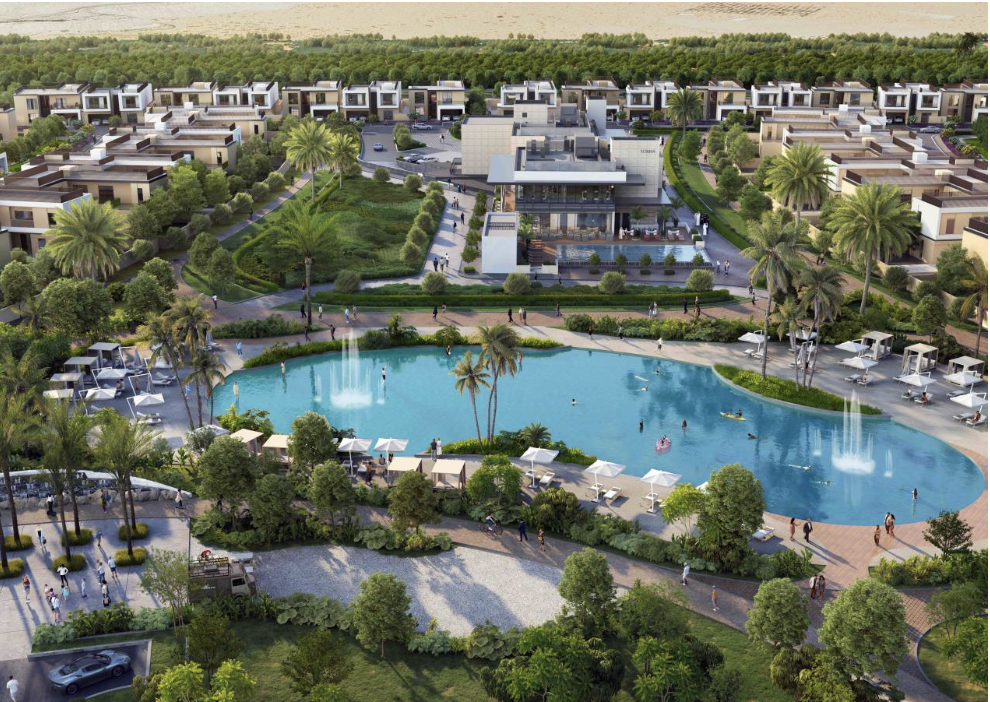
Dubai South moves into balanced residential growth phase

ZāZEN Properties says Dubai South is entering a more mature residential phase, with end-user demand increasingly shaping buying behaviour

DUBAI, UAE, 16 February 2026: ZāZEN Properties said Dubai South is entering a more mature phase of its residential cycle, with end-user demand increasingly shaping buying behaviour as infrastructure delivery and population growth begin to translate into long-term liveability.

Making the announcement through a Press Release, ZāZEN Properties said that looking ahead to 2026, Dubai’s residential market is widely expected to enter a phase of balanced growth, with price appreciation projected to remain moderate rather than speculative. The company added that residential property prices are forecast to increase between 4% and 7% in 2026, reflecting a stabilising market supported by sustained demand and a controlled supply pipeline.

According to ZāZEN Properties, this outlook is further reinforced by strong demographic fundamentals, with Dubai’s population projected to approach 4.7 million by the end of 2026, representing an estimated five per cent increase. The company said this growth is expected to underpin sustained long-term demand across both the rental and ownership segments.

ZāZEN Properties said that as buyer priorities evolve, clearer segmentation is emerging across Dubai’s residential market. The company noted that in premium mid-market districts under development, there is increasing emphasis on family-friendly layouts, adaptable living spaces, and community-oriented design that support long-term occupancy.

Madhav Dhar

At the same time, the company added that more central locations, including waterfront and mixed-use districts, continue to attract a balanced mix of investor and end-user demand. ZāZEN Properties said its approach in Dubai South reflects this distinction, with low-density planning and wellness-led amenities designed around everyday liveability.

ZāZEN Properties said that Dubai South’s outlook for 2026 and beyond continues to be supported by major infrastructure investments, including the expansion of Al Maktoum International Airport. The company said this development further strengthens the district’s positioning as a live-work destination.

Madhav Dhar, CEO, ZāZEN Properties, said: “Dubai South is reaching a point where long-term planning is beginning to show real results on the ground. Infrastructure delivery, transport connectivity, and the growth of nearby employment hubs are now shaping how people think about where they live, not just where they invest. We are seeing a clear shift toward end-user demand, with buyers prioritising space, functionality, and community over short-term gains. This evolution is changing how residential projects need to be designed, away from speculative formats and toward homes that support everyday life, family needs, and long-term value.”

As Dubai’s residential landscape evolves, ZāZEN Properties said Dubai South is increasingly being viewed not as a peripheral market, but as a district where infrastructure delivery, population growth, and end-user demand are beginning to align. The company said this shift is likely to influence development strategies across the city in the coming years.

Premium Story

Tabreed reports FY 2025 revenue of AED 2.46 billion

District Cooling utility company reports a connected capacity increase of 19% YoY to 1.57 million Refrigeration Tons, and an EBITDA of AED 1.27 billion, with a margin of 51.6%

ABU DHABI, UAE, 13 February 2026: National Central Cooling Company PJSC announced its results for the period ending December 31, 2025, reporting revenues of AED 2.46 billion and net profit of AED 465 million. The results reflect continued operational resilience, record capacity expansion and disciplined capital execution, the utility company said through a Press Release.

Total connected capacity increased 19% year-on-year to 1.57 million Refrigeration Tons (RT) as of December 31, 2025, driven by strong organic expansion and acquisitions, Tabreed said. Excluding the impact of M&A, connected capacity growth was up 4.4% year-on-year, near the high end of the company’s guidance range, Tabreed further said. Organic additions reached 58,200 RT in 2025 – the highest level in the past five years – driven primarily by new connections in the UAE, Tabreed added.

According to Tabreed, inorganic additions totalled 190,800 RT, resulting from the acquisition of PAL Cooling in a 50:50 joint venture, alongside CVC DIF. Tabreed said it commissioned three new greenfield plants during the year and acquired five operational plants, as part of PAL Cooling, bringing the total number of its operating plants to 99 as a group. Tabreed said consumption volumes reached 2.62 billion RTH, a slight one per cent year-on-year decline due to relatively colder weather conditions. Throughout the year, operational availability and efficiency remained high, Tabreed said, reflecting its investment in innovative technologies and proactive asset management.

According to Tabreed, group revenue increased one per cent, year-on-year to AED 2.46 billion, underscoring the resilience provided by fixed capacity charges despite weather-related softness in consumption revenue. EBITDA, Tabreed said, increased by one per cent, year-on-year to AED 1.27 billion, with a margin of 51.6%, supported by operating leverage and efficiencies.

Net profit for FY 2025, Tabreed said, was AED 465 million, primarily reflecting the company’s continued operational strength while absorbing the impact of higher finance costs, following the refinancing of low-cost debt at prevailing market rates and additional debt raised to fund Tabreed’s investment in PAL Cooling. Reported earnings, Tabreed pointed out, also reflect one-off transaction costs related to the closing of the Palm Jebel Ali concession and PAL Cooling acquisition, as well as higher financing and fair value amoritisation charges related to the PAL Cooling JV.

Tabreed listed the following milestones:

  • Completed the acquisition of PAL Cooling Holding in a 50/50 partnership with CVC DIF for an enterprise value of AED 4.1 billion, adding c. 600,000 RT of concession capacity across eight exclusive concessions on Abu Dhabi’s main island and Al Reem Island (ADGM)
  • Signed a landmark joint venture and concession with Dubai Holding Investments to provide 250,000 RT of District Cooling to Palm Jebel Ali. Construction commenced in Q3 2025, with first cooling expected in late 2027 or early 2028
  • Commissioned three new greenfield plants during 2025 and added five operating plants as part of the PAL Cooling acquisition, deepening Tabreed’s presence across core markets and reinforcing high operational availability
  • In partnership with the UAE Ministry of Defence and Emerge, Tabreed completed the integration of around 4,000 solar panels supplying 2.4 MW of clean electricity to two Abu Dhabi District Cooling plants. This reduces reliance on the grid during peak periods and prevents more than 2,600 tonnes of CO₂, annually

  • Entered a long‑term framework with Johnson Controls to co‑develop next‑generation cooling technologies, including centrifugal chillers with variable‑speed drives and AI‑enabled performance analytics, supporting efficiency, reliability and regional climate‑neutrality goals
  • Strengthened the capital structure and liquidity profile through refinancing of debt and additional debt issuance, thereby extending average loan maturity and supporting growth investments
Dr Bakheet Al Katheeri (image courtesy Tabreed)

Commenting on the full-year performance, Dr Bakheet Al Katheeri, Tabreed’s Chairman, said: “2025 was a transformational year for Tabreed, marked by major strategic steps that have strengthened our platform for both the medium and long term. The addition of PAL Cooling and the Palm Jebel Ali concession have deepened our presence in core markets and expanded the scale at which we operate. Across the business, our teams continued to deliver reliably for customers while investing in the systems and infrastructure that will support the company’s next phase of growth. As a national champion in District Cooling, we are proud to support the UAE’s energy efficiency goals and remain focused on delivering capacity-led, concession-backed growth and creating lasting, sustainable value for our shareholders and stakeholders.”

According to Tabreed, as of year-end 2025, net debt to EBITDA stood at 4.6x, a temporary increase in leverage reflecting the impact of PAL Cooling acquisition. Liquidity remains robust, Tabreed said, supported by a fully undrawn AED 1.2 billion Green RCF and the absence of any near‑term debt maturities. Tabreed said it remains disciplined and focused on its capital allocation approach.

Tabreed said it strengthened its financial position during 2025 through the issuance of a USD 700 million Green Sukuk in Q1, executed under its Green Finance Framework, with proceeds directed toward refinancing of debt obligations. In Q3, Tabreed said, it doubled its Green Revolving Credit Facility to AED 1.2 billion from AED 600 million, maintaining original terms. This increase, Tabreed said, materially improves its funding flexibility and underpins its broader creditworthiness. In Q4, Tabreed said, it raised AED 1.8 billion new bank debt to support its strategic growth initiatives and optimise its capital structure.

Tabreed said it continues to hold investment-grade ratings from Moody’s and Fitch.

Tabreed said the Group’s Board of Directors recommended a final dividend of 6.5 fils for H2 2025, bringing the total dividend for the year to 13 fils per share. This, Tabreed said, represents a payout ratio of 71% of 2025 normalised net profit, aligned with historical levels, despite significant investment undertaken to secure long-term growth.

Tabreed said it is entering 2026 with a strong and stable core business, supported by long-term contracted capacity, high operational availability and disciplined financial management. Capacity growth and margins are expected to remain within its guided range, driven by continued real estate development, infrastructure expansion and delivery of new tourism destinations across the UAE and Saudi Arabia, Tabreed said. Demand fundamentals and customer relationships, it added, remain solid, and the organic capex programme continues to progress on schedule.

Looking ahead, Tabreed said, medium-term growth will be reinforced by the integration and ramp-up of PAL Cooling and the buildout of Palm Jebel Ali, both expected to contribute positively as capacity comes online. With a well-capitalised balance sheet and proven execution capability, Tabreed said, it is well positioned to deliver sustainable, capacity-led growth through 2026 and beyond.

Premium Story

SODECA presents HATCH ventilation systems with motorised dampers

Company highlights resistance testing, fire certification and façade integration features of its ventilation solutions

RIPOLL, Spain, 12 February 2026: SODECA presented its ventilation systems with motorised dampers, designed to improve energy efficiency in buildings. Making the announcement through a Press Release, SODECA said its HATCH system includes ventilation solutions with motorised dampers for the extraction of stale air from buildings and for smoke evacuation in the event of a fire.

SODECA said the system consists of the ROOF System for roof applications and the WALL System for façade installations. SODECA said its HATCH solutions with motorised dampers have undergone multiple resistance tests under extreme conditions, including snow and wind loads.

SODECA said the systems have also been subjected to fire resistance certification tests, in accordance with EN 12101-3 in accredited laboratories. SODECA said all ventilation solutions with motorised dampers are certified F400 and F300 for smoke exhaust in the event of a fire.

SODECA said its ventilation systems with motorised dampers contribute to lower energy demand and optimised energy efficiency, thanks to the automatic closing of the extractors when they are not in use. SODECA added that the systems offer the possibility of customising finishes and adapting them to the characteristics of the building, allowing the ventilation systems to be integrated into the building without compromising functionality.

SODECA said its ventilation systems with motorised dampers ensure the perfect integration of the façade, energy efficiency and smoke evacuation safety in the event of a fire within one ventilation system.

Premium Story

Eurovent Middle East to host webinar on Desert Certification scheme

Association says the new certification scheme provide realistic performance data at T3 with optional testing at T4 conditions

DUBAI, UAE, 11 February 2026: Eurovent Middle East said it will host a dedicated technical webinar on the recently launched Eurovent Desert Certification scheme, which will take place on 24 February 2026 from 11:00 to 12:00 GST over Microsoft Teams. Making the announcement through a Press Release, the Association said the session is intended for HVACR industry stakeholders seeking deeper insight into high-ambient performance verification.

Eurovent Middle East said air conditioning equipment in the Middle East is subjected to challenging operating conditions during peak summer months and that while most products have been tested in the past these tests have failed to independently verify performance at peak loads.

The Association said the new certification scheme provides more realistic performance data at T3 condition (46 degrees C) with optional testing at T4 (48 degrees C). Eurovent Middle East said the scheme also incorporates a unique seasonal efficiency calculation referred to as the Desert Seasonal Energy Efficiency Ratio (DSEER).

Eurovent Middle East said the webinar will outline key technical aspects of the Desert Certification scheme and that the scheme represents the first high-ambient performance verification scheme in the region. The Association said the session will focus on explaining the technical framework and verification methodology behind the Desert Certification scheme.

Premium Story

US climate body responds to EPA’s volte-face on GHGs

C2ES President says the proposed action would undermine climate progress and economic opportunity in the United States

WASHINGTON, D.C., United States, 11 February 2026: The Center for Climate and Energy Solutions (C2ES) issued a statement from its President, Nathaniel Keohane, responding to the Environmental Protection Agency’s (EPA’s) forthcoming repeal of the Greenhouse Gas Endangerment Finding and Vehicle Standards.

Keohane said: “America needs leadership that will protect communities from the worsening impacts of climate change and seize the economic opportunities created by growing energy demand. This action fails on both counts. Instead, the EPA is piling on new problems by distorting the scientific record and turning its back on settled law, going well beyond reasonable partisan differences. It is an ideologically driven crusade that will threaten the health of our communities and undermine the economic wellbeing of our nation.

“EPA’s repeal of the Greenhouse Gas Endangerment Finding and climate pollution standards for cars and trucks will leave climate change unchecked in the largest polluting sector of our economy. While these protective guardrails may be gone, the reality of climate change remains. Climate-fueled extreme weather events are increasingly taking lives and wreaking economic havoc in cities and towns across the nation today, and that concern will only grow in the coming years.

“Stripping away the well-designed policy framework put in place over decades will not change that reality. What will change is the willingness of businesses to invest in America. No business asked for this; they see the rest of the world is racing toward the vast opportunity of the clean energy economy.

“A thriving, more prosperous future is possible: One in which abundant, affordable clean energy powers our economy, improves everyday lives and dramatically reduces climate pollution. The EPA has chosen a less prosperous path for Americans, making that reality far more difficult for families to achieve.”

Premium Story

European body reports fifth-warmest January on record

Copernicus Climate Change Service (C3S) says the world was witness to contrasting temperature extremes in the Northern and Southern Hemispheres, adds that January 2026 was 1.47 degrees C above pre-industrial temperatures

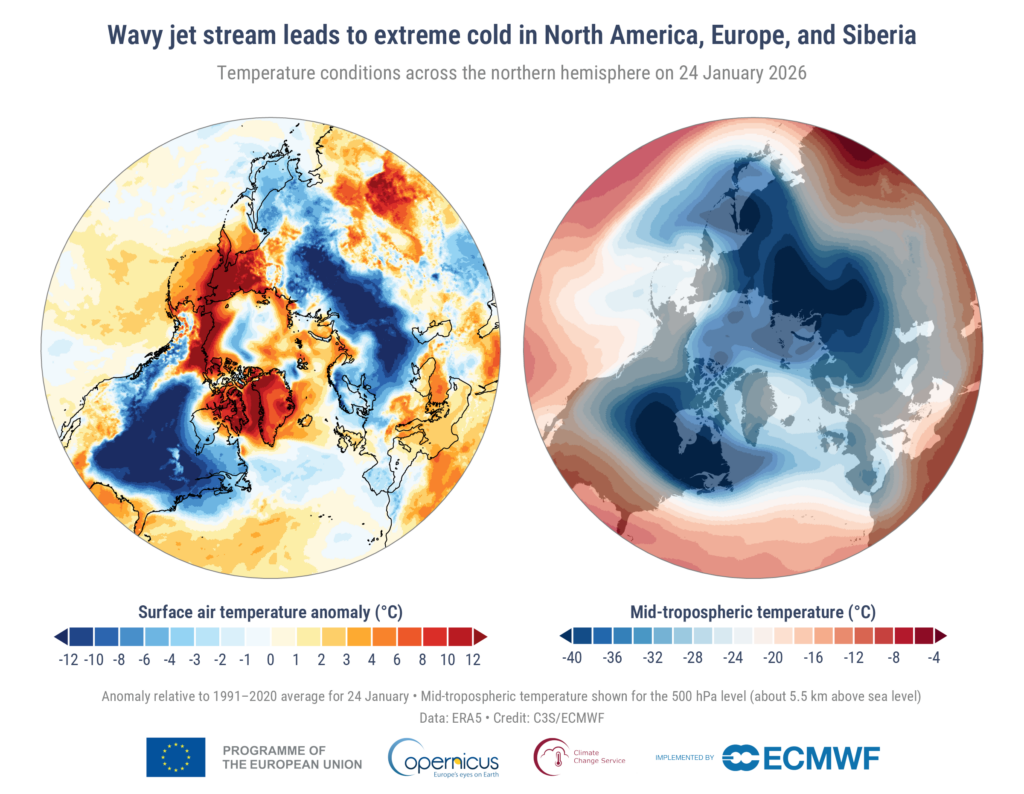
 North-polar view of temperature conditions across the Northern Hemisphere on 24 January 2026. (Left) Daily average surface air temperature anomaly (degrees C) relative to the 1991-2020 average for the same calendar day. (Right) Daily average absolute temperature (degrees C) at 500 hPa, a pressure level corresponding to the middle troposphere (around 5.5 km above sea level), highlighting the frigid polar air (blue) and the warmer air at lower latitudes (red).
Data source: ERA5. Image courtesy C3S/ECMWF

January 2026 was the fifth warmest on record and saw contrasting temperature extremes in the Northern and Southern Hemispheres, according to the Copernicus Climate Change Service (C3S), implemented by the European Centre for Medium-Range Weather Forecasts (ECMWF). C3S also recorded the month as being 1.47 degrees C above pre-industrial temperatures.

Samantha Burgess, Strategic Lead for Climate, ECMWF, said: “January 2026 delivered a stark reminder that the climate system can sometimes simultaneously deliver very cold weather in one region and extreme heat in another. While human activities continue to drive long-term warming, these recent events highlight that resilience and adaptation to increasing extremes are key to prepare society for heightened climate risk in the future.”

In the final weeks of January, the Northern Hemisphere experienced severe cold waves as a meandering polar jet stream spilled icy air into Europe and North America (as shown in the visual above). This contributed to Europe experiencing its coldest January since 2010, with an average temperature of -2.34 degrees C. Despite these cold episodes, monthly temperatures in January were above average over much of the globe, including in large parts of the Arctic and western North America (as shown in the world map visual below). Further highlights on the cold outbreaks can be found here.

In the Southern Hemisphere, record breaking heat provided fuel for extreme conditions, including wildfires that turned dramatic in the second half of January, as highlighted by The Copernicus Atmosphere Monitoring Service (CAMS). That included intense blazes claiming lives across Australia, Chile and Patagonia. Heavy rains in southern Africa in the final week of the month led to severe flooding, particularly in Mozambique, with a catastrophic impact on lives and livelihoods.

Surface air temperature anomaly for January 2026 relative to the January average for the period 1991-2020. Data source: ERA5. Credit: C3S/ECMWF.

January 2026 – surface air temperature and sea surface temperature highlights

Global temperature

  • January 2026 was the fifth-warmest January, globally, with an average surface air temperature of 12.95 degrees C, 0.51 degrees C above the 1991-2020 average for January, according to the ERA5 dataset.
  • January 2026 was 0.28 degrees C cooler than the warmest January on record in 2025. 
  • January 2026 was 1.47 degrees C above the estimated 1850-1900 average used to define the pre-industrial level, according to the ERA5 dataset. 

Europe and other regions

  • During the second half of January 2026, severe cold conditions affected large parts of the Northern Hemisphere, including North America, Europe and Siberia, mainly driven by a wavier-than-usual polar jet stream that allowed frigid Arctic air to spill into mid-latitudes. 
  • The average temperature over European land for January 2026 was -2.34 degrees C, 1.63 degrees C below the 1991-2020 average for January, making it the coldest January since 2010. 
  • Widespread cold conditions occurred across Fennoscandia, the Baltic States, eastern Europe, Siberia, and the central and eastern United States. 
  • The largest warmer-than-average temperatures occurred across the Arctic, most notably in most of the Canadian Arctic Archipelago, Baffin Bay, Greenland and the Russian Far East. Above-average temperatures were also recorded across southern South America, northern Africa, central Asia, and most of Australia and Antarctica. 

Sea surface temperature

  • The average sea surface temperature (SST) for January 2026 over 60 degrees S – 60 degrees N was 20.68 degrees C, the fourth-highest value on record for the month, 0.29 degrees C below the January 2024 record.
  • A large region of the subtropical and the northeast North Atlantic, including the Norwegian Sea, had the warmest SSTs on record for the time of year. 
  • Most of the North Pacific continued to experience much above-average SSTs. In contrast, SSTs were close to or below the 1991-2020 average in the central and eastern equatorial Pacific, reflecting weak La Niña conditions.
  • The most below-average SSTs were recorded in the Arabian Sea, the Indian Ocean, the central South Pacific Ocean and in the Tasman Sea.

January 2026 – sea ice highlights

  • In the Arctic, the average sea ice extent in January was six per cent below average, the third lowest on record for the month.
  • Regionally, sea ice concentrations were much below average in the northern Barents Sea, between Svalbard and Franz Josef Land, as well as in Baffin Bay and the Labrador Sea, coinciding with much-above-average surface air temperatures in those regions.
  • In the Antarctic, the monthly sea ice extent was eight per cent below average, outside of the 10 lowest extents for the month.
  • Sea ice concentrations around Antarctica were above average in the Weddell Sea, but generally below average in other ocean sectors, particularly in the Bellingshausen Sea.

January 2026 – highlights of hydrological variables

  • In January 2026, it was wetter than average in much of western, southern and eastern Europe. Heavy precipitation led to flooding and associated damage and disruption in many regions, including the Iberian Peninsula, Italy, the western Balkans, Ireland and the UK. 
  • Drier-than-average conditions were seen in a large region of central Europe, stretching north-eastward across the Baltic States to Finland and part of western Russia, Scandinavia and Iceland.
  • Outside Europe, wetter-than-average regions include western Canada, northern Mexico and southern United States, central Asia, easternmost Russia and Japan, southeastern Brazil, northern Australia and southern Africa. In many regions, heavy rainfall led to floods or disruptions.
  • Drier-than-average conditions were seen in the north-western coastal and southern United States, southern parts of China, much of extra-tropical South America and much of southern and western Australia. In Chile, Argentina and Australia, the hot and dry conditions were conducive to wildfires.

The Copernicus Climate Change Service (C3S), implemented by the European Centre for Medium-Range Weather Forecasts on behalf of the European Commission with funding from the EU, routinely publishes monthly climate bulletins reporting on the changes observed in global surface air and sea temperatures, sea ice cover and hydrological variables. Most of the reported findings are based on the ERA5 reanalysis dataset, using billions of measurements from satellites, ships, aircraft and weather stations around the world.

Premium Story

Jeddah Construct 2026 to address construction growth demand across Saudi Arabia’s western region

Organiser says the event will act as a meeting point for industry leaders as major projects move from vision to delivery

JEDDAH, Saudi Arabia, 9 February 2026: The organiser of Jeddah Construct 2026, Big 5 Construct Saudi, said the western region of Saudi Arabia witnessed accelerated development, with major residential, commercial and infrastructure projects driving sustained demand across the construction sector. Making the announcement through a Press Release, the organiser said coastal developments such as Red Sea Global and Qiddiya Coast paved the way for what it described as a new era of premium coastal living in the Kingdom.

The organiser said that by 2030 these initiatives were expected to deliver more than 382,500 new homes, over three million m2 of office space, 4.3 million m2 of retail space and more than 330,000 hotel rooms, positioning the region as a dynamic and globally competitive destination, citing Knight Frank as the source.

The organiser said that as projects move from vision to delivery, Jeddah Construct 2026 will serve as the meeting point where industry leaders connect, source solutions and drive construction forward across the western region.

The organisers said industry confidence is already high, with several suppliers confirming their participation, including Masdar, Al Yamamma Steel, Unicoil, Emaar Industries and Salaba Energy, and added that these companies are expected to meet active buyers at the event.

The organiser said ongoing project demand is supported by 17 large-scale projects underway across the Kingdom’s western seaboard, with USD 431.3 billion in announced investment since 2016 and USD 57 billion already awarded in contracts.

The organiser said the event provides direct access to decision-makers, including contractors, project owners, government bodies and investors, who attend to source new partners.

The organiser said companies establishing a presence at the event position themselves for upcoming tenders and long-term supply contracts, providing what they described as a competitive advantage.

The organiser said Jeddah Construct 2026 broadens its scope to include new sectors ranging from HVACR to facilities management. The organiser said Jeddah Construct 2026 will take place from 28 to 30 September 2026 at the Jeddah Superdome.

Premium Story

ASHRAE concludes 2026 Winter Conference and AHR Expo

The Society says the Winter Conference accelerated discussions around IEQ, healthy buildings and the evolving role of HVACR professionals

ATLANTA, Georgia, United States, 6 February 2026: ASHRAE announced the conclusion of its 2026 Winter Conference in Las Vegas with momentum around Indoor Environmental Quality (IEQ), healthy buildings and the evolving role of HVACR professionals in shaping the future of the built environment.

Making the announcement through a Press Release, ASHRAE said the Winter Conference was held from February 2 to 4 and convened HVACR leaders, engineers, policymakers and researchers from around the world to examine the intersection of technology, sustainability, health and human experience in buildings. ASHRAE said attendees explored emerging trends including artificial intelligence (AI), low-global-warming-potential refrigerants, energy storage, geothermal systems and occupant-centred design across hundreds of sessions and committee meetings.

ASHRAE said the conference drew 3,825 registrants and featured more than 400 committee meetings, over 100 technical sessions and a broad range of networking and professional development opportunities.

ASHRAE said the AHR Expo ran concurrently and transformed the Las Vegas Convention Center into a global showcase for HVACR innovation. The Society added that the Expo hosted 1,945 exhibitors, including 601 international companies and 186 first-time exhibitors, across 565,000 net ft2 of exhibit space and welcomed an estimated 50,000 attendees over three days.

According to ASHRAE, some of the most highly attended Winter Conference sessions included ‘The Liquid Revolution: Best Practices in Cooling for Tomorrow’s Data Centers’, ‘AI in Action: A Real World Application of AI for Campus Energy Optimisation’, ‘Demystifying GenAI: What HVAC Professionals Need to Know’, ‘Can We Eliminate VAV Zone Reheat During Cooling? Real-World Results Using ASHRAE Guideline 36 Sequences and AI Optimisation’ and ‘Control of Chiller Plants: Reducing Energy Consumption and Improving Comfort Levels’.

ASHRAE said that during his State of the Society Address, Bill McQuade, President, 2025-2026, ASHRAE, shared progress on the Society’s focus on healthy buildings and IEQ, emphasising a transition from vision to sustained action.

McQuade said: “Six months into this Society year, we are seeing real progress. To ensure this work translates into lasting impact, we established the IEQ Center of Excellence – a dedicated platform to advance a coordinated roadmap, strengthen collaboration, and support ASHRAE’s leadership in policy, advocacy and global engagement.”

The Society said McQuade also highlighted advances in water safety, pathogen mitigation and integrated approaches to health-focused building design.

At the conference, ASHRAE said, McQuade announced the recipients of the 2025-26 Presidential Initiative Challenge, a grant programme supporting chapter-led projects that advance energy efficiency, emissions reduction and IEQ at the local level. The Society said the programme was supported by the Gordon Holness Presidential Fund and administered by the Young Engineers in ASHRAE committee.

ASHRAE said the programme received 21 submissions and awarded six projects with total grants of USD 46,350, including:

  • Cedar Valley Chapter – Air Quality, Lighting and Plumbing Upgrades for Ullo Kindergarten Center, Ghana (USD 9,500)
  • Falcon Chapter – Healthy Classroom for a Low-Carbon Future (USD 9,200)
  • Ghana Chapter – IEQ Improvements at Ayeduase Health Center (USD 10,000)
  • Monterrey Chapter – Healthy Learning Environments: Bright Futures Initiative (USD 5,000)
  • Nigeria Chapter – Project BREATHE: Building Resilient Environments for Air, Thermal, Health and Efficiency (USD 7,150)
  • Regina Chapter – Blanket of Warmth Project (USD 5,500)

ASHRAE said it strengthened global and industry-aligned partnerships in the months leading up to the Winter Conference by renewing memoranda of understanding with 17 organisations across engineering, architecture, public health, energy and standards development. The Society said these included:

  • AFE, Association for Facilities Engineering
  • AIA, American Institute of Architects
  • AMCA, Air Movement and Control Association
  • ASHE, American Society of Healthcare Engineers
  • ASPE, American Society of Plumbing Engineers
  • BCxA, Building Commissioning Association, as a new partner
  • DKV, Deutscher Kälte-und Klimatechnischer Verein
  • IAPMO, International Association of Plumbing and Mechanical Officials, Inc.
  • IDEA, International District Energy Association
  • IUVA, International Ultraviolet Association
  • JSRAE, Japan Society of Refrigerating and Air Conditioning Engineers
  • NAFA, National Air Filtration Association
  • NASEO, National Association of State Energy Officials
  • NSF, National Sanitation Foundation International
  • PHVACRS, Pakistan HVACR Society
  • SAREK, Society of Air-conditioning and Refrigerating Engineers of Korea
  • VISRAE, Vietnam Society of Refrigeration & Air-Conditioning Engineers

ASHRAE said it recognised outstanding member contributions during its Honors and Awards Program. The Society said Jeff Littleton, Executive Vice President, Secretary, ASHRAE, provided an update on membership growth and organisational influence.

ASHRAE said Littleton announced the approval of two new chapters in Region XIV, the Benelux Chapter and the DACH Chapter, along with the addition of 13 new student branches. The Society added that it now includes 202 chapters, 42 sections and 342 active student branches worldwide.

ASHRAE said Littleton also highlighted the Society’s expanding role in public policy, noting that in the past year it submitted letters or testimony on 22 IEQ-related bills. ASHRAE said legislation referencing its standards had been signed into law in Colorado, New Jersey and Virginia, with additional indoor air quality legislation under development in several other states.

ASHRAE said the ASHRAE Learning Institute offered 21 courses during the conference. The Society said top attended courses included ‘Guideline 36: Best in Class HVAC Control Sequences’, ‘Advanced Concepts in Designing and Retrofitting Energy Efficient Data Centers’, and ‘Demystifying Dehumidification: Designing Efficient and Effective HVAC Moisture Removal Systems’.

The Society said that for the first time, the ASHRAE Learning Institute also delivered a ‘Fundamentals of District Cooling System Design (MENA)’ course, providing region-specific instruction led by local experts to better serve practitioners across the Middle East, Africa and Asia.

ASHRAE said all registered attendees, both in-person and virtual, would have access to the conference platform during the event and for 12 months following.

Looking ahead, ASHRAE said the 2026 ASHRAE Annual Conference would take place between 27 June and 1 July in Austin, Texas. The Society added that the 2027 Winter Conference would be held from 23 to 27 January 2027 and that the AHR Expo would run from 25 to 27 January 2027 in Chicago, Illinois.


Premium Story

CAREL to outline sustainability, advanced design and innovation focus at MCE 2026

Company says its portfolio will feature optimised controllers and ready-to-use application software, among other solutions

BRUGINE, Italy, 6 February 2026: CAREL said it will take part in MCE 2026 in Milan Rho from 23 to 27 March with a proposal that integrates sustainability, energy efficiency and innovation across the entire HVAC ecosystem.

CAREL MCE, Hall 1, stand A01/B10

Making the announcement through Press Release, CAREL said this systemic approach was aligned with European decarbonisation policies and the growing adoption of natural refrigerants. CAREL added that the approach was designed to support designers, OEMs and industry professionals in the transition towards more efficient and resilient buildings and systems.

CAREL said that key highlights included its solutions for next-generation heat pumps developed for residential, commercial and industrial applications. The company said its portfolio featured optimised controllers, ready-to-use application software, high-efficiency inverters and precision sensors. CAREL added that these were engineered to ensure high performance, safety and regulatory compliance even in complex and retrofit scenarios.

In the field of ventilation, CAREL said, it would present new cross-flow air-to-air heat exchangers. CAREL added that these were characterised by low pressure drops combined with high performance, reduced weight and a lower carbon footprint. The company said that these solutions had been developed to further enhance the competitiveness and performance of air handling units.

CAREL said significant focus would also be placed on automation, sensing and Indoor Air Quality (IAQ) control solutions for buildings. The company said these were essential to meet the requirements of the new EPBD directive. The company added that its systems enabled measurable improvements in IAQ while optimising energy consumption. CAREL said this was demonstrated by real-life application cases and by integration with KIONA digital platforms for advanced system monitoring.

CAREL said MCE 2026 would mark a major milestone with the introduction of STone, which it described as a new future-ready software ecosystem for HVACR control programming. CAREL said STone Copilot, the AI-based assistant, supported unit development by making programming faster, more accurate and more accessible. The company added that the offering was completed by next-generation Smart Building monitoring and supervision solutions.

“Participation in MCE 2026 represents a key moment for CAREL to share with the market our vision of HVAC that is increasingly focused on integration, sustainability and value for design,” said Matteo Zanesco, Head of Solution Marketing, Western Europe Region, CAREL and Marco Galluppi, Head of Solution Marketing, EEMEA, CAREL. “Through advanced technological solutions, digital platforms and tools designed to simplify the work of designers and OEMs, we aim to support the entire value chain in delivering buildings that are more efficient, intelligent and capable of ensuring comfort, Indoor Air Quality and long-term energy performance.”

Premium Story

Sobha in renewable energy systems initiative

Real estate developer says it is deploying mobile battery energy storage systems to reduce diesel use and support cleaner on-site operations

DUBAI, UAE, 5 February 2026: Sobha Realty said it has deployed clean energy systems from Positive Zero at its Sobha Elwood development. Positive Zero is a UAE-based energy transition company offering clean energy and on-site power solutions, including distributed solar, energy-efficiency measures and battery storage, to help clients cut energy use and emissions. Making the announcement through a Press Release, Sobha Realty said the project used Positive Zero’s HYPR systems, including what it described as the region’s first mobile battery energy storage system, to power the project office and store.

Model design of Sobha Elwood

Sobha Realty said the fume-free and noise-free mobile battery units delivered electricity where needed on the construction site and replaced traditional diesel generators and fossil fuel dependency.

The company said that, over the duration of the two-year agreement, Positive Zero’s HYPR system replaced the equivalent of more than 30,000 gallons of diesel, which it said was enough to power more than 25 million smartphones.

Ravi Menon, Chairman, Sobha Group, said: “At Sobha Realty, sustainability is a fundamental pillar of how we build and how we envision the future of our communities. Our partnership with Positive Zero for Sobha Elwood marks another decisive step in integrating clean, renewable energy solutions across our developments. In alignment with the UAE Green Agenda 2030 and the Dubai 2040 Urban Master Plan, this initiative reinforces our commitment to shaping communities that are world-class, future-ready, and environmentally resilient.”

Sobha Realty said each mobile battery system was charged using clean and renewable solar power and was more efficient compared to diesel-powered equivalents.

Sobha Realty added that Positive Zero swapped batteries in and out as required to ensure a constant supply of on-site electricity and estimated that 219 MWh of electricity was delivered through the systems per year.

David Auriau, CEO, Positive Zero, said: “We are delighted to support Sobha Realty in its pioneering new approach to real estate development, powering more sustainable construction and lowering carbon emissions. Sobha Realty is setting a clear benchmark for developers and demonstrating that clean energy can make a transformative difference to the sustainable development of cities.”

Sobha Realty said Sobha Elwood is the second project it has signed with Positive Zero, following the implementation of Positive Zero’s HYPR clean energy systems at Sobha One.

Sobha Realty said the adoption of these renewable energy solutions forms part of its support for Dubai’s strategic initiative to reduce carbon emissions by 50% by 2030.