CCME.NEWS, covering the regional and global HVACR industry with an unwavering commitment to providing in-depth news and analyses on policy, business and technology
Company says shareholders approved cash dividends for the second half of 2025 during its Annual General Meeting
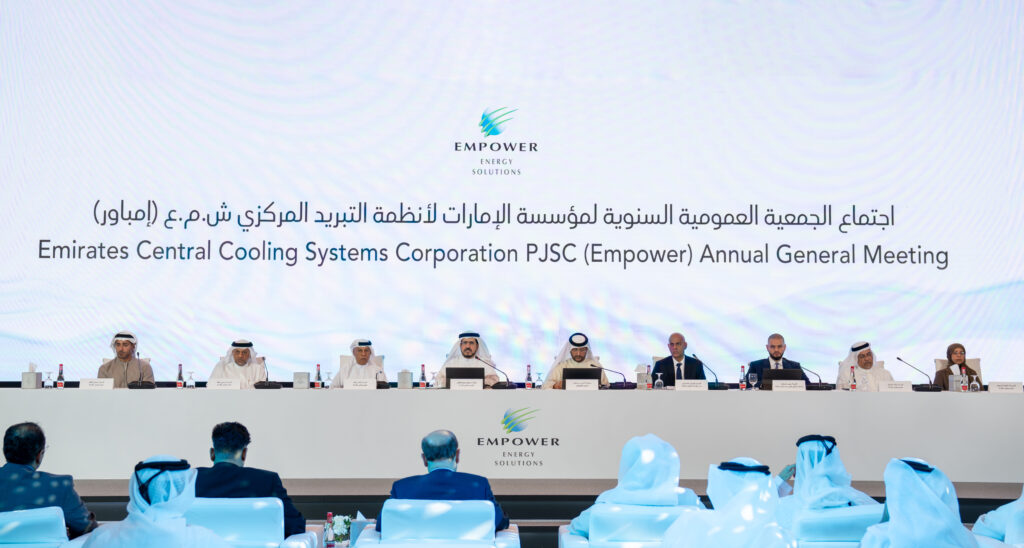
DUBAI, UAE, 26 March 2026: Empower said the Annual General Meeting (AGM), held with a quorum of 85% of the company’s paid-up share capital, approved the Board of Directors’ proposal to distribute cash dividends of AED 437.5 million, equivalent to 4.375 fils per share and 43.75% of the company’s paid-up capital for the second half of 2025.
Empower’s Annual General Meeting
Making the announcement through a Press Release, the company said the meeting was held on March 26, 2026, at Kempinski The Boulevard Dubai and was chaired by H.E. Saeed Mohammed Al Tayer, Chairman of the Board of Directors, Empower and attended by H.E Ahmad Bin Shafar, CEO, Empower, along with members of the Board of Directors. Empower said that during the meeting, the company’s shareholders approved various items on the agenda and ratified the company’s performance report and financial statements for the fiscal year ended 31 December 2025.
Empower, which is listed on the Dubai Financial Market, said it reported record financial results for the year ended 31 December 2025. The company said it recorded revenues of AED 3.42 billion during 2025, the highest since its listing, with net profit after tax reaching AED 1.004 billion, while EBITDA rose to AED 1.65 billion. The approved dividends, Empower said, will be distributed in accordance with its dividend distribution policy.
In 2025, Empower said it distributed cash dividends of AED 875 million in two equal installments of AED 437.5 million each in April and October. According to the company, this distribution comes in line with its commitment to distribute AED 875 million annually in dividends to shareholders.
H.E. Saeed Mohammed Al Tayer, Chairman of the Board of Directors, Empower, said: “In line with the vision of the wise leadership of His Highness Sheikh Mohammed bin Rashid Al Maktoum, Vice President and Prime Minister of the UAE and Ruler of Dubai, and the directives of His Highness Sheikh Hamdan bin Mohammed bin Rashid Al Maktoum, Crown Prince of Dubai, Deputy Prime Minister and Minister of Defense and Chairman of the Executive Council of the Emirate of Dubai, and His Highness Sheikh Maktoum bin Mohammed bin Rashid Al Maktoum, First Deputy Ruler of Dubai, Deputy Prime Minister and Minister of Finance, to raise the economic and service levels of the Emirate, Empower achieved record revenues of AED 3.42 billion with unprecedented net profits of AED 1.004 billion for the year 2025, while profits before interest, taxes, depreciation and amortization increased to AED 1.65 billion, reflecting our ability to maintain strong profit margins through operational efficiency. These achievements are a testament to the development efforts undertaken by the company to expand its services and enhance its efficiency across the Emirate of Dubai.”
H.E. Al Tayer added: “Empower’s strong performance reflects the strength of its business model and the efficiency of its operational strategies, underscoring its ability to deliver sustainable value to shareholders. The company continues to strengthen its position as a key partner in developing Dubai’s District Cooling ecosystem by expanding its services and enhancing operational efficiencies. Empower also focuses on developing its District Cooling infrastructure and adopting the latest global technologies in this field, ensuring the delivery of reliable and highly efficient services that support the company’s sustainable growth and reinforce its role in the emirate’s urban development.”
Empower said H.E. Al Tayer reaffirmed shareholders’ confidence in Empower’s strategies and plans, reiterating the company’s commitment to well-planned development initiatives and to advancing its focus on delivering consistent performance that ensures sustainable long-term success.
H.E Ahmad Bin Shafar, CEO, Empower, said: “Empower draws inspiration for its expansion and development from Dubai’s continuous progress and the emirate’s ongoing development journey. Under the patronage of His Highness Sheikh Mohammed bin Rashid Al Maktoum, Vice President and Prime Minister of the UAE and Ruler of Dubai, the emirate has witnessed a construction boom that has opened broad opportunities for investment and business growth. This momentum has led to increased demand for District Cooling and energy services, creating new investment opportunities in the utilities sector. Empower has responded to this demand through expansion projects and the development of innovative service solutions to ensure reliability and high efficiency. The company has achieved notable success in fulfilling this role, reflected in another successful year that contributes to opening new horizons for investment and development in the future.”
Premium Story
Danfoss launches CoolTrain™ for data centre liquid cooling applications
Company says plug-and-play valve train is designed to address energy efficiency and deployment risks in direct-to-chip cooling systems
DUBAI, UAE, March 26, 2026:Danfoss said it has launched the Danfoss CoolTrain™, which it described as a modular pre-engineered and factory-tested valve train subsystem designed to address energy efficiency and deployment risks in direct-to-chip liquid cooling. Making the announcement through a Press Release, the company said the solution is intended to support the transition towards liquid cooling driven by AI and high-density computing.
Danfoss said the CoolTrain™ replaces on-site assembly with a plug-and-play solution. The company added that the system is designed to accelerate project timelines and optimise system performance from the outset.
Danfoss CoolTrain™
Danfoss said traditional on-site assembly of liquid cooling systems is a source of inefficiency. The company added that manually assembled systems are often not dynamically hydronic balanced, which it said leads to increased energy use from pumps. Danfoss said such methods are also prone to errors and may introduce risks of leaks and contamination, which it said can affect data centre operations.
Moath Shanaah, Data Center Business Development Manager, Danfoss – Türkiye, Middle East and Africa, said: “We saw the immense pressure our customers are under. They need to deploy liquid cooling fast and at scale, but the traditional methods are holding them back with risks and inefficiency. The CoolTrain™ is our direct answer to this. It’s about replacing on-site variables with factory-guaranteed certainty. We want to empower engineers to go with the smart flow, confident that their system is efficient and leak-proof from the moment it’s connected.”
Danfoss said the CoolTrain™ is a modular subsystem designed to connect facility cooling loops with server racks. The company added that each unit is assembled in a factory environment, pressure-tested, internally cleaned to ISO standards, pre-filled with coolant and sealed prior to delivery.
Danfoss said this approach reduces installation time and addresses causes of cooling system failures. The company added that the system integrates components intended to support reliability, hydronic balancing and digital monitoring.
Danfoss said the solution incorporates features such as interlockable couplings and flexible hoses to reduce leakage risks. The company added that the system includes a pressure independent control valve designed to provide continuous hydronic balancing.
Danfoss said the system can be equipped with a digital actuator to provide operational data, including flow rates and temperatures. The company added that this capability supports remote optimisation and predictive maintenance.
Danfoss said the CoolTrain™ supports specified operating parameters, including flow capacity, pressure and temperature ranges, and is designed for high-density rack cooling applications. The company added that the solution is available for specification in data centre projects.
Premium Story
Only 14% of global cities met WHO PM2.5 guideline in 2025, IQAir says
IQAir report highlights worsening pollution trends, impacts of wildfires and gaps in global monitoring infrastructure
STEINACH, Switzerland, 26 March, 2026: IQAir said its 2025 World Air Quality Report shows a decline in global air quality, with only 14% of cities meeting the World Health Organization (WHO) annual PM2.5 guideline. IQAir said the findings are based on data from 9,446 cities across 143 countries, regions and territories, collected through more than 40,000 monitoring stations and sensors.
IQAir said only 13 countries, regions and territories globally recorded annual PM2.5 concentrations within the WHO guideline of five micrograms/m³. The organisation added that this represents a decline from 17% of cities meeting the guideline in 2024, highlighting a worsening trend in air quality performance.
IQAir said air pollution gained increased global attention in 2025, with international institutions elevating it as a major risk factor. The organisation added that the United Nations General Assembly classified air pollution as a significant contributor to non-communicable diseases, including cardiac disease, stroke and cancer.
IQAir said environmental factors, particularly wildfires, played a major role in degrading air quality during the year. The organisation added that biomass burning released approximately 1,380 megatonnes of carbon globally, contributing to elevated pollution levels.
According to IQAir, the highest population-weighted PM2.5 concentrations continued to be concentrated in Africa and Central and South Asia. The organisation added that countries including Pakistan, Bangladesh and India ranked among the most polluted globally based on annual averages.
IQAir said disparities in monitoring infrastructure remain a key challenge. The organisation added that Africa and West Asia continue to be underrepresented in monitoring networks, despite hosting some of the most polluted regions.
IQAir said non-government monitoring stations have become increasingly important in addressing data gaps. The organisation added that in many countries, such stations provided the only real-time air quality data available.
IQAir said PM2.5 remains the primary pollutant tracked in the report due to its significant health impacts. The organisation added that sources of PM2.5 include industrial emissions, transportation, power generation, agricultural burning and natural events, such as dust storms and wildfires.
IQAir said the findings highlight the need for sustained global efforts to improve air quality. The organisation added that maintaining clean air requires long-term strategies, continuous monitoring and coordinated action across governments and stakeholders.
Company says shareholders endorsed cash dividend and re-elected board
ABU DHABI, UAE, 26 March, 2026: National Central Cooling Company PJSC (Tabreed) said it held its Annual General Assembly (AGA), during which shareholders approved a second-half cash dividend of 6.5 fils per share. Making the announcement through a Press Release, the company said the approval brings the total dividend for 2025 to 13 fils per share.
Tabreed said the total dividend represents a yield of approximately five per cent, based on the closing share price on March 25, 2026. The company added that the dividend reflects its financial and operational performance during the year.
Bakheet Al Katheeri
Tabreed said the dividend demonstrates its approach to delivering returns while continuing to invest in long-term opportunities. The company added that despite merger and acquisition activity during 2025, its dividend payout as a percentage of net profit increased to 79%.
Tabreed said shareholders also approved the re-election of the existing Board of Directors for a three-year term. The company added that the re-election was conducted in accordance with the regulations of the Capital Market Authority.
Tabreed said the AGA was chaired by its Chairman, Bakheet Al Katheeri. The company added that during the meeting, it highlighted its development from a utility provider into an infrastructure company with a focus on resilience and innovation.
Al Katheeri, said: “Our long-term contracts, strong customer base and solid financial position make Tabreed one of the most reliable infrastructure investments in the region.
“In 2025, Tabreed delivered strong operational performance and advanced its long-term growth strategy. Our core business remains robust, with stable operations, healthy margins and high asset availability. Connected capacity during 2025 reached 1.57 million refrigeration tonnes (RT), a 19% increase year-on-year driven by both organic growth and M&A. Excluding M&A, organic capacity growth was 4.4%, near the top of our guidance range.
“Our balance sheet remains strong, and we continue to maintain investment grade metrics, which is a core priority. Tabreed’s strong and visible growth pipeline gives us exceptional confidence in the future and reflects our commitment to sustainable value creation for our shareholders. Our strategy is disciplined and balanced: rewarding shareholders today while strengthening the company for tomorrow. We are well positioned to capitalise on the growth already secured through long-term concessions and new opportunities ahead of us.”
Premium Story
Cooling countdown: Is the GCC Region ready for the refrigerant shift?
As the Kigali phasedown approaches, experts warn that the GCC region’s cooling sector must accelerate policy clarity, industry readiness and supply-chain adaptation to avoid shortages and compliance gaps
In a region where air conditioning is as essential as running water, the question hanging over this industry was not if change would come, but whether the people responsible for that change were moving fast enough to manage it or not.
This question is no longer theoretical. Speaking on this matter from the perspectives of manufacturing and supply chain is Amir Naqvi, General Manager, Middle East, Solstice Advanced Materials. And giving a regulatory perspective is Dr Ahmed Alaa Eldin Mohamed, Past Director, Regional Chair 2018-2021, ASHRAE, based on tracking how Gulf governments are tightening the rules under the Kigali Amendment to the Montreal Protocol and related climate commitments.
Amir Naqvi
When the discussion turns to how prepared the region really is, Naqvi does not pretend everything is already in place. “The Middle East refrigerant supply chain is currently in a state of active transition to low‑GWP (global warming potential) alternatives,” he says, describing “significant progress while simultaneously working to remove any structural bottlenecks, such as training workforce for handling mildly flammable (A2L) refrigerants, having warehouses ready for A2L refrigerants and other items”. Major manufacturers, he notes, have already reworked their catalogues. “Many large projects in District Cooling, commercial refrigeration, commercial air conditioning and data centre cooling already have used low‑GWP refrigerants for close to a decade in the region,” he says.
Dr Ahmed Alaa Eldin Mohamed
For Naqvi, the main concern is what happens if the industry waits too long. “When there is a disconnect between the regulation and market adoption, it creates a volatile environment for stakeholders,” he warns, adding that Solstice has “seen these patterns globally”. He lists three risks: The “risk of stranded assets”, if companies delay and are left with systems that cannot easily be serviced; “supply chain imbalance and a grey or black market” that puts legitimate businesses at a disadvantage and raises safety concerns; and “technical preparedness and training gaps” around new, mildly flammable refrigerants. In his view, all three become sharper the closer the region gets to key phase‑down dates.
Those dates are what preoccupy Dr Mohamed. From his side of the table, the story starts with signatures and legal texts. “From a policy and regulatory standpoint, GCC Region markets are entering a crucial preparation phase for the next phase of refrigerant regulation,” he says, pointing to the HFC phasedown under the Kigali Amendment and newer low‑GWP policies. “But their readiness is still evolving and varies by country.” The UAE, he notes, has already ratified Kigali and “is the first GCC Region member-country to do so, committing to freeze HFC production by 2028 and a phasedown through 2047”. Saudi Arabia, Bahrain, Kuwait and Oman are further along the ratification path, while “Qatar is the only GCC Region member that had not yet ratified by late 2025, though pressure and consensus indicate ratification is likely forthcoming”. Ratification, he stresses, creates binding obligations on HFC consumption and sets phase‑down schedules, but enforcement and detailed implementation mechanisms are still under development across most GCC region countries.
That gap between headline commitments and day‑to‑day reality is where pressure is building. Under the international timetable for many Gulf states, there will be a freeze on HFC consumption and production from 2028, a 10% reduction around 2032, and steeper cuts later in the 2030s and the 2040s. Dr Mohamed sums up the dilemma bluntly in a single line, “Current compliance timelines, particularly the 2028 freeze and the early phasedown milestones are technically achievable as policy targets, but they are likely unrealistic in practice, unless GCC Region markets accelerate adoption of alternatives, strengthen enforcement and scale up industry capacity well ahead of schedule.” Industry warnings suggest how that could feel on the ground: Rising cooling demand and the way the baseline is calculated mean that “by 2032, the first 10% reduction might be experienced as a 30% effective shortage of HFC refrigerants in practice, if alternatives aren’t adopted rapidly.”
Naqvi’s answer to that risk is simple: Move early and move together. “The ‘wait‑and‑see’ approach is the greatest risk to regional industry,” he says. In his view, original equipment manufacturers, distributors and contractors all need to commit upfront. With time on their side, he says, OEMs can plan for supply constraints, contractors can properly train their teams on updated handling, installation and safety procedures for the low‑GWP refrigerants, and that distributors can clear legacy inventory and transition their stock efficiently. He says Solstice is already trying to accelerate that shift, supporting regional industry readiness by bringing a wealth of expertise gained from spearheading similar refrigerant transitions across Europe and the USA, and running webinars and training with partners on A2L refrigerants.
Dr Mohamed agrees that the clock is ticking, but says the biggest obstacle is not willingness, it is clarity. He calls policy clarity “the biggest bottleneck”, arguing that even willing, capable markets stall when the rules aren’t precise. Regulations often spell out the destination – the phasedown of HFCs – but not the route. “Many regulations state what must happen – HFC phasedown – but not clearly how markets should transition,” he says. Safety codes, building rules and fire standards, he says, often lag behind refrigerant policy, especially for A2L and natural refrigerants, and detailed questions about import licences, quotas and penalties are still being worked out. The result, he says, is predictable: Manufacturers and developers hedge their bets, delay redesigns and continue specifying legacy refrigerants ‘until forced otherwise’.
Next comes enforcement. Dr Mohamed labels it “the risk multiplier”. Weak enforcement, he says, turns ambitious policy into theoretical compliance. Monitoring of imports and stockpiles, he says, is still developing, and not all ports and authorities are fully equipped to identify blends, GWP values or mis-declared refrigerants. In several markets, he adds, enforcement is still largely advisory rather than corrective or punitive. That may be manageable now, but once phasedown steps begin, non‑compliant imports and grey markets become economically attractive. In that scenario, he warns, legitimate players are penalised first, while laggards gain short‑term cost advantages, undermining confidence among early adopters.
Both men point to training and standards as the levers that can change the outcome. Naqvi argues that stakeholders should not wait for local mandates to reach their final phase, and urges them to work with companies with a global footprint to evaluate product options and ensure compliance with global standards. He says acting now would help the region move from transactional buying to strategic supply relationships, test low‑GWP options in Gulf heat, and start planning for recovery and reclamation of refrigerants.
Dr Mohamed, meanwhile, focuses on the organisations that turn broad laws into engineering rules. He says standards bodies, such as ISO, IEC, ASHRAE, EN, and national code authorities take mandates, such as reducing HFCs and translate them into charge limits, leak detection requirements, ventilation and zoning rules, equipment classification (A1, A2L, A3), and installation and servicing protocols. “Without this layer,” he says, “regulators can ban a refrigerant, but engineers still don’t know what they’re allowed to install, instead.” In the Gulf, where cooling loads are high and systems are often centralised, he argues that standards mitigate the risk associated with A2L and natural refrigerants by defining safety envelopes, give fire services and municipalities confidence to approve projects, and offer insurers and developers defensible compliance benchmarks. His shorthand for the reality on the ground is stark: “In practice, no standard = no permit, even if regulation allows it.”
On enforcement, Dr Mohamed predicts governments will avoid sudden shocks. He expects an initial period of soft enforcement or signalling, in the forms of import registration, reporting, voluntary compliance, guidance and education‑first inspections, designed to change behaviour before punishment. After that, he foresees “selective enforcement”, starting with new equipment and priority sectors and targeting serious breaches. Only later, once markets have adjusted, does he anticipate full enforcement with market maturity, including strict import quotas, penalties for non‑compliant specifications and links to building permits and occupancy certificates. A hard cut‑off, he argues, would risk refrigerant shortages, cost spikes, project delays, grey‑market imports and political pushback. “No GCC Region government wants cooling security questioned in a hot climate,” he says. “So expect managed descent, not a regulatory free‑fall.”
Seen together, their comments sketch the outlines of the next decade for the Gulf’s cooling sector. On one side is Dr Mohamed’s assessment: “The success of the next regulatory phase in the GCC Region countries will depend heavily on harmonised standards, proactive industry adaptation and capacity building, including training, certification and supporting infrastructure in the coming few years.” On the other hand, Naqvi’s message to the market is that companies that move early can avoid stranded assets and grey‑market risks and help steer the region from transactional buying to strategic supply relationships, built around low‑GWP technologies. Between now and the 2028 freeze, the outcome will be decided less by the text of international agreements than by how quickly governments, standards bodies and industry manage to close the gap between rules on paper and equipment on the ground.
Premium Story
JCI reports progress on energy efficiency, emissions reduction in 2026 Sustainability Report
Company highlights cost savings, emissions reductions and advancements in energy efficiency across mission-critical industries
CORK, Ireland, 22 April 2026: Johnson Controls International (JCI) released its 2026 Sustainability Report, outlining progress towards its sustainability goals and the outcomes delivered for customers across mission-critical industries. Making the announcement through an April 22 Press Release, JCI said the report details performance across such sectors as healthcare, advanced manufacturing and higher education.
JCI said its technologies have helped organisations save more than USD 9.5 billion in energy and operating costs across thousands of projects worldwide. The company added that the savings were achieved alongside environmental benefits equivalent to avoiding emissions from nearly six million US homes, enabling organisations to redirect capital towards strategic priorities, such as capacity expansion and workforce development.
Joakim Weidemanis, CEO, JCI, said: “Our purpose is grounded in the belief that what we do matters for human society. In the mission-critical environments we serve, performance, reliability and sustainability are foundational for the future. Our 2026 Sustainability Report shows that in the industries where failure is not an option, we put energy efficiency to work to unlock growth opportunities and enable peak performance, which frees up capital for long-term growth in the places that really matter.”
Johnson Controls said its solutions have delivered measurable results across mission-critical environments, citing projects such as a healthcare facility, where upgraded chillers and heat pumps reduced heating fuel needs by 69% and generated significant annual energy cost savings. JCI added that additional digital optimisation further increased savings, while large-scale heat pump deployments in Europe contributed to climate-neutral heating and reduced emissions.
JCI said the report highlighted a 33% reduction in Scope 3 emissions from the use of sold products, exceeding its 2030 target of 16%. The company added that it has also introduced new low-embodied-carbon chiller options with 44% lower embodied carbon than conventional systems.
Katie McGinty, Vice President, Chief Sustainability, External Relations Officer, JCI, said: “With energy prices on the rise, the most forward-looking companies are treating energy efficiency as a business strategy to drive every dollar into innovation, technology adoption and competitive advantage. Energy efficiency is one of the fastest ways to lower operating expenses, reduce emissions and improve performance at the same time. At Johnson Controls, we’re proud to help customers turn decarbonization into a source of financial strength and competitive advantage.”
Johnson Controls said it has reduced Scope 1 and Scope 2 emissions from its operations by 46% since 2017, reaching 84% of its 2030 target. The company added that 91% of its global electricity needs are being met or matched with carbon-free energy, helping reduce exposure to energy price volatility and long-term risk.
JCI said it allocated 77% of its new product research and development in 2025 to sustainability and climate-related innovation, supporting improvements in energy cost management, refrigerant transition and digital integration. The company added that its product portfolio includes heat pumps capable of delivering emissions reductions of up to 55% compared to conventional systems while reducing operating costs.
JCI said its high-efficiency chillers and heat pumps exceed regulatory requirements and contribute to improved performance in mission-critical cooling environments. The company added that its solutions also support data centres by reducing non-IT energy use through high-efficiency cooling, thermal management and building automation systems.
JCI said its technologies enable data centres to reduce energy intensity and reuse waste heat through solutions such as absorption chillers and heat pumps. The company added that the approaches support improved efficiency, resilience and operational performance while contributing to broader sustainability goals.
Premium Story
Empower highlights water efficiency measures in District Cooling operations
Company says the initiative focuses on the use of treated sewage effluent and reverse osmosis technologies to reduce freshwater consumption
DUBAI, UAE, 21 March 2026: Marking World Water Day, observed annually on 22 March, Empower said it will continue to implement operational measures aimed at improving water efficiency in District Cooling systems.
Making the announcement through a Press Release, Empower said a key element of its approach involves the use of Treated Sewage Effluent (TSE) and reverse osmosis technologies within its District Cooling operations. According to the company, these methods are intended to reduce reliance on freshwater resources while supporting operational requirements in cooling infrastructure.
The company said it expanded its in-house reverse osmosis capacity to 24,969 m3/day in 2025, compared with 21,359 m3/day in 2024. Empower added that recycled water usage reached 9.22% in 2025, compared with 8.3% in the previous year. The company said the increase reflects operational adjustments linked to its internal targets and the availability of recycled water supply.
H.E. Ahmad Bin Shafar
Commenting on the announcement, H.E. Ahmad Bin Shafar, CEO, Empower, said: “Water is a vital resource for life and sustainable development. At Empower, we are committed to enhancing the efficiency of water use within our operations by adopting treated water and reverse osmosis technology for District Cooling, thereby reducing freshwater dependency. These efforts align with the directives of our wise leadership to preserve natural resources and ensure their sustainability for future generations through responsible and efficient resource management practices. At Empower, we strive to provide District Cooling services according to the highest standards of quality and reliability, based on a sustainable operational methodology that aligns with the UAE Water Security Strategy 2036.”
H.E. Bin Shafar added: “World Water Day is an important occasion to reaffirm the importance of water resources and their pivotal role as a strategic driver of economic and social development, as well as their vital contribution to achieving the Sustainable Development Goals. Empower remains committed to promoting sustainable practices and fostering a culture of responsible resource use, supporting the nation’s vision for a more sustainable future.”
Premium Story
Kanthal inaugurates service centre in North Carolina
Company says the facility would support U.S. customers requiring high-temperature heating solutions and expand manufacturing capacity for silicon carbide heating elements
HALLSTAHAMMAR, Sweden, March 19, 2026: Kanthal, a company focused on industrial heating technology and resistance materials, said it has inaugurated a new service centre in Concord, North Carolina, intended to support customers requiring high-temperature electrification technologies across manufacturing sectors. Making the announcement through a Press Release, Kanthal said the facility forms part of efforts to expand its production capacity for Globar silicon carbide heating elements.
Kanthal said the heating elements are used in high-temperature industrial processes. The company added that the elements are designed to operate at temperatures of up to 2,950 degrees F (1621.1 degrees C) and are applied in sectors such as electronics, glass and steel manufacturing.
Kanthal said the expansion reflects increasing demand for high-temperature electric heating technologies from manufacturers exploring alternatives to combustion-based heating processes. The company added that the new service centre will support customer service operations and help improve delivery lead times for customers in the United States.
Kanthal said combustion emissions from the manufacturing sector account for approximately 573 million metric tonnes of greenhouse gas emissions, representing around 75% of the sector’s total emissions, citing the Congressional Budget Office.
Simon Lile and Bruce Dionne, Production Unit Manager, Concord
Robert Stål, President, Kanthal, said: “We have served the U.S. market since the 1930s. We are already supporting our customers from Concord with a broad portfolio, and adding Globar to the mix allows us to leverage existing infrastructure. The opening of our Concord service center is the next step in strengthening our local presence in the region which is experiencing a surge in advanced manufacturing.”
Kanthal said the service centre forms part of an investment of approximately USD 11 million that also includes an expansion of its primary production facility in Perth, Scotland. The company added that the expansion in Scotland involves the addition of around 19,000 ft2 of manufacturing space along with new equipment, revised production layouts and expanded warehousing capacity.
Kanthal said the combined developments are expected to increase production capacity by approximately 40%. The company added that the Concord facility manufactures several products, including metallic heating elements, Tubothal heating elements, high-temperature tubes and Fibrothal heating elements.
Kanthal said, prior to the expansion, Globar heating elements supplied to U.S. customers were produced at the company’s facility in Perth. The company added that it consolidated production from three U.S. locations into a single manufacturing and distribution centre in Concord in 2022.
Simon Lile, President, Heating Systems Business Unit, Kanthal, said: “This is not just a new service center. We have implemented technology improvements in Concord that allow us to adapt product configurations based on customer furnace setups and order cycles. The result is a more responsive operation, faster to quote, faster to ship, and better aligned with U.S. customer needs.”
Kanthal said it traces its origins to the discovery of an iron-chrome-aluminium alloy by Hans von Kantzow in 1916. The company added that the patent for the alloy was approved in 1926 and that the business was established in 1931.
Kanthal said it expanded its technology portfolio through acquisitions, including the Globar trademark for silicon carbide heating elements in 1994 and several heating element and materials companies in North America. The company added that it operates today as part of the Alleima group, which was separated from Sandvik in 2022.
Premium Story
Castel introduces 3030 series safety valves for HFO and hydrocarbon refrigerant systems
Company says the valves were developed for refrigeration and air-conditioning applications operating with A2L and A3 refrigerants
MILAN, Italy, 17 March 2026: Castel said it has expanded its range of safety devices with the introduction of the 3030 series safety valves designed for refrigeration and air-conditioning systems using HFO and hydrocarbon refrigerants classified as A2L and A3.
Castel 3030 series safety valves
Making the announcement through a Press Release, Castel said modern refrigeration systems are increasingly operating under demanding conditions that combine higher working pressures and elevated discharge temperatures. According to the company, the 3030 series has been developed to address such conditions, with set pressures reaching up to 50 bar and operating temperatures up to 150 degrees C.
The company said the valves feature a compact design and incorporate materials intended to support use in a range of refrigeration and air-conditioning installations. Castel added that the series offers a set-pressure range between 8 and 50 bar, allowing installation in both low-pressure and high-pressure sections of refrigeration systems.
According to Castel, one of the design features of the 3030 series is repeatable performance after activation, with the valve maintaining its original calibration following operation. The company said this characteristic is intended to support continued system protection over time.
Castel said the development of the new safety valve series forms part of its broader portfolio of safety components intended for refrigeration systems operating with natural and low-GWP refrigerants.
Premium Story
Sensitron previews new gas detection control panel
Company says the new system introduces a redesigned interface for gas detection applications
MILAN, Italy, 13 March 2026: Sensitron said it has previewed a new gas detection control panel designed for systems with up to eight gas detectors, adding that the product is expected to be commercially available within 2026. Making the announcement through a Press Release, Sensitron said the new control panel builds on its existing portfolio of fixed gas detection systems, detectors and control panels across applications.
Sensitron’s new gas detection control panel
Sensitron said the new control panel evolves from its PL4+ system. The company said the development introduces a user-oriented design approach, featuring a redesigned interface that is more modern, readable and intuitive, aimed at simplifying operation and improving on-site user experience.
Sensitron said the new design is the result of its first collaboration with AMDL CIRCLE, a multidisciplinary studio founded by Michele De Lucchi. The company said the collaboration focused on integrating technical functionality with design innovation, resulting in a more compact and visually distinct control platform adaptable across international markets.
Sensitron said the development process involved close interaction between technical specialists and the design team, leading to a reconfiguration of internal components and the creation of a new architectural form. Nicholas Bewick and Andrea Borgogni, Architecture Art Director and Senior Product Designer, AMDL CIRCLE, said: “The design is the result of a complete reconfiguration of the internal components — battery, printed circuit boards, mounting systems, etc. – arranged according to a new hierarchical order. The re-organization of the elements has allowed the creation of an unusual pyramidal architectural form, with a redesigned main display and control panel to simplify the physical and visual interface with the entire gas safety network.”
Sensitron said the system has been developed based on feedback from users, focusing on how the control panel is read, understood and operated in real-world conditions.
Marco Passadori
“We chose design as a strategy to complement our technical expertise, adding an element of differentiation in a highly competitive market,” said Marco Passadori, Managing Director, Sensitron. “Technology, compliance with standards, and experience are the foundations of our product development. The decision to introduce design stems from listening to those who use the product. From our ongoing dialogue with customers came the desire to create a control panel truly designed for its users,” Passadori added.
Sensitron said the control panel features a redesigned interface with new graphical elements, including pop-ups, directional arrows, switches, menus and contextual buttons, aimed at enabling faster understanding without prior familiarity. The company added that a multi-level digital login system replaces the physical key, providing enhanced operational control, traceability and system security.
Sensitron said the system allows configuration directly via the display or through a PC, enabling users to save and replicate settings across installations. The company added that event logs can be downloaded for diagnostic analysis, supporting system traceability and proactive monitoring.
Sensitron said the control panel complies with ATEX Directive 2014/34/EU and key performance and functional safety standards, including EN IEC 60079-29-1 and EN 61508 / EN 50402 (SIL1). The company added that all its products are tested and CE-approved and, where applicable, carry international certifications attesting to protection, performance and reliability.
Sensitron said the new control panel forms part of a broader strategic product and business development plan, aimed at redefining the role of control interfaces in gas detection systems.