
CCME.NEWS

Your source for the HVACR Industry, covering in-depth news & analyses on policy, business & technology.

Get Premium:

Sign-up

COMMERCIAL ENQUIRIES:

Frédéric Paillé
Co-Founder & Commercial Director
fred@cpi-industry.com
+971 50 714 7204

Follow Us

CCME.NEWS

CCME.NEWS, covering the regional and global HVACR industry with an unwavering commitment to providing in-depth news and analyses on policy, business and technology

Contact Info

PO Box 13700,
Dubai Media City, Dubai
admin@cpi-industry.com
+971 50 714 7204

Follow Us

Premium Story

OnAire – Episode 3 | Fortress Data Centres | Cold Chain | IEQ & IVF Outcomes

Welcome to the third episode of CCME ON AIRE, the official online broadcast platform of CPI Industry, publishers of Climate Control Middle East magazine. We bring you news, views and commentary from across the global HVACR and allied sectors.

In This Episode

1. NEWS

▪ ASHRAE launches a Center of Excellence focused on Indoor Environmental Quality
▪ Carrier explores turning air conditioners into grid assets
▪ A European report highlights the role of multi-level governance in climate action
▪ Frascold marks 90 years in the HVACR sector
▪ India’s data centre capacity grows fourfold
▪ Mostra Convegno Expocomfort 2026 concludes in Milan
▪ Saudi Arabia unveils a USD 100 billion AI initiative, with massive cooling implications
▪ Princeton University says it is deploying a large-scale system combining heat pumps and geo-exchange technology
▪ New research highlights the growing role of heat pumps and refrigerants in the global energy transition


2. VIEWPOINT

This fortnight, we examine two critical areas that sit at the intersection of engineering, logistics and economic wellbeing:

▪ Food safety and food security in the context of cold chain infrastructure
▪ Data centres and the threat from drone attacks

We speak to Bobby Krishna, Senior Specialist at the Food Safety Department of Dubai Municipality (UAE), and Brent Melvin, General Manager of RSA Cold Chain, on today’s global landscape, where food systems are under pressure from geopolitical disruptions, supply chain constraints and rising demand. The conversation explores how countries across the GCC region are working to ensure food availability remains stable and resilient during times of conflict. Stability is being achieved through strategic cold chain logistics, diversified sourcing, and strong, flexible regulatory frameworks.

We also speak to George Berbari, CEO of DC PRO Engineering and author of The Energy Budget, who explains how traditional data centres can be vulnerable to emerging threats, including low-cost aerial attacks. In response, he highlights the concept of “Fortress Data Centres” — facilities designed with reinforced structures, advanced cooling, and protected infrastructure to ensure operational continuity.


3. COMMENTARY

This fortnight, the spotlight is on how Indoor Environmental Quality plays a critical role in achieving successful IVF outcomes. In an IVF laboratory, embryos are developed outside the human body, meaning their survival depends entirely on the surrounding environment, particularly air quality.

Embryos are among the most sensitive cellular structures in medicine and are highly vulnerable to airborne contaminants. Studies show that exposure to such contaminants can trigger oxidative stress, leading to cell damage, DNA fragmentation, and impaired embryo development.

In this context, multi-stage filtration systems with advanced filter media in IVF facilities can significantly improve embryo survival rates and overall treatment outcomes.
Premium Story

ASHRAE outlines technical programme for 2026 annual conference

The conference will feature sessions on system performance, workforce development and emerging building technologies across eight technical tracks, Society says

ATLANTA, Georgia, United States, 15 April 2026: ASHRAE released its technical programme for the 2026 Annual Conference, scheduled to take place from June 27 to July 1 in Austin, Texas, in the United States. Making the announcement through an April 15 Press Release, ASHRAE said the conference would bring together industry professionals, researchers and practitioners from around the world for knowledge sharing, technical exploration, professional development and peer engagement.

ASHRAE said the complete schedule has been made available online and through its ASHRAE 365 platform, enabling attendees to build personalised conference itineraries in advance. ASHRAE added that the technical programme features sessions across eight tracks, covering fundamentals and applications, HVACR systems and equipment, research, workforce development, ground-source heat pumps, hot climate building system design, artificial intelligence in building design, and construction and building decarbonisation.

Bill McQuade, ASHRAE President for the 2025-2026 Society Year, said: “The ASHRAE Annual Conference brings together established practices and new ideas that are reshaping how we design, build and operate buildings. Attendees will find opportunities to deepen their expertise, discover innovative approaches and connect with peers tackling similar challenges.”

ASHRAE said the programme includes sessions led by subject matter experts from around the world, combining research-driven presentations, interactive discussions and collaborative opportunities to support professionals at various stages of their careers. ASHRAE said key sessions would cover topics such as artificial intelligence, cloud technologies and cybersecurity in smart building design, data centre cooling and waste heat reuse, workforce preparedness, community energy systems, and building health and efficiency.

ASHRAE said the ASHRAE Learning Institute would offer 10 continuing education courses approved for Professional Development Credits towards maintaining P.E. licensure. ASHRAE added that the courses include laboratory controls, dehumidification, A2L refrigerant system design and installation, decarbonisation strategies, and pathways to net-zero buildings aligned with updates to ASHRAE 90.1.

ASHRAE said the conference would feature a plenary session with Society updates and a farewell address from the current president. ASHRAE added that during the President’s Luncheon, it would install new officers and directors and that incoming 2026-27 President, Sarah Maston would deliver her inaugural address under the theme, ‘Changing the Game: Retrofitting for Resilience’.

Premium Story

Copernicus reports fourth-warmest March globally with near-record sea surface temperatures

Data highlights elevated global temperatures, shifting ocean conditions and regional climate contrasts in March 2026

READING, United Kingdom, 10 April 2026: The Copernicus Climate Change Service (C3S), implemented by the European Centre for Medium-Range Weather Forecasts (ECMWF), reported that March 2026 was the fourth-warmest March globally on record, with temperatures reaching 1.48 degrees C above pre-industrial levels. C3S said March also recorded the second-warmest global sea surface temperatures on record, which it said reflected a likely transition towards El Niño conditions.

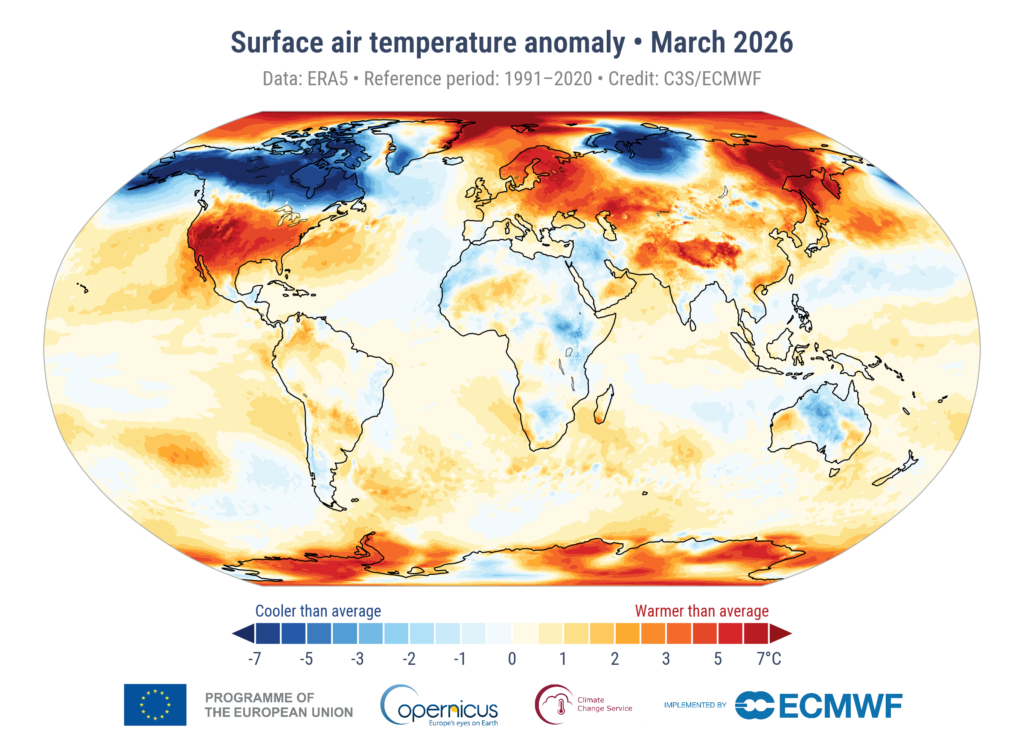
Surface air temperature anomaly for March 2026 relative to the March average for the period 1991-2020. 
Data source: ERA5. Credit: C3S/ECMWF.

March 2026 – Surface air temperature and sea surface temperature highlights

C3S said the global average surface air temperature for March 2026 was 13.94 degrees C, which it said was 0.53 degrees C above the 1991-2020 average for the month. The service added that the warmest March on record occurred in 2024.

C3S said Europe experienced its second-warmest March on record, with an average land temperature of 5.88 degrees C, which it said was 2.27 degrees C above the 1991-2020 average. The service added that most of Europe recorded warmer-than-average conditions, with the most pronounced anomalies observed over northwest Russia, northern Fennoscandia and the Baltic States, while it said slightly cooler-than-average conditions were seen over Türkiye, southern Europe and most of Iceland.

C3S said severe heat and dry conditions were observed in other regions, including an early heatwave and drier-than-average conditions in parts of the United States and Mexico. The service added that warmer-than-average temperatures were also recorded across much of the Arctic, northeast Russia and parts of Antarctica, while it said unusually cold conditions were observed across Alaska, most of Canada, southern Greenland and northwest Siberia.

C3S said strong contrasts between warmer and cooler than average temperature anomalies persisted across the Northern Hemisphere, similar to February.

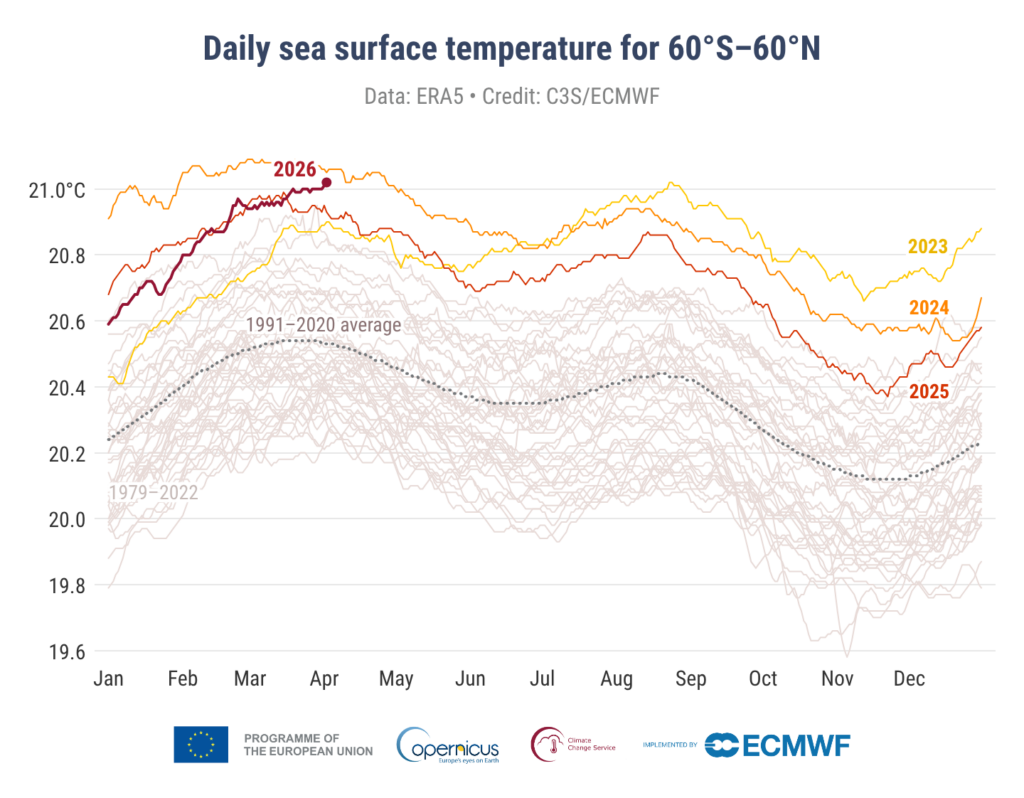
C3S said the average sea surface temperature for March 2026 over 60 degrees S to 60 degrees N was 20.97 degrees C, which it said was the second-highest value on record for the month. The service added that daily sea surface temperatures increased steadily throughout March and were approaching the record levels set in 2024, and it said many climate centres forecast a transition from neutral to El Niño conditions in the second half of the year.

Daily sea surface temperature (degrees C) averaged over the extra-polar global ocean (60 degrees S to 60 degrees N) for 2023 (yellow), 2024 (orange), 2025 (red) and 2026 (dark red). All other years between 1979 and 2022 are shown with grey lines. The daily average for the 1991–2020 reference period is shown with a dashed grey line.
Data source: ERA5. Credit: C3S/ECMWF.

March 2026 – Sea ice highlights

C3S said that in the Arctic, both the annual maximum sea ice extent and the monthly average for March were the lowest on record. The service added that Arctic sea ice extent in March was 5.7% below average, which it said was marginally below the previous record set in 2025.

C3S said the daily Arctic sea ice extent reached its joint lowest winter maximum, tied with March 2025. The service added that regional sea ice deficits were most pronounced in the northern Barents Sea, the Svalbard region and the Sea of Okhotsk.

C3S said Antarctic sea ice extent was 10% below the March average, which it said placed it outside the ten lowest on record for the month, following several years of larger negative anomalies.

March 2026 – Hydrological variables highlights

C3S said March followed a colder-than-average and exceptionally wet February in Europe, which it said had widespread flooding and ranked as the third coldest February for the continent in the last 14 years. The service added that much of continental Europe experienced drier-than-average conditions during March, while it said Iceland, the northern UK, much of Scandinavia, parts of the Mediterranean and the Caucasus recorded wetter-than-average conditions, with some areas experiencing flooding linked to storm activity.

C3S said wetter-than-average conditions outside Europe were recorded in regions including eastern and western USA and Canada, parts of Australia, southern Chile, eastern Brazil, parts of the Middle East, and parts of eastern Asia and southeastern Africa. The service added that drier-than-average conditions were observed in southern USA and northern Mexico, southeastern China, parts of South America and western Australia.

Carlo Buontempo, Director, C3S, ECMWF, said: “Copernicus data for March 2026 tells a sobering story: 1.48 degrees C above pre-industrial levels, the lowest Arctic sea ice extent on record for March, and sea surface temperatures again approaching historic highs. Each figure is striking on its own – together, they paint a picture of a climate system under sustained and accelerating pressure. Reliable data, produced operationally from billions of measurements across satellites, ships, aircraft and weather stations, is no longer a scientific luxury. It is the essential foundation for any serious climate adaptation and policy response.”

Premium Story

EIA report alleges illegal refrigerant trade linked to organised crime in Italy

Agency says investigation identifies supply chain risks and widespread illicit practices in HFC market

LONDON, United Kingdom, 9 April, 2026: The Environmental Investigation Agency (EIA) said illegal refrigerant gases are entering Italy through organised criminal networks and reaching major supply chains, including manufacturing, supermarkets and the state railway. Making the announcement through a Press Release, EIA said the trade represents hundreds of millions of euros in lost profits annually for legitimate suppliers.

EIA said its report, ‘Fakes, Fraud and F-gases’, presents findings from its investigations into the illegal trade in hydrofluorocarbons (HFCs). EIA said HFCs are fluorinated gases, widely used in refrigeration and air conditioning. They are being phased down globally under the Montreal Protocol’s Kigali Amendment. The European Union, EIA said, is pursuing further reductions through its F-Gas Regulation.

EIA said that following reductions in legal HFC supply in Europe, a large-scale illegal trade has emerged. The Agency added that the trade is driven by profit opportunities and uneven enforcement, which it said has attracted organised criminal networks.

Fin Walravens, Senior Climate Campaigner, EIA, said: “Estimating the scale of illegal trade in any product is difficult, but industry associations have claimed nearly half of the refrigerant gas on the Italian market is illegal.”

EIA said the European Union introduced new regulations in 2024 aimed at addressing illicit trade, including cylinder take-back requirements and strengthened customs checks. The Agency said its investigation found companies across the supply chain admitting to practices such as exceeding quota limits, falsifying invoices, mislabelling refrigerants and evading Value Added Tax (VAT).

EIA said the report identifies a trend of counterfeit F-gases being sold as lower-impact alternatives. The Agency added that some companies claimed to supply counterfeit refrigerants even to well-known hypermarkets and chiller manufacturers, raising concerns that illegal refrigerants may be entering commercial supply chains.

Walravens said: “Companies have known for a long time that rapid reductions in HFCs are coming, and yet many retailers and other sectors across Europe remain heavily reliant on these climate-wrecking refrigerants, despite the ready availability of alternatives. Ultimately, this demand is driving illegal trade.

“High consumer demand drives up European prices, spurring organised criminals to exploit the price differentials with HFCs bought outside the EU and smuggled either directly to Italy or via countries with weaker border enforcement, such as Bulgaria and Romania.”

EIA said Italy is the European Union’s largest consumer of air conditioning and reported the highest number of HFC seizures in 2024. The Agency added that it conducted undercover investigations in 2025 across the supply chain, engaging with importers, distributors and online sellers.

EIA said Italian authorities have acknowledged the issue and established a roundtable involving the environment ministry, customs and police to address illegal trade. The Agency added that enforcement efforts have increased across Europe.

Walravens said: “Despite increased enforcement efforts across Europe, EIA’s findings once again highlight the deeply interconnected nature of illegal HFC trade across member state borders.

“With a 50% supply cut due in 2027, consumers across Europe must rapidly wean themselves off F-gases and onto natural refrigerant alternatives, if they want to avoid organised crime in their supply chains.”

EIA said the report calls for actions, including phasing out HFCs in equipment, strengthening implementation of the F-Gas Regulation, increasing inspections, improving cross-border enforcement and introducing stronger penalties for violations.

Premium Story

E+E Elektronik highlights TDS501 dew point transmitter for industrial drying

Company says TDS501 sensor is designed to provide continuous dew point measurement down to -70 degrees C for stable process monitoring in low-humidity environments

ENGERWITZDORF, Austria, 7 April 2026: E+E Elektronik said its TDS501 dew point transmitter forms part of its product portfolio for industrial applications requiring precise low-humidity measurement. Making the announcement through a Press Release, E+E Elektronik said the TDS501 is designed to measure dew point temperatures down to -70 degrees C, supporting continuous monitoring in demanding industrial drying processes.

E+E Elektronik said the sensor is developed for environments where even small variations in moisture levels can affect product quality, process stability and safety. The company added that the TDS501 provides continuous dew point data to support 24/7 monitoring and stable control of drying processes.

E+E Elektronik said the TDS501 features its proprietary measurement approach, combining multiple sensing elements to enable uninterrupted in-line monitoring while maintaining accuracy during auto-calibration cycles. The company added that the system ensures stable and repeatable measurement performance, even under changing operating conditions.

E+E Elektronik said the transmitter offers a measurement range of -70 degrees C to +60 degrees C with an accuracy of ±2 degrees C dew point and supports operation at pressures of up to 80 bar. The company added that the device includes analogue and digital interfaces, enabling integration into industrial control systems.

E+E Elektronik said the TDS501 is designed with a stainless steel construction and configurable filter options to ensure reliable operation in harsh environments, including conditions where temporary condensation may occur. The company added that the sensor maintains measurement continuity without output interruption during auto-calibration, supporting real-time process control.

E+E Elektronik said typical applications include industrial drying processes, compressed air systems, cleanrooms and sectors such as battery production, pharmaceuticals and food processing. The company added that reliable dew point monitoring supports efficient process control, reduces energy consumption and minimises downtime.

E+E Elektronik said the TDS501 forms part of its broader dew point measurement portfolio designed for applications requiring high accuracy and long-term stability in low-moisture environments.

Premium Story

Eurovent Certification launches Sustainability Department

Body says the new department offers a one-stop-shop for EPDs and LCA services to help manufacturers navigate sustainability requirements

BRUSSELS, Belgium, 7 April 2026: Eurovent Certification announced the launch of a new Sustainability Department designed as a one-stop-shop to support manufacturers across a growing range of sustainability topics. Making the announcement through a Press Release, Eurovent Certification said the department was initially focused on Environmental Product Declarations (EPDs) and Life Cycle Assessment (LCA) services while laying the groundwork for broader support in environmental data, methodology harmonisation and future sustainability requirements.

The Body said the HVACR sector operates within a fragmented landscape where standards and guidelines are not always consistent across countries and are sometimes misaligned within the same sector. Eurovent Certification added that this lack of harmonisation could result in inconsistent environmental data.

Eurovent Certification said challenges such as variable and complex methodologies, data and supply chain gaps and HVACR-specific technical issues, including refrigerants and use-phase energy modelling, made the creation of EPDs and LCA a burden for manufacturers. The Body added that regulatory uncertainty alongside the cost, time and resources required to produce and maintain EPDs made it essential to rely on organisations capable of managing these variables.

Alejandro Fernandez De Mera (left) and Fabian Diaz (right)

Eurovent Certification said the new department is led by Alejandro Fernandez De Mera, Sustainability Director and Fabian Diaz, LCA Lead. The Body added that its services aimed to simplify environmental data by offering a structured, one-stop-shop approach to EPDs and LCA tailored specifically to HVACR products.

Eurovent Certification said it has launched an end-to-end EPDs service that included data scoping, LCA modelling, drafting aligned with recognised standards such as EN 15804 and ISO 14025, support with programme operator selection, verification coordination and publication. The Body added that by structuring the process from start to finish and aligning with certified data, it enables manufacturers to produce high-quality EPDs while reducing administrative complexity.

Eurovent Certification said it is also offering dedicated LCA services to help manufacturers gain deeper insights into the environmental impacts of their products. The Body added that LCA studies enable manufacturers to identify environmental hotspots, compare design or sourcing scenarios and build sustainability baselines for product portfolios. Eurovent Certification said the service includes Product Environmental Footprint-ready lifecycle studies aligned with the European Commission methodology, advanced lifecycle modelling for Ecodesign and portfolio strategy and scenario analysis to test potential improvements.

Eurovent Certification said it is working with the industry to improve the consistency and usability of sustainability data. The Body added that its approach aligns with recommendations from Eurovent Association and aims to support greater harmonisation of lifecycle methodologies, improved comparability of environmental data and increased automation of sustainability workflows.

Eurovent Certification said these efforts are designed to help manufacturers prepare for future digital frameworks and simplify the management of product environmental information. The Body added that, with its expertise in HVACR certification and testing, the new department is designed to support the sector’s wider sustainability transition.

Eurovent Certification said EPDs and LCA are the first services being rolled out, forming the basis for a broader sustainability offering that would evolve with market, industry and regulatory needs. The Body added that the sustainability services are open to both certified and non-certified manufacturers.

Premium Story

ELIPS reports 2025 growth and wider insulated piping presence across regional markets

Company highlights project growth, increased production output and expanding client base across multiple countries

DUBAI, UAE, 6 April 2026: Empower Insulated Pipe Systems (ELIPS) said it observed continued growth momentum following strong operational performance in 2025 and into the first quarter of 2026. Making the announcement through a Press Release, ELIPS said it strengthened its position as a provider of insulated pipe solutions, attributing this to sustained demand and expansion across regional markets.

ELIPS said it supported critical infrastructure projects in the UAE and wider region during 2025 through the delivery and execution of insulated piping systems. The company added that it enhanced the efficiency of its production and operational processes, which it said strengthens its ability to meet growing demand for high-efficiency and sustainable infrastructure solutions.

ELIPS said it added more than 30 new projects to its portfolio in 2025, bringing the total number of projects delivered since its establishment to 282.

ELIPS said the total length of piping systems it produced and delivered exceeds 950 kilometres, including 50 kilometres delivered in 2025. The company added that this reflects continued growth in its production capabilities and its ability to respond to rising market demand.

ELIPS said it expanded its regional and international customer base to more than 340 clients following the addition of approximately 40 new customers during 2025. The company added that this reflects growing confidence in its solutions across multiple sectors and that it contributed to securing contracts for major projects during the first quarter of 2026.

ELIPS said it maintains a presence across key markets including Bahrain, Egypt, Kuwait, Oman, Qatar, Saudi Arabia and the UAE. The company added that it established itself as a regional player through a growing portfolio of projects and long-term partnerships, which it said reinforces its role in supporting urban infrastructure development.

H.E. Ahmad Bin Shafar

H.E. Ahmad Bin Shafar, Chairman, ELIPS, said: “ELIPS’ performance in 2025 reflects the efficiency of its business model and its success in strengthening its position as a leading provider of insulated pipe solutions that support various vital sectors. This sustained growth underscores the company’s ability to meet the requirements of diverse projects and keep pace with the rapid expansion of infrastructure projects at both the local and regional levels”

H.E. Bin Shafar added: “Over 17 years of operation, ELIPS has continued to enhance its operational and production capabilities, supporting its expansion plans in regional markets, and strengthening its role in developing sustainable infrastructure that meets the needs of various sectors, in line with the comprehensive development aspirations across the region.”

Premium Story

Vertiv launches wall-mounted cooling system for edge and small data rooms in EMEA

Vertiv says the system is designed for IT equipment, removing heat and enabling continuous operation while taking up zero floor space

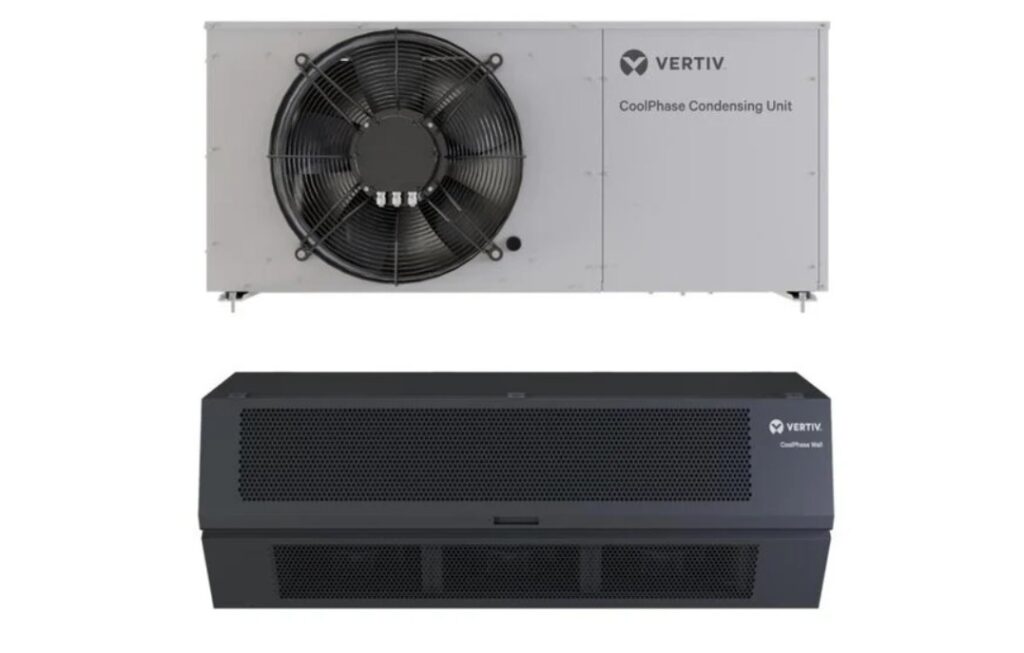
DUBAI, UAE, 31 March 2026: Vertiv announced the launch of the Vertiv CoolPhase Wall, which the company described as a space-saving wall-mounted cooling system designed for small IT spaces and edge environments. Making the announcement through a Press Release, Vertiv said the system is designed specifically for the needs of IT equipment, removing heat and enabling continuous operation while taking up zero floor space. The company added that the Vertiv CoolPhase Wall is available across Europe, the Middle East and Africa.

Vertiv said that as distributed computing becomes more critical to business operations, compact IT environments require high-quality thermal control designed for sensitive electronic systems. However, Vertiv said many facilities still rely on comfort cooling systems designed for human comfort rather than addressing the high sensible heat ratio (SHR) and higher airflow requirements of IT equipment. Vertiv added that the Vertiv CoolPhase Wall addresses this gap with a system that provides the required SHR along with integrated monitoring and control capabilities to protect equipment and enable 24/7 operational continuity.

Vertiv CoolPhase Wall

Vertiv said the Vertiv CoolPhase Wall features a split system with an indoor wall-mounted cooling unit designed to offer installation flexibility. Vertiv added that the system delivers up to 60% greater airflow than standard comfort cooling systems and leverages variable-speed compressors and fans to modulate according to heat load demand and improve energy efficiency, contributing to operational cost reductions.

Vertiv said the Vertiv CoolPhase Wall is designed to handle thermal loads of up to 11 kW and is engineered to operate reliably in outdoor ambient temperatures ranging from -35 degrees C to 48 degrees C. Vertiv added that the system features Vertiv Liebert iCOM operational control, which enables local configuration and supervision of key operating parameters. Vertiv further said the Vertiv CoolPhase Wall includes onboard remote communication capability to provide real-time alerts and operational status through a secure web interface.

Vertiv said the Vertiv CoolPhase Wall utilises R-32 refrigerant, which the company described as a low-global warming potential (GWP) alternative that reduces environmental impact while maintaining thermal performance. Vertiv said this positions the company ahead of evolving regulatory requirements, including the European Union’s F-Gas regulations that restrict the use of high-GWP refrigerants. Vertiv added that while many comfort cooling systems are still transitioning to lower-GWP options, the company is applying these standards to IT-focused cooling to support alignment with future environmental expectations.

Sam Bainborough, Vice President, EMEA Thermal Business, Vertiv, said: “As IT continues to expand into areas that were not originally intended for high-density electronics, the demand for adaptable and energy-efficient cooling solutions is increasing across EMEA. The Vertiv CoolPhase Wall is engineered to support continuous operations, enabling customers to maintain reliable, efficient thermal performance in small IT rooms and edge sites year-round.”

The company said the Vertiv CoolPhase Wall expands its thermal management portfolio, which includes precision cooling systems for edge deployments, enterprise data centres and high-density AI environments. Vertiv added that the portfolio ranges from room-based cooling to direct-to-chip liquid cooling and rear door heat exchangers.

Premium Story

The Abu Dhabi Department of Energy expands Solar Energy Self-Supply Policy to residential sector

Authority says second phase enables villa owners and residential buildings to generate and store electricity through rooftop solar systems

ABU DHABI, UAE, 31 March 2026: The Abu Dhabi Department of Energy said it has launched the second phase of its Solar Energy Self-Supply Policy, expanding its scope to include the residential sector for the first time in Abu Dhabi. Making the announcement through a Press Release, the authority said the policy covers villa owners and residential buildings, where applicable, enabling them to generate and store electricity from rooftop solar systems and integrate its usage efficiently with the grid.

The Abu Dhabi Department of Energy said the initiative forms part of its mandate to develop policies and regulatory frameworks that advance the transition towards a more efficient and sustainable energy system, while promoting the adoption of smart and flexible solutions for energy production and consumption. The authority added that the initiative builds on the success of the policy’s first phase, which was launched during the World Government Summit in February and enabled owners of farms, rest houses and ranches to benefit from solar energy solutions for self-generation and storage of electricity, improving consumption efficiency.

The Abu Dhabi Department of Energy said the expansion reflects the growing uptake of renewable energy solutions among customers and aligns with national objectives to meet increasing demand for energy through advanced solutions serving all sectors. The authority added that the new phase focuses on facilitating adoption through a simplified regulatory framework that streamlines installation and grid connection procedures alongside the standardisation of technical requirements to ensure high levels of safety and operational efficiency.

The Abu Dhabi Department of Energy said that, in line with the first phase of the policy, it has issued a policy on the procurement of efficient consumption appliances, providing a practical framework to support individuals and entities in purchasing and operating the most efficient solutions based on actual performance data and total lifecycle cost. The authority added that the policy covers key systems that impact consumption efficiency, including air conditioning and cooling, water heating, lighting and electrical appliances as well as pumps, motors and irrigation systems. The authority further said the policy highlights best operational practices, smart control solutions and regular maintenance, contributing to reduced energy and water consumption, lower peak loads and enhanced economic and environmental efficiency.

The Abu Dhabi Department of Energy said the second phase of the policy enables customers to meet a significant share of their daily energy consumption during daylight hours and allows them to store electricity through battery storage systems. The authority added that this reduces pressure on the grid and improves electricity load management across the emirate.

H.E. Abdulaziz Mohammed Al Obaidli, Director General, Regulatory Affairs, Abu Dhabi Department of Energy, said: “The second phase of the Solar Energy Self-Supply Policy represents a significant step in advancing the policy’s implementation, integrating the residential sector to enhance energy consumption efficiency and support the integration of the power system. We are strengthening partnerships in the transition towards clean energy, contributing to a more balanced and sustainable energy mix by empowering a broader segment of society.”

The Abu Dhabi Department of Energy said the policy reflects its commitment to accelerating the adoption of advanced energy solutions, supporting system efficiency and contributing to the emirate’s Energy and Water Efficiency Strategy 2030 targets. The authority added that the policy embodies an integrated approach combining regulatory frameworks, technical solutions and behavioural measures to enhance efficiency at both the consumer and system levels.

Premium Story

Eurovent releases Environmental Product Declarations guide for air filters

Guide provides recommendations to support consistent development and interpretation of environmental product declarations for air filtration products

BRUSSELS, Belgium, 31 March 2026: Eurovent said it has released its latest guide on Environmental Product Declarations (EPDs) for air filters, providing practical recommendations on assessing and communicating the environmental performance of air filtration products. Making the announcement through a Press Release, Eurovent said the guide establishes a consistent approach for developing EPDs for air filters to support improved transparency and comparability across the HVAC industry.

Eurovent said the guide addresses the growing demand for reliable environmental data and helps stakeholders better understand the lifecycle impacts of filtration solutions. Eurovent added that as sustainability requirements continue to increase across the HVAC sector, the need for reliable and comparable environmental data has become essential.

Eurovent said air filters play a dual role in ensuring high indoor air quality while influencing the energy consumption of ventilation systems. Eurovent added that the new guide addresses this complexity by providing recommendations on how to develop and interpret EPDs specifically for air filters.

Eurovent said the guide supports a harmonised methodology for EPD development and promotes greater transparency of environmental performance. Eurovent added that the guide supports sustainable product selection and green building schemes and improves comparability between air filter solutions.

Eurovent said the document has been developed by its Product Group ‘Air Filters’ (PG-FIL), which brings together industry specialists and manufacturers to ensure a practical and consensus-based approach aligned with current standards and market needs.