CCME.NEWS, covering the regional and global HVACR industry with an unwavering commitment to providing in-depth news and analyses on policy, business and technology
The company outlines new reference designs for water-cooled, air-cooled and absorption chiller applications in AI factories
MILWAUKEE, Wisconsin, United States, 2 February 2026: Johnson Controls said it has launched its Reference Design Guide Series for one-gigawatt (GW) AI data centres. Making the announcement through a Press Release, the company said each guide maps the full thermal chain and provides cooling architectures tailored to different compute densities, geographies and elevations.
Johnson Controls said the series begins with a detailed blueprint for water-cooled chiller plants and added that future guides will address air-cooled and absorption chiller solutions. Johnson Controls said the guides respond to what it described as the rapid evolution of data centre infrastructure as AI increases the scale and complexity of thermal management.
Johnson Controls said the guides outline how to achieve energy and water efficiency while maintaining flexibility to scale across diverse climates and operational requirements. The company said the first guide presents a complete thermal architecture supporting both liquid and air-cooled IT loads through integrated computer room air handlers, fan coil walls, coolant distribution units and high-efficiency YORK centrifugal chillers.
Johnson Controls said the guide provides sizing guidance for 220-megawatt (MW) compute quadrants and defines temperature and operating conditions across all major facility loops, including Technology Cooling System loops supporting next-generation GPUs.
Johnson Controls said key outcomes of the design include zero water consumption through fully water-free heat rejection using dry coolers, high-temperature loop readiness for compatibility with future GPU architectures, alignment with the NVIDIA DSX reference architecture for scalable one-GW-class deployments and operational efficiency enabled by elevated condenser water temperatures, bifurcated loops and YORK high-lift chillers.
Austin Domenici, Vice President and General Manager, Johnson Controls Global Data Center Solutions, said: “AI Factories are production facilities — the places where intelligence is manufactured at an industrial scale. By supporting the NVIDIA DSX reference architecture and improving water and energy efficiency in the cooling process while maintaining high temperature-loop compatibility, our Reference Design Guide equips customers to deploy gigawatt-scale AI infrastructure that is scalable, repeatable, resilient and sustainable.”
Premium Story
Vaisala introduces Origo for data centre cooling efficiency
Company says small temperature or humidity errors can lead to significant cooling and operational losses
VANTAA, Finland, 2 February 2026: Vaisala highlighted the impact of minor temperature inaccuracies on cooling efficiency in global data centres. Making the announcement through a Press Release, Vaisala said roughly 80% of the world’s data centres still rely on air cooling and that correcting a 0.5 degrees C measurement error could avoid around USD 805 million in cooling waste annually across moderate 10 MW sites. Vaisala added that this could amount to approximately USD 8 billion in avoided waste over a decade.
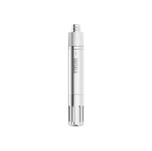
Vaisala said it introduced Origo as a next-generation modular measurement platform designed to support environmental monitoring in data centres and other mission-critical buildings.
Origo10LW
The company said a temperature sensor deviation of just 0.5 degrees C may appear insignificant but can result in more than USD 800,000 in wasted cooling energy over ten years in a 10 MW data centre. Vaisala added that in life science cleanrooms, even small inaccuracies in parameters such as temperature or relative humidity can compromise product integrity or research outcomes, with losses extending beyond energy costs.
Vaisala said there are an estimated 12,000 data centres worldwide, with the United States and Europe accounting for more than half. Vaisala added that while liquid and hybrid cooling solutions are expanding rapidly for high-density AI workloads, air cooling continues to form the universal foundation of data centre thermal management. The company further said hybrid architectures combining air cooling for space-level requirements and liquid cooling for dense loads are now standard in both new build and retrofit projects.
XMP10 Plastic
Vaisala said reliable and precise measurement is essential for optimising air-cooled environments. Anu Kätkä, Product Line Manager, HVAC and Critical Buildings, Vaisala, said: “Generic sensors with ±0.5 degrees C accuracy drive overcooling and energy waste, costing operators tens of thousands of dollars annually. Origo’s precise ±0.1 degrees C and ±1 percent RH accuracy and stable measurements reduce unnecessary cooling while ensuring the reliable environmental control that critical facilities depend on. It translates to performance that pays for itself in months and protects uptime for years to come.”
XMP10 Metal
Vaisala noted that data centres currently consume about 1.5% of global energy and that demand is expected to more than double by 2030. The company said precision sensing is essential to managing energy use and emissions while safeguarding IT performance.
Vaisala said Origo is engineered for simplicity and long-term adaptability through a modular design that supports multiple measurement parameters using compatible probes, including carbon dioxide and dew point sensors. The company added that this flexibility allows the platform to adapt to evolving requirements in environments such as cleanrooms, life science facilities and semiconductor manufacturing.
Vaisala said Origo is backed by the company’s commitment to reliability and is designed to deliver accurate measurements throughout its service life. Vaisala said field-replaceable probes enable quick on-site updates with minimal interruption and that a range of services, including accredited calibrations and technical support, is available to complement on-site expertise.
Premium Story
ASHRAE announces nominees for its 2026-2027 leadership slate
Society to release its list of officer and director nominees for member voting in May
ATLANTA, United States, 2 February 2026: ASHRAE said it has announced its nominees for the 2026-2027 slate of officers and directors. Making the announcement through a Press Release, Society said nominations were made by its Nominating Committee from a list recommended by individual members and from Chapters Regional Conferences.
ASHRAE said the nominee for President-Elect is Ashish Rakheja and that the nominee for Treasurer is Wade Conlan.
Society said the nominees for Vice President are Blake Ellis and Mahroo Eftekhari.
ASHRAE said the nominees for Directors and Regional Chairs are Carrie Kelty for Region VII, Keith Reihl for Region VIII, Daniel Russell for Region IX, Colin Laisure-Pool for Region X and Eduardo Maldonado for Region XIV.
Society said the nominees for Directors-at-Large are Martin Dieryckx, Krishnan Gowri and Filza Walters. ASHRAE added that the nominee for Alternate Director-at-Large is Doug Fick.
ASHRAE said members will vote on the nominees via electronic ballot in May. ASHRAE added that Sarah Maston will serve as ASHRAE President for the 2026-2027 Society Year.
Premium Story
Johnson Controls previews YORK YK-HT two-stage economised centrifugal chiller at AHR Expo 2026
Company says YK-HT’s capabilities translate into reductions in both water use and noise
MILWAUKEE, Wisconsin, United States, 2 February 2026: Johnson Controls announced the preview of its YORK YK-HT two-stage economised centrifugal chiller at AHR Expo 2026 in Las Vegas. Making the announcement through a Press Release, Johnson Controls said the product has been engineered for data centres and large industrial, pharmaceutical and healthcare campuses.
Johnson Controls said the YK-HT delivers what it describes as the industry’s widest operating range from a single driveline, operating with condenser leaving fluid temperatures of up to 165 degrees F (73 degrees C) and up to 110 degrees F (43 degrees C) of lift.
Johnson Controls said the expanded operating range supports closed-loop heat rejection with dry coolers and enables heat pump and heat recovery applications. The company added that, by reusing thermal energy that would otherwise be wasted, such systems can offset more than 35 MMBtu per hour, which it said is equivalent to the heating demand of approximately 350 single-family homes per hour, while lowering carbon emissions and reducing energy costs.
Aaron Lewis, Vice President and General Manager, Applied Equipment, Johnson Controls, said: “Water conservation, energy efficiency and decarbonisation are priorities for our customers. The YK‑HT expands what is possible by enabling high‑temperature operation in a compact and efficient platform, helping customers move beyond traditional water‑intensive heat rejection and unlock new opportunities for efficient electrified heating. With its expanded operating range, mission‑critical facilities can scale with confidence while advancing sustainability, performance and long‑term operating efficiency.”
Johnson Controls said the YK-HT’s capabilities translate into reductions in both water use and noise. The company stated that a typical 2,000-tonne chiller operating in Las Vegas consumes approximately eight to nine million gallons of cooling tower water annually and that, when paired with dry coolers, the YK-HT eliminates that water use entirely.
Johnson Controls added that, for large data centres, including AI factories facing water conservation constraints and strict noise limits, the YK-HT’s enhanced lift capability enables up to a 60% reduction in dry coolers and enough fan power reduction to lower onsite noise by as much as 20 dBA.
Johnson Controls said the YK-HT is positioned as a unified heating and cooling platform for large buildings, capable of producing 44 degrees F (6.6 degrees C) chilled water and 140 degrees F (60 degrees C) hot water at the same time, which it described as a normal operating condition for heat pumps, while delivering efficiency levels that it said exceed ASHRAE requirements.
Johnson Controls said this unified feature eliminates the need for cascaded systems, additional electrical infrastructure or major mechanical room redesigns. The company added that the single-driveline design reduces rotating components by 50%, which it said simplifies installation and service while improving uptime amid skilled-labour shortages.
Johnson Controls further said the YK-HT has a footprint nearly 30% smaller than most alternatives, making it suitable for existing legacy chiller spaces and helping reduce retrofit investment in cost, time and labour.
Johnson Controls listed additional features of the YK-HT as including support for low-GWP refrigerants R-1234ze and R-515B, an integrated lubrication system, dual variable geometry diffuser control, a flash tank economiser, optional variable speed drives for increased efficiency, battery energy storage system compatibility and factory-equipped Smart Ready connectivity for integration.
Johnson Controls said YK-HT chillers are tested against what it described as extreme real-world conditions at its Advanced Development and Engineering Center in New Freedom, Pennsylvania, as well as in Wuxi, China. The company added that the chillers are planned for global distribution and will be manufactured in San Antonio, Texas and Wuxi, China.
Premium Story
RAKWA signs project agreements for Ras Al Khaimah’s first large-scale wastewater PPP project
Authority says the project has an investment of approximately USD 300 million
DUBAI, UAE, 2 February 2026: The Ras Al Khaimah Wastewater Authority (RAKWA) said it has signed project agreements with the EWE-Saur-TAQA Water Solutions consortium for Ras Al Khaimah’s first large-scale wastewater Public Private Partnership (PPP) project.
Making the announcement through a Press Release, RAKWA said the project, which has an investment of approximately USD 300 million, marks a defining milestone in the Emirate’s transition towards modern, resilient and sustainable utility services. The Authority added that the initiative supports long-term population growth and economic development.
RAKWA signing project agreements with the EWE-Saur-TAQA Water Solutions consortium
RAKWA said that within the EWE-Saur-TAQA Water Solutions consortium, Saur will act as a key equity partner and lead operator and will be responsible for operations and maintenance throughout the concession period. The Authority said Saur will draw on its track record and global expertise in managing complex performance-based wastewater systems. RAKWA added that Saur will oversee lifecycle optimisation, operational resilience and compliance management. The Authority said these measures are intended to ensure that service standards are maintained through long-term operations.
RAKWA said the project is structured under a design-finance-build-own-operate-maintain-transfer (DFBOMT) model. The Authority said the project is being developed under the oversight of the Public Services Department (PSD) and that the development will deliver a fully integrated wastewater system serving Sector 6 and key growth areas of the Emirate.
RAKWA said central to the project is the design, construction and long-term operation of an Independent Sewage Treatment Plant. The Authority said the plant will be engineered to treat 60,000 m3of wastewater per day in its initial phase and that the plant will later expand to 150,000 m3 per day as demand increases. RAKWA said the project also encompasses associated gravity sewer mains, twin rising mains, pumping stations, treated sewage effluent (TSE) transmission facilities and an emergency outfall. The Authority said these components are intended to ensure system resilience, operational robustness and continuity of service.
RAKWA said the EWE-Saur-TAQA Water Solutions consortium was awarded the contract after passing the technical evaluation and that the consortium also submitted the most competitive tariff in a global procurement process. RAKWA added that interest from regional and international infrastructure developers and operators highlighted the project’s strategic significance within the UAE’s water sector.
Luis de Lope, CEO, Saur International, said: “We are truly honoured to be part of the consortium delivering the RAKWA wastewater project. It underscores our commitment to supporting Ras Al Khaimah’s infrastructure ambitions through long-term, performance-driven partnerships. The project aligns closely with our expertise in managing integrated wastewater systems where reliability, environmental performance, and compliance are fundamental.”
The Authority said environmental performance and resource efficiency are embedded across the project’s design and operational framework, which includes effluent quality standards, odour and noise control, sludge management and system resilience measures. RAKWA said the plant will operate with a low-carbon footprint powered by renewable energy and added that a core focus will be placed on enabling the reuse of treated effluent. RAKWA said this will contribute to reduced reliance on desalinated water and support Ras Al Khaimah’s circular economy and sustainability objectives.
RAKWA said that, with agreements now in place, the project will advance through financial close and detailed engineering. The Authority added that this will be followed by construction, commissioning and full-scale operations and that once completed, the project will play a role in protecting public health, preserving the environment and supporting the Emirate’s long-term economic resilience.
RAKWA said the agreement also strengthens Saur’s footprint in the Middle East by building on the company’s wastewater operations in Qatar, Saudi Arabia and the UAE.
Premium Story
LINQ Modular and SIBS form strategic collaboration to scale industrialised construction
LINQ says the partnership aims to expand modular development capacity across the region
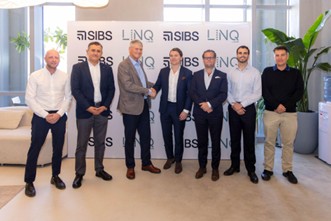
DUBAI, UAE, 2 February 2026: LINQ Modular, part of ALEC Holdings, announced that it has signed a collaboration with SIBS AB (publ) to accelerate the delivery of large-scale developments across the Middle East. Making the announcement through a Press Release, LINQ said the agreement brings together SIBS’ global manufacturing capability with LINQ’s delivery expertise and ALEC Holdings’ regional construction experience.
SIBS and LINQ
LINQ said the collaboration aims to unlock the next phase of industrialised construction in the region with a focus on delivering what the company describes as faster, more predictable and more sustainable residential and mixed-use developments at scale. LINQ said the collaboration builds on its early work in prefabricated and modular construction since 2020 and added that it has demonstrated the commercial and technical viability of modular construction for hospitality, bespoke residential and complex urban developments.
LINQ said the next phase of the collaboration expands on these foundations and is guided by a shared ambition to deliver at least 1,500 modular units per year across residential, commercial and hospitality developments, subject to project awards and client approvals, through an industrialised and repeatable delivery model. LINQ said it will continue to lead market engagement, regulatory approvals and in-country delivery and added that ALEC Holdings will support on-site execution. LINQ said SIBS will provide industrial production capacity, design-for-manufacture expertise and factory-produced quality.
LINQ said the strategy is intended to address growing demand in the region’s residential sector where speed of delivery is critical but must align with quality, safety and sustainability requirements. LINQ said a key enabler of the collaboration is the modular licence granted by Dubai Municipality to the company, which it said allows it to deliver G+6 residential and commercial buildings in the Emirate. LINQ said that, combined with SIBS’ experience in delivering large apartment complexes internationally, the collaboration is, in the company’s view, positioned to respond to market momentum as residential supply struggles to meet demand across major Gulf cities. LINQ said clients will have access to SIBS’ experience in industrialised construction and noted that SIBS has delivered approximately 7,000 apartments globally. LINQ added that, according to SIBS, its modular systems typically reduce project timelines by around 40%, production costs by up to 30% and energy consumption by up to 50% compared with traditional construction methods.
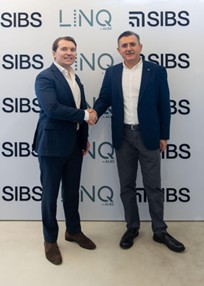
Erik Thomaeus (left)
Erik Thomaeus, CEO, SIBS, said: “This cooperation is a major step forward for modular growth in the UAE. LINQ and ALEC Holdings bring deep and proven on-site expertise across the region, while SIBS contributes industrialised production capacity and repeatable manufacturing quality. Together, we can provide clients with a faster, more predictable and scalable modular solution, from manufacturing through to project completion.”
Graham Petty, Operations Manager, LINQ, said: “This collaboration represents the natural next phase of a strategy we have been executing over several years – building market understanding, proving modular at the premium end of the sector and developing a strong pipeline of opportunities. By combining SIBS’ ability to manufacture at scale with our delivery capabilities and ALEC Holdings’ on-site expertise, we can now offer clients a full-spectrum industrialised construction solution that supports speed, certainty and long-term value.”
LINQ said the collaboration is already underway with multiple near-term project opportunities being progressed and evaluated.
Premium Story
Johnson Controls introduces Smart Ready Chillers with factory-installed connectivity
Company says Smart Ready Chillers enable digital service capabilities to meet diverse customer needs
MILWAUKEE, Wisconsin, United States, 2 February 2026: Johnson Controls announced the launch of the next generation of its Smart Ready YORK Chillers with factory-installed connectivity to harness real-time performance insights from the day of installation.
Making the announcement through a Press Release, Johnson Controls said customers using connected chillers experience faster identification of potential issues remotely, in many cases before they happen, 32% fewer unplanned service calls resulting in greater uptime and improved reliability with lower total cost of ownership.
Johnson Controls said Smart Ready Chillers empower operators to access critical data to set parameters at startup, validate performance baselines and monitor system health using fault detection and diagnostics. The company added that the connected solution streamlines commissioning while algorithms immediately begin to learn the chiller to detect even the slightest change in performance and flag potential issues as soon as possible to maximise uptime and operating efficiency.
Johnson Controls said centrifugal chillers will lead the rollout of the technology, with screw and scroll models to follow.
Tyler Smith, Vice President, Global Lifecycle Solutions, Johnson Controls, said: “Smart Ready Chillers mark a significant step forward in our commitment to being our customers’ service partner of choice by connecting all our assets from the start. Johnson Controls pioneered connecting assets in 1883 when Warren Johnson invented the first thermostat and we continue to lead the industry in leveraging connected insights to help our customers operate their buildings more effectively. Smart Ready Chillers help ensure that connectivity can be achieved on day one.”
Johnson Controls said Smart Ready Chillers enable digital service capabilities to meet diverse customer needs, adding that its standard digitally enabled services include the ability to remotely gain insights coupled with on-site support for customers seeking reliability, performance and reduced operational risks.
The company said Smart Ready Chillers provide over 200 data points immediately, far beyond what building automation systems typically offer, and deliver analytics enabled with AI to help operators identify issues early and optimise ongoing performance. Johnson Controls said even small deviations can increase energy costs over a chiller’s lifecycle.
Johnson Controls said the importance of real-time performance insights is central to the role of Smart Ready Chillers within building operations. Smith added: “Chillers are one of the most critical pieces of equipment in a building, and even small performance deviations can jeopardize uptime and drive-up lifecycle costs. Smart Ready Chillers give operators the real-time data they need to maintain peak efficiency, increase uptime, reduce operating costs and extend the life of their investment, while keeping occupants comfortable.”
Premium Story
ASHRAE recognises member achievements at 2026 Winter Conference
The Society says the recognitions celebrate individuals whose leadership and technical work have supported progress across the built environment
ATLANTA, Georgia, United States, 1 February 2026: ASHRAE said it honoured members whose leadership, innovation and service have made a lasting impact on the Society and the built environment during its 2026 Winter Conference in Las Vegas. Making the announcement through a Press Release, the Society said the recognitions highlighted the distinct ways ASHRAE members advanced building performance, sustainability and the HVACR profession worldwide.
ASHRAE said Chandra Sekhar, Fellow Life Member, ASHRAE, received the F. Paul Anderson Award. The Society said the award is its highest technical achievement given for notable achievement of outstanding services performed in the HVACR field and added that Sekhar is a professor at the National University of Singapore, College of Design and Engineering, Department of the Built Environment, Singapore.
The Society said Ron Jarnagin (1946-2024), Presidential Fellow Life Member, ASHRAE and Kenneth Loudermilk (1954-2023), Life Member, ASHRAE have been inducted into the ASHRAE Hall of Fame. ASHRAE said the ASHRAE Hall of Fame honours deceased members who have made milestone contributions to the growth of ASHRAE-related technology or the development of ASHRAE as a society.
ASHRAE said Darryl Boyce, Presidential Fellow Life Member, ASHRAE, received the ASHRAE Distinguished Public Service Award and added that the award recognises a member who has performed outstanding public service in their community and has helped improve the public image of the engineer. The Society said Boyce is the owner of Boyce Consulting Services in Kemptville, Ontario, Canada.
ASHRAE Winter Conference group photo
The Society said it has elevated 24 members to the grade of Fellow ASHRAE, which it described as a membership grade recognising members who have attained distinction and made substantial contributions in HVACR and the built environment. ASHRAE listed the new Fellows as Omar Abdelaziz, Amanda Bogner, Lianne Cockerton, Lorenzo Cremaschi, Abdel Kader Darwich, Steven J. DiFlora, Mahroo Eftekhari, Kenneth M. Fulk, Christopher Gray, Gregor P. Henze, Satish N. Iyengar, Amir Jokar, Tracey Jumper, Michael J. Langton, Phil Naughton, Alan Neely, Bruce I. Nelson, Clay Nesler, Daniel C. Pettway, Carsten Rode, Richard W. Trent, Thanos Tzempelikos, James W. VanGilder and Mack Wallace.
ASHRAE said Alekhya Kaianathbhatta received the YEA Inspirational Leader Award, noting that the award recognises a Young Engineer in ASHRAE member who has made considerable contributions to the industry and community. The Society said Kaianathbhatta is an Associate at The HIDI Group in Toronto, Ontario, Canada.
The Society said Nasser A. Karimzadeh received the Milton W. Garland Refrigeration Award and added that the award recognises the designer and owner of a commercial or industrial refrigeration application that demonstrated innovation and advancement in the field. ASHRAE said Karimzadeh is the Chief Industrial Refrigeration Engineer at VaCom Technology in Oakwood, Georgia.
ASHRAE said John Constantinide received the John F. James International Award, which the Society said recognises a member who has done the most to enhance the Society’s international presence or posture. ASHRAE said Constantinide is a Range Mechanical Engineer with the U.S. Space Force at Patrick Space Force Base in Florida.
The Society said Carey Simonson received the E.K. Campbell Award of Merit. ASHRAE said the award honours an individual for outstanding service and achievement in teaching and added that Simonson is with the Department of Mechanical Engineering at the University of Saskatchewan in Saskatoon, Saskatchewan, Canada.
ASHRAE said the Award of Engineering Excellence was presented to Kunita Shindo and Dr Shun Kawakubo in the new industrial facilities or process category for the OKI Honjo Plant H1 Factory in Saitama, Japan. The Society said the building is owned by OKI Electric Industry Co., Ltd.
ASHRAE said its Technology Awards recognises achievements by members who have applied innovative building designs. The Society said Barry Lau received an award in the EBCx commercial buildings category for Citygate Outlets in Hong Kong, owned by Swire Properties Limited. ASHRAE said Eikichi Ono, Takamasa Hasama, Toby Cheung and Yuichi Takemasa have received an award in the new commercial buildings category for The GEAR in Singapore, owned by Kajima Development.
The Society said Ben Kleine-Kracht and Jess Farber have received an award in the existing educational facilities category for Buckley Elementary School in Manchester, Connecticut, owned by the Town of Manchester. ASHRAE said Grayson Woods, Ben Hobbs and Kyle Sprague have received an award in the new educational facilities category for Benjamin Banneker Academic High School in Washington, D.C., owned by the Department of General Services.
ASHRAE said Nolan Amos and Bill Sharp received an award in the new institutional category for Centre College Champions Hall in Danville, Kentucky, owned by Centre College. The Society said Jess Farber, Ben Kleine-Kracht, Thom Anderson and Kyle Smith received an award in the EBCx health care facilities category for Boston Medical Center: Brockton Behavioral Health Center in Boston, Massachusetts, owned by Boston Medical Center.
ASHRAE said Kevin Sharples, Kurt Monteiro and Peter Kastelic received an award in the new health care facilities category for New Western Memorial Regional Hospital in Corner Brook, Newfoundland, Canada, owned by the Government of Newfoundland. The Society said Austin Boone and Brice Watson received an award in the existing public assembly category for Stead Park Recreation Center in Washington, D.C., owned by DGS.
ASHRAE said Spencer Howell, Shruti Borle, BEMP and David W. Griffin II, BEMP received an award in the new public assembly category for Salt Lake County Daybreak Library in South Jordan, Utah, owned by Salt Lake City County Facilities Management.
The Society said its Student Design Competition focused on a new medical office building in Manchester, England. ASHRAE said first place in the HVAC Design Calculations category was awarded to Ain Shams University and added that first place in the HVAC System Selection category was also awarded to the same institution. The Society said first place in the Setty Family Foundation Net Zero Energy Design category was awarded to New Jersey Institute of Technology.
ASHRAE said the Setty Family Foundation Applied Engineering Challenge focused on the development of a carbon capture and utilisation module and that the first-place student team was awarded to Simon Fraser University. The Society said the first-place student team in the Building EQ Competition was awarded to the University of Washington.
Premium Story
IEEFA report flags gaps in India’s corporate transition planning for net-zero
The Institute says India’s corporate transition plans remain fragmented, limiting the effectiveness of disclosures for investors and lenders
CLEVELAND, Ohio, United States, 30 January 2026: The Institute for Energy Economics and Financial Analysis (IEEFA) said credible corporate climate transition planning is becoming a critical requirement for mobilising capital in India, given the country requires cumulative investments of USD 10 trillion (INR 883 lakh crore) to achieve net-zero emissions by 2070. Making the announcement through a Press Release, IEEFA said transition planning in India’s corporate landscape remains fragmented and largely driven by compliance, according to its recent report.
IEEFA said the absence of dedicated transition plan disclosures within the Business Responsibility and Sustainability Reporting (BRSR) framework, combined with limited guidance on financial materiality and forward-looking metrics, has resulted in disclosures that are difficult to compare, verify or use meaningfully for investment and lending decisions.
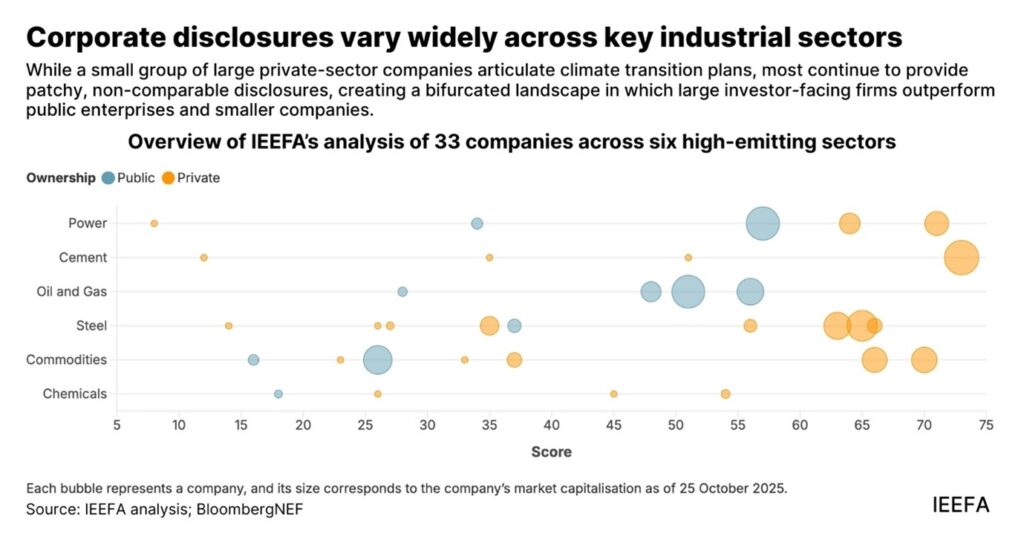
The Institute said its report examines transition planning practices across India’s corporate sector through an assessment of 33 companies operating in six high-emitting sectors, namely power, steel, cement, chemicals, commodities and oil and gas.
Overview of IEEFA’s analysis of 33 companies across six high-emitting sectors
IEEFA said its analysis identifies three systemic weaknesses in India’s current transition planning landscape. The Institute said transition ambition rarely translates into quantified, time-bound and financially integrated pathways, with limited linkage between targets, capital expenditure, revenues and risk management. IEEFA said governance structures are present in form but weak in substance. The Institute added that disclosures are fragmented and backward-looking, reducing their usefulness for capital providers.
IEEFA said the assessment found that while most companies had announced net-zero or emission reduction targets, few explained how these targets would be achieved. Shantanu Srivastava, Research Lead, Sustainable Finance and Climate Risk, South Asia, said: “Only a limited number link their goals to capital expenditure plans, revenue assumptions or changes in business strategy, making it difficult for investors and lenders to assess the feasibility of transition pathways.”
IEEFA said financial disclosures remained a major gap, with companies rarely quantifying the potential financial impacts of climate-related risks and opportunities. IEEFA added that scenario analysis, where disclosed, was qualitative and lacked transparency around assumptions, time horizons or financial implications.
IEEFA said governance disclosures further weakened the effectiveness of transition planning. The report’s co-author, Tanya Rana, Energy Analyst, IEEFA , South Asia, said: “While most companies report board- or management-level oversight of sustainability issues, few provide evidence of clear accountability, decision-making authority or incentive structures linked to transition outcomes.”
IEEFA said the sectoral review revealed significant heterogeneity in transition plan disclosure maturity across India’s key emitting industries. IEEFA said a consistent pattern emerged in which a handful of large, listed or globally exposed companies demonstrated relatively advanced practices, while the majority remained at an early stage of transition planning.
Srivastava added, “Disclosures are strongest on high-level ambition statements, and weakest on lever-level quantification, financial integration and Scope 3 coverage.”
IEEFA said governance structures were often in place but that operational embedding, capacity building and climate-linked remuneration remained limited. IEEFA said engagement on workforce and community transition continued to be framed as Corporate Social Responsibility rather than Just Transition and that external assurance practices varied widely by firm size.
The Institute said the report outlined targeted recommendations to strengthen corporate transition planning and improve the decision-usefulness of disclosures in India.
IEEFA said that at the corporate level, the report recommends companies move beyond high-ambition statements and develop transition plans that clearly link emissions targets to capital expenditure, operational changes, financing needs and risk management processes. The Institute said this includes improving the use of scenario analysis, strengthening internal data systems and embedding transition planning within core business strategy.
IEEFA said that for regulators, the report recommends SEBI explicitly integrate transition planning expectations within the BRSR framework, including clearer guidance on forward-looking metrics, financial materiality and the linkage between climate targets and business strategy.
Rana said, “Strengthening corporate transition planning and disclosure practices will require coordinated action by regulators and corporates.” IEEFA said Indian corporates should invest in internal capacity building, scenario analysis, data systems and governance structures.
IEEFA said regulatory coherence will also be key, adding that alignment with the Reserve Bank of India’s proposed climate risk disclosure framework, sectoral decarbonisation roadmaps and the Bureau of Energy Efficiency’s Carbon Credit Trading Scheme could help ensure that corporate transition planning becomes part of a unified ecosystem driving India’s low-carbon transformation.
Premium Story
Hisense marks decade at AHR Expo with updated portfolio display
Company says it will present its most advanced range yet of residential, light commercial and VRF solutions
LAS VEGAS, United States, 30 January 2026: Hisense said it will return to AHR Expo 2026 with what it described as a clear message to deliver comfort with confidence today and for the decade ahead. Making the announcement through a Press Release, Hisense said the 2026 edition marks its tenth consecutive year exhibiting at AHR, which it said reflects its commitment to the North American HVAC market and to distributors, contractors and partners.
Hisense said it will showcase what it describes as its most advanced portfolio of residential, light commercial and VRF solutions to date. The company added that these solutions are engineered for efficiency, reliability and installation flexibility across all climate zones.
Hi-COMFORT Air + Water Systems
Hisense said it continues to expand its residential and light commercial offerings with a focus on universal compatibility, high efficiency and extreme-temperature performance. The company said its Hi-PRO HD, Hi-ULTRA HD and Hi-EDGE HD systems deliver up to 20 SEER2 efficiency, low-ambient heating down to -13 degrees F (-25 degrees C) and high-temperature cooling up to 125 degrees F (51.67 degrees C). Hisense added that compact side-discharge designs, 24V controls, broad AHRI match-ups and compatibility with existing coils, furnaces and line sets are intended to simplify both new installations and retrofits without sacrificing performance.
Hisense said its ductless single-zone and multi-zone systems offer SEER2 ratings up to 32 and ultra-low-temperature heating as low as -22 degrees F (-30 degrees C). Hisense added that flexible indoor unit configurations include wall mounts, slim ducts, cassettes, consoles and air handlers. Hisense said features including FrostClean self-cleaning technology, built-in Wi-Fi, A2L refrigerant safety logic and quiet inverter operation are, according to the company, intended to support comfort while managing energy use.
HD Series Universal Ducted Systems
Hisense said its Hi-MULTI system enables whole-home comfort by connecting up to five indoor units to a single outdoor system. The company added that Hi-MULTI supports wall-mounted units, slim duct, ceiling cassette, console and air handler applications and is, according to the company, designed to perform in both extreme heat and cold. Hisense said its Hi-UNI universal 1:1 solution pairs one outdoor unit with multiple indoor unit options to simplify replacements and support fast, versatile installations.
Hisense said its Hi-PAK inverter packaged lineup brings inverter efficiency to 2–5-tonne applications. The company added that the range carries ENERGY STAR certification, compact form factors and cold-climate capability. Hisense said Hi-PAK is presented by the company as designed for ease of transport, installation and service and said it continues to gain traction as a versatile option across North American markets.
Hisense said it will also highlight its growing commercial portfolio, including VRF, air-to-water and applied solutions. The company added that its Hi-COMFORT Air + Water systems combine space conditioning and domestic hot water through heat recovery. Hisense said these systems deliver high efficiency and full heating capacity down to five degrees F (-15 degrees C) from a single outdoor unit.
Hisense said its VRF solutions support a range of applications with heat recovery, low-ambient operation, DOAS compatibility and flexible indoor unit options. Hisense added that these capabilities are intended to enable precise control and scalable performance for commercial buildings.
Hisense said it brings more than 28 years of inverter experience, nine generations of inverter technology and global production capacity exceeding 26 million HVAC units annually to the North American market. The company added that its customers benefit from what it described as warranties, contractor-focused programmes, training platforms and technical support.
Hisense said that in 2026 it will also serve as an Official Sponsor of the FIFA World Cup 2026. The company added that it considers this sponsorship as reinforcing its global presence and its stated commitment to connecting performance, innovation and trust on and off the field.