CCME.NEWS

Your source for the HVACR Industry, covering in-depth news & analyses on policy, business & technology.

Get Premium:

Sign-up

COMMERCIAL ENQUIRIES:

Frédéric Paillé
Co-Founder & Commercial Director
fred@cpi-industry.com
+971 50 714 7204

Follow Us

CCME.NEWS

CCME.NEWS, covering the regional and global HVACR industry with an unwavering commitment to providing in-depth news and analyses on policy, business and technology

Contact Info

PO Box 13700,
Dubai Media City, Dubai
admin@cpi-industry.com
+971 50 714 7204

Follow Us

Premium Story

New Intermarché Store features Epta’s Integral series refrigeration solutions

Company says with this project, Epta has been able to reaffirm its expertise in designing a refrigeration system tailored to the specific needs of the retailer and the sales area

MILAN, Italy, 28 March 2025: Epta said it has outfitted a fully integral Intermarché store on Rue Etienne Marcel, in the heart of Paris. Making the announcement through a Press Release, Epta said the achievement was made possible by the refrigerated cabinets from its Bonnet Névé brand, which it claimed is a benchmark for outstanding performance and maximum energy efficiency in proximity retail.

Epta said the new supermarket has been established within a historical post office building, following a conversion process that has preserved the essence and distinctive architecture of the site, on the bustling Rue Étienne Marcel, in the 2nd Arrondissement, just a stone’s throw from the capital’s main attractions.

According to Epta, bridging tradition and innovation, the Haussmannian architectural style provides the perfect backdrop for a dynamic urban shopping environment. The store’s cutting-edge solutions have been designed to create a smoother shopping experience for Parisians and tourists who flock to the city centre throughout the year, Epta said.

With the project, the company said, it reaffirms its expertise in designing a refrigeration system tailored to the specific needs of the retailer and the sales area. Customised cabinet layouts are, in fact, configured to optimise space and enhance product presentation, the company added.

Cécile Marty, Trade Marketing Manager, Epta, said: “Intervening in a historic[al] city-centre building not originally designated for commercial use has posed a significant challenge for Epta, which was successfully overcome thanks to the responsiveness and problem-solving expertise of a team of specialists, whose skills were recognised and appreciated by the retailer at every stage of the project. The two-level layout of the 840-square-metre sales area, the reduced ceiling height on the second floor and the absence of a machine room naturally led to the choice of relying on the extensive range of Integral series of refrigeration solutions by Bonnet Névé, which proved to be perfectly suited for this type of application, further supported by the contribution of Epta’s Energy Management division.”

The propane-based Integral series solutions, fuelled entirely by natural refrigerants, have a fully built-in refrigerated unit pre-assembled inside the cabinet, combining a modular approach and energy performance standards of remote cabinets with the ease of installation of plug-in units, Epta said.

Epta said the Bonnet Névé Integral series has taken centre stage in the store, featuring models designed to enhance the attractiveness and profitability of various departments.

Premium Story

IAPMO launches fund to advance water, plumbing and mechanical solutions

New initiative seeks to address critical public health, sustainability and infrastructure challenges

California, United States, 2 April 2025: The International Association of Plumbing and Mechanical Officials (IAPMO) has announced through a Press Release about the launch of the IAPMO Innovation and Research Fund, an initiative intended to drive research and foster solutions in plumbing, water, and mechanical systems. The organisation said the fund aims to improve public health, enhance climate resilience and contribute to housing affordability through collaborative, industry-driven innovation.

Based in Ontario, California, IAPMO said the new fund is designed to bring together industry-leading companies, academic institutions, philanthropic groups and individuals who believe that technological innovation is essential to improving the quality of life in communities.

According to IAPMO, the Innovation and Research Fund will focus on key areas such as water access, environmental safety and efficient system development. The organisation said the fund will support “cutting-edge research” in areas it has identified as priority concerns.

Key focus areas, as outlined by IAPMO, include:

  • Water + Health: Research into new methodologies that improve water quality and develop delivery methods that promote human health and safety.
  • Innovative New Systems: Investigation and promotion of efficient systems and best practices to address water scarcity and enable sustainable resource utilisation.
  • New Tools: Encouraging the increased use of accurate pipe sizing measurements to support system design and performance.

Participation in the fund, the organisation noted, extends beyond financial support. “Contributors will play a pivotal role in shaping the future of the plumbing and mechanical industries,” IAPMO said, adding that the research aims to generate expert-reviewed data that can inform legislation and regulatory frameworks relating to water and sanitation.

“The research it fuels promises to be a game-changer for innovators,” the organisation added, citing the potential for long-term impacts on infrastructure safety, affordability, and
sustainability.

Premium Story

Eurovent announces Julien Grilliat as Chairperson of PG-FANS

Association says Grilliat will be supported by the newly elected Vice-Chairperson, Simon Engert

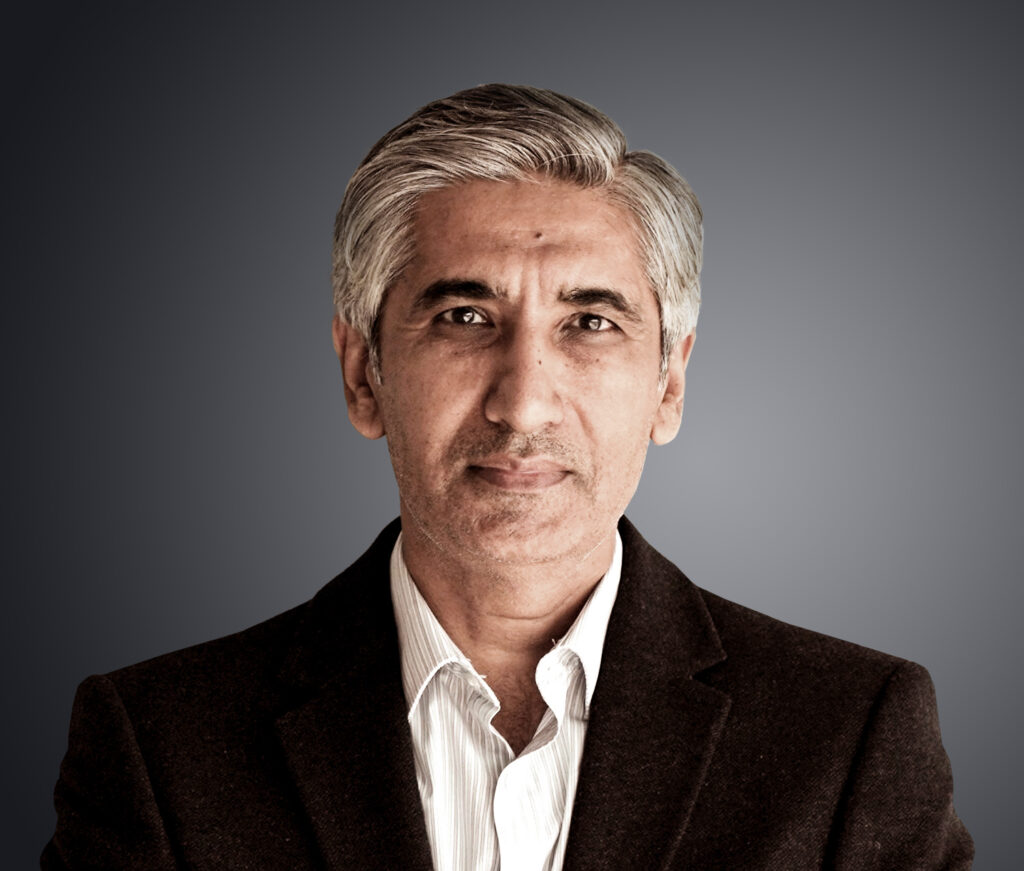
BRUSSELS, Belgium, 1 April 2025: Eurovent said the Eurovent Product Group ‘Fan Technology’ (PG-FANS) participants have elected Julien Grilliat as the new group Chairperson. Eurovent said he will be supported by the newly elected Vice-Chairperson, Simon Engert. Making the announcement through a Press Release, Eurovent said Grilliat succeeds Uwe Sigloch to the role, and congratulated the former Chairperson’s contributions to the HVAC industry and wished him well in the next chapter of his life.

According to Eurovent, Grilliat is Director of Regulatory Affairs, Global Product Management at ebm-papst. He brings years of industry experience and technical knowledge, Eurovent said. He has been a key player in the fan technology sector and has demonstrated a deep understanding of the challenges and opportunities facing the industry, the association added.

Engert is Public Affairs and Associations – Product Unit Ventilation at Ziehl-Abegg, Eurovent said, adding that he brings a wealth of experience and a strategic vision for advancing the interests of the fan technology community. He has shown remarkable leadership and innovation throughout his career, Eurovent said. The new appointments, Eurovent said, are a testament to their expertise, leadership, and commitment to driving forward innovation and standards in the fan technology industry.

Grilliat said: “Following Uwe Sigloch’s footsteps, I gratefully accept this challenge and warmly thank Vice-Chair, Simon Engert for helping alongside me. While the present context rather exhibits isolationism and competition, I do believe cooperation is needed more than ever for our industry to successfully find common solutions to common problems. Following this conviction, I will work fully committed to the role our members trusted me with.”

Engert added: “I am honoured to be elected as Vice-Chairperson of the Eurovent PG-FANS. With my passion for the industry and commitment to its advancement, I will support the group and Chairperson Julien in facing the upcoming challenges for

the fan industry. The new ErP-Regulation for fans has been published, implementation is underway and the next revision is just a blink of an eye away. I am dedicated to ensuring the PG-FANS is well-prepared for these challenging times.”

Premium Story

The refrigerant transition in the region has begun

Markus Lattner, Managing Director, Eurovent Middle East, outlines current developments and the implications of the refrigerant transition for various stakeholders in the industry

The refrigerant transition has been looming over the industry in the region for several years. It is only now that the fog has begun to lighten, with specific implications taking shape.

In a significant development, Bahrain, Kuwait, Oman and the UAE, aside from Jordan, Lebanon and Syria, have ratified the Kigali Amendment to the Montreal Protocol. The remaining countries in the region will have to follow suit shortly. The Kigali Amendment is a legally binding agreement, designed to create rights and obligations in international law; and thus, it is not a question of ‘if’ but in what way the phase down of fluorinated refrigerants will take place.

The UAE has recently published a Climate Law (Federal Decree Law 11/2024), which will be effective from May 30, 2025, and which commands “using alternatives to saturated fluorocarbons”. The transition, thus, has become mandatory, and it is crucial for all stakeholders to fully understand implications on their future operations. In addition to regulatory developments within the region, it is helpful to consider the global situation.

With China, India, Japan, Korea, Turkey, the European Union and the United States of America, every key production hub for air conditioning equipment has already ratified the Kigali Amendment and implemented specific steps to phase down HFCs, resulting in a strong surge of A2L and natural refrigerants. The European Union has even imposed restrictions on the export of equipment with refrigerants not complying with its rigid GWP limits from 2027 onwards. The global trend will significantly reduce the availability of products based on HFCs with higher GWP in the years to come.

From a technical point of view, the transition towards mildly flammable and natural refrigerants is possible and is being exercised already in many countries. Even with the higher ambient temperatures in the Middle East, such a transition can be made, provided basic safety standards are followed. However, this is currently the biggest bottleneck for the region: The technology is ready, the people aren’t.

With higher risks associated with A2L and A3 refrigerants, the education, training and qualification of personnel – starting from design engineers to service technicians – constitute a key factor, one that is notoriously missing among the workforce in the region. But the situation also presents a unique opportunity. The industry estimates that between 50% and 70% of the refrigerants placed in the market are either leaked or intentionally vented into the atmosphere.

This is not only a blatant waste of resources, but it also hugely inflates the region’s carbon emissions and, at the same time, causes air conditioning equipment to run in overdrive to compensate lost refrigerant loads, in itself resulting in higher energy bills and a faster degradation of HVACR systems. Minimising leakages and putting an end to venting thus harbours some significant saving opportunities. Not only will countries’ carbon emissions reduce substantially, freeing up precious carbon credits, but they will also reduce operational costs drastically in them, if HVACR systems are installed and maintained with better skills.

The reasons for leakages and venting

The underlying cause for the high leakage rates and venting of refrigerants is availability and low price. No one in the industry is yet encouraged to put more care in the handling of such gases. However, this availability will be reduced once the phase down commences, and prices will hike accordingly. This will also support the introduction of reclamation facilities to avoid the loss of refrigerants; such facilities will be of high demand for servicing existing installations.

Leakages also occur owing to untrained, unskilled workers. Refrigerants escape during brazing and installation processes. Further, the absence of protocols for leak detection and commissioning also lead to leakages. With rising prices for refrigerants, the aforementioned reasons will surely come under more scrutiny, but we must also ensure that we intervene with certain requirements ahead of time, as handling alternatives requires strict adherence to quality and safety standards. It is time now to start upskilling the workforce and to ready the business for the future.

Aspects of time

The timeline will be a relevant factor. The transition will happen gradually over a long period of time. The first step is scheduled for 2032, with a 10% reduction of HFCs allowed into the market. This provides the industry enough time to adjust and prepare. But stakeholders must be aware that it is also easy to run out of time if they ignore the facts. Waiting until 2032 to begin preparations will no doubt put businesses in dire straits. The truth of the matter, though, is that so far, the industry in the region is acting more reactively than proactively.

There are great business opportunities for those who understand what is about to happen and act accordingly in time, building up expertise and becoming leaders rather than followers. There is a noticeable increase in projects requesting alternative refrigerants already, as international consultancies and larger corporations seek to

reduce the carbon footprint of their projects. The need for specialised engineers and technicians is already on the rise.

The timeline provides ample room for government, industry and service providers to get ready. However, when taking into account how long certain measures will take to become effective, from developing the regulatory framework to qualifying the workforce, it is clear that everyone must start acting now. We are somewhat in a stalemate currently, where the industry is waiting for the government to impose, and where the government is waiting for guidance from the industry.

As industry association, we are always confronted with the question what happens next. Looking into the future and shaping it with recommendations and other initiatives is at the core of our mission. Together with our members, Eurovent Middle East is at the centre of the discussion and engaged with the region’s policy makers as well as with the United Nations Environment Programme to provide guidance to all stakeholders from the perspective of manufacturers and service providers.

The industry’s main concern is to pre-emptively reduce any pressure on the timeline with voluntary action, but it is also requesting governments to implement stepping stones, which will help in getting the whole process on the way. As there will never be a one-size-fits-all solution, the transition should already start, where it is relatively easy to do so. The more we shift the market away from HFCs ahead in time, the less pressure on timeline and quantities we will experience. Also, this will allow for a steady build-up of experience and knowledge.

With transition to A2L and A3 refrigerants, adherence to safety standards will be crucial. Therefore, governments are advised to include relevant international standards, like IEC 60335-2-40, IEC 60335-2-89 and EN 378 in all relevant regulations, especially product-related technical regulations and building codes.

We need to assess existing regulations for the lack of safety standards or prohibitive passages, which would exclude new technology for unjustified reasons.

Industry and government need to initiate an education and training campaign to upskill the workforce – including architects, engineers and service technicians – and qualify people to work with new refrigerants. Here, the timeline is crucial again, as it will take time to build up the necessary resources to train and qualify enough personnel for new refrigerants. But it is successfully being done elsewhere, and there should be no discussion that this can’t be done in the region. There is no other option, and it must commence immediately.

The need for a region-wide qualification and certification system for technicians is obvious. This can only be achieved with a harmonised approach by all members of the GCC region. Differing timelines, GWP limits, and declaration and certification requirements will stall the transition with dire consequences for businesses and the

whole industry. It also would put safety at risk, if we were confronted with varying or conflicting safety protocols across borders. Harmonisation of the transition throughout the GCC region, therefore, is a great concern to our members.

Eurovent Middle East has introduced its HVACR Leadership Academy to provide certified technical trainings for F-Gases and Alternatives as a first solution to the pending upskilling requirement and to create an ecosystem for education and training. Eurovent has also started to build up local trainers and assessors to slowly expand resources and the availability of trainings. The training programme is designed to serve as a blueprint for qualification requirements for governments and should provide a strong argument for harmonisation.

The refrigerant transition will bring about big changes, but it also provides great business opportunities for those who get on the train early and harbours an extensive energy-saving potential. The time to start the journey is now. We encourage all stakeholders to join our efforts as an association and stay ahead of developments. Details on our HVACR Leadership Academy can be found at our website www.eurovent.me. All businesses who want to prepare for the coming changes and build up the required competences, are encouraged to make use of our certified training courses.

Premium Story

World Filtration Institute’s online course scheduled for April 8

Web course to cover key industry topics on air filtration

TORONTO, Canada, 30 March 2025: The World Filtration Institute (WFI) has announced an upcoming online course, titled Air Filtration: Fundamentals, Applications, Innovations, and Future Trends, scheduled for Tuesday, April 8, from 8am to 10am, EDT. The session will be available live as well as a recorded resource.

According to WFI, Dr Iyad Al-Attar, Strategic Director, WFI, Canada, will serve as the instructor, leading an expert panel, comprising:

· Dr Marc Schmidt, Vice President of Technologies Europe at AAF International, Germany

· Nick Agopian, President of Reviveaire, USA

· Satish Dinakaran, Senior Principal at AprilAire, USA

· Dr R Vijayakumar, Founder of AERFIL, USA

· Dr. Christine Sun, President of WFI, USA

According to WFI, the course aims to provide industry professionals with a comprehensive understanding of air filtration science, covering fundamental principles, application-specific considerations, industry challenges and emerging innovations.

WFI said the course will cover basic filtration principles, including historical perspectives, particle collection mechanisms, filter performance characteristics and selection criteria based on application sensitivities. Maintenance strategies and the impact of particle loading on system performance, WFI said, will also be discussed.

According to WFI, the course will explore filtration requirements in various settings, including HVAC systems in commercial and residential buildings, healthcare facilities, pharmaceutical manufacturing, transportation systems and microelectronics production. WFI said it will also touch on air quality management in power generation, food and beverage processing and personal protection.

WFI highlighted several industry challenges, including pre-clogging, leakage, filter failures and compliance with regulatory standards. The course, WFI said, will address additional

considerations, such as climate-related impacts, energy consumption management and public awareness.

WFI said advancements in filtration technology, including smart filters, sensor integration and AI-driven monitoring, will be key discussion points. Sustainable materials, energy-efficient designs and trends in reusable filtration solutions will also be addressed, it added.

According to WFI, the course will conclude with a panel discussion, offering insights from industry experts and an interactive Q&A session for participants.

Premium Story

Ziehl-Abegg reports revenue decline in 2024, anticipates growth in 2025

Company says investments and market shifts require cost discipline

KUNZELSAU, Germany, 28 March 2025: The year 2024 for German manufacturer, Ziehl-Abegg posed major challenges, but the company said the outlook is bright. By the end of the year, the company said, it recorded a noticeable uptick in incoming orders.

Making the announcement through a Press Release, the company said a key driver behind the momentum is the construction of new data centres – most notably in the United States but also in Asia. The positive development is also reflected in staffing: Since the start of the year, more than 200 temporary workers have been added in Germany alone, the company said.

Ziehl-Abegg reported revenues of EUR 893 million (USD 965 million) for 2024, a drop of roughly seven per cent compared to the previous year, EUR 955 million in 2023 (USD 1 billion). Ziehl-Abegg said the downturn was particularly pronounced in Germany, where revenues declined by over 20%. Other European markets also fell short of expectations, the company said. In contrast, business in the Americas (North and South America) saw strong growth, and Asia posted a modest increase, the company added.

Joachim Ley, CEO, Ziehl-Abegg, said, “Growth in the Americas and Asia, unfortunately, wasn’t enough to offset the downturn in Europe.”

Ziehl-Abegg said the air technology division once again generated the lion’s share of revenue (90%), while drive technology contributed 10%. Despite market headwinds, there were no layoffs; reduced capacity was managed through temporary staffing and short-time work, the company said. In total, the company’s headcount increased from 5,000 to 5,300 employees, Ziehl-Abegg said. This growth occurred outside Germany, while staffing levels at the company’s three German locations remained steady at 2,800, the company added.

In addition to shifting market dynamics, Ziehl-Abegg said, 2024 was also marked by major investments. In August, Ziehl-Abegg said, it opened a new plant in the United States – the largest single investment in company history at EUR 100 million. Earlier in the year, a new production facility began operations in Vietnam, Ziehl-Abegg said.

And in late 2023, the company said, it completed another plant in Poland, initially intended to meet growing demand for heat pump fans – a boom that has yet to materialise. Ley said, “Long transport routes drive up costs and make little sense ecologically.” These investments underscore Ziehl-Abegg’s long-term growth strategy, but they also call for strict cost discipline – despite strong order books, the company said.

Ziehl-Abegg said the demand for energy-efficient solutions in data centres is booming and that operators in the United States and Asia are increasingly turning to Ziehl-Abegg’s high-performance fans to boost energy efficiency in their facilities. Ziehl-Abegg said this trend is fuelling optimism for 2025.

As is tradition, Ziehl-Abegg said, it does not publish profit figures – but one thing is clear: 2024 was economically unsatisfactory. That makes the strong start to 2025 all the more important. Ley said, “The company is globally positioned for growth – we’ve done our homework.”

[Editor’s Note: Currency conversions in the article are as per March 28 2025]

Premium Story

Ziehl-Abegg Enters 2025 with Tailwind

Revenue Decline in 2024 – Investments Require Continued Cost Discipline

The year 2024 posed major challenges, but the outlook is bright: By the end of the year, Ziehl-Abegg recorded a noticeable uptick in incoming orders. A key driver behind this momentum is the construction of new data centers – most notably in the U.S., but also in Asia. This positive development is also reflected in staffing: Since the start of the year, more than 200 temporary workers have been added in Germany alone.

Ziehl-Abegg reported revenues of €893 million for 2024, a drop of roughly 7 percent compared to the previous year (€955 million in 2023). The downturn was particularly pronounced in Germany, where revenues declined by over 20 percent. Other European markets also fell short of expectations. In contrast, business in the Americas (North and South America) saw strong growth, and Asia posted a modest increase. “Growth in the Americas and Asia unfortunately wasn’t enough to offset the downturn in Europe,” says CEO Joachim Ley. The air technology division once again generated the lion’s share of revenue (90 percent), while drive technology contributed 10 percent.

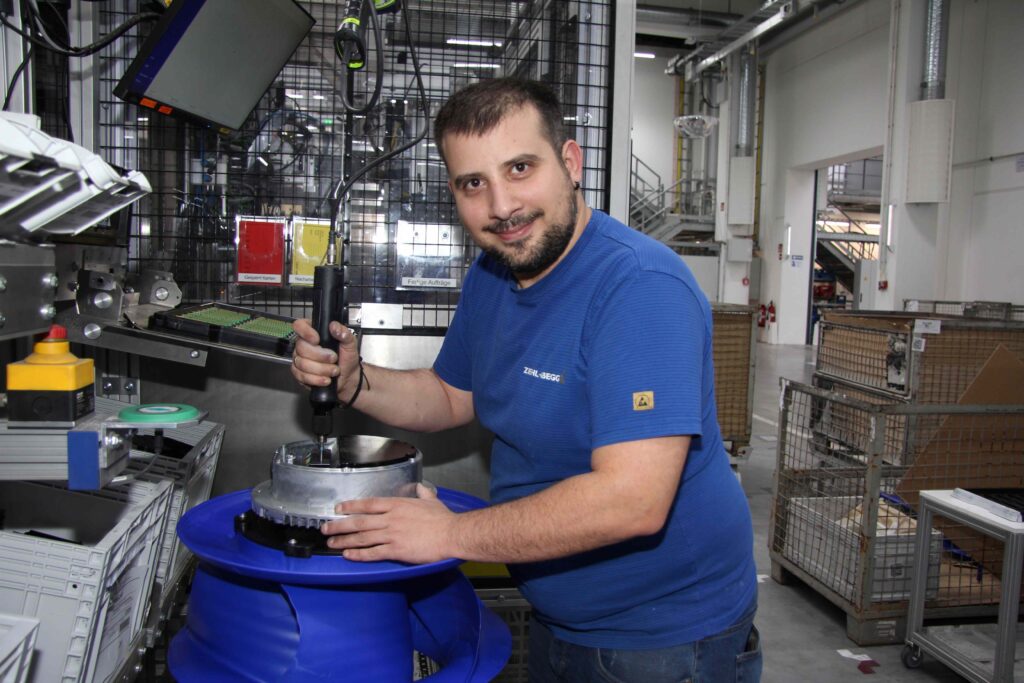
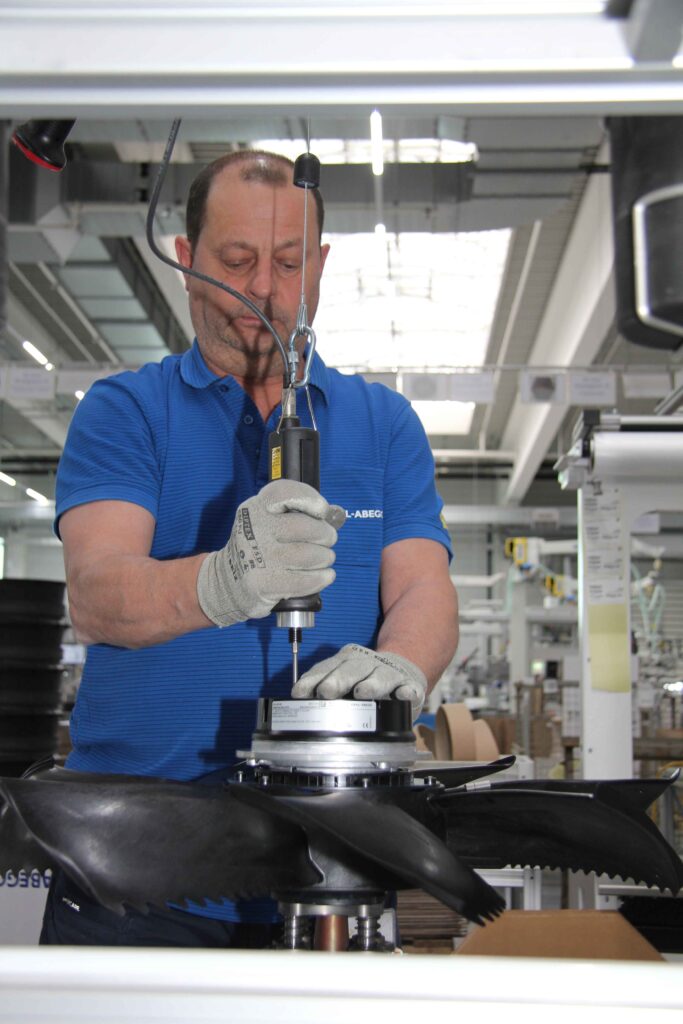
Ilias Fotiadis is assembling an axial fan at Ziehl-Abegg in Kupferzell; this type of fan is used in data centers.

Despite market headwinds, Ziehl-Abegg stayed committed to its long-term strategy of developing and manufacturing locally. There were no layoffs; reduced capacity was managed through temporary staffing and short-time work. In total, the company’s headcount increased from 5,000 to 5,300 employees. This growth occurred outside Germany, while staffing levels at the company’s three German locations remained steady at 2,800.

Investing in the Future – With an Eye on Costs

Sandor Genye is fastening the cover of a centrifugal fan at the Kupferzell plant; this type of fan may later be used in cooling units.

In addition to shifting market dynamics, 2024 was also marked by major investments. In August, Ziehl-Abegg opened a new plant in the U.S. – the largest single investment in company history at €100 million. Earlier in the year, a new production facility began operations in Vietnam. Back in late 2023, another plant was completed in Poland, initially intended to meet growing demand for heat pump fans – a boom that has yet to materialize. “Long transport routes drive up costs and make little sense ecologically,” CEO Ley explains. These investments underscore Ziehl-Abegg’s long-term growth strategy, but they also call for strict cost discipline – despite strong order books.

Outlook: Growth Drivers for 2025

Demand for energy-efficient solutions in data centers is booming. Operators in the U.S. and Asia are increasingly turning to Ziehl-Abegg’s high-performance fans to boost energy efficiency in their facilities. This trend is fueling optimism for 2025.

As is tradition, Ziehl-Abegg does not publish profit figures – but one thing is clear: 2024 was economically unsatisfactory. That makes the strong start to 2025 all the more important. “The company is globally positioned for growth – we’ve done our homework,” emphasizes CEO Ley.

About Ziehl-Abegg

Ziehl-Abegg (Künzelsau, Germany) is one of the leading global companies in the field of ventilation, control and drive technology. In the 1950s, Ziehl-Abegg established the basis for modern fan drives: external rotor motors which even today are still seen as state-of-the-art worldwide. Another area of business is electric motors which provide the power, for example, for elevators, medical applications (computer tomography equipment) or deep-sea underwater vehicles.

The high-tech company has an impressive innovative capability (all figures and statements refer to the year 2024). Ziehl-Abegg employs 2,800 personnel in its production plants in southern Germany. The company has a global workforce of 5,300 spread between 17 production plants, 30 companies and 114 sales locations. The products, approx. 30,000 in all, are sold in more than 100 countries. Turnover totals 893 million euros.

Emil Ziehl founded the company in Berlin in 1910 as a manufacturer of electric motors. After World War II the company’s headquarters were relocated to southern Germany. Ziehl-Abegg SE is not a listed company but instead is family-owned.

For more information go to https://www.ziehl-abegg.com/en/

Premium Story

Stakeholders discuss multi-sector strategies for rain resilience

Policymakers; urban planners; developers; and civil, structural and MEP engineers gather to explore innovative solutions for enhancing safety of our cities by bolstering infrastructure and buildings

On April 16 2024, an unprecedented rainstorm wreaked havoc across UAE and some other parts of the GCC region, highlighting areas for improvement in urban planning, infrastructure and emergency response.

In response to this, CPI industry organised The Rain Resilience Conference on February 19 at Hamdan bin Mohammed Smart University, Dubai, convening policymakers; urban planners; developers; and civil, structural and MEP engineers developers and climate experts with the objective of discussing strategies that need to be implemented for mitigating the impact of future extreme weather events through enhanced urban planning, upgrading drainage systems and, broadly speaking, resilient infrastructure and buildings. The conference underscored the virtue of proactive rain resilience approaches across multiple sectors.

George Berbari, CEO, DC PRO Engineering, and a leading advocate of climate change mitigation, donned the role of conference chair, lending stewardship to the cause of climate adaptation. In his remarks, he highlighted the stark contrast in expenditure between climate mitigation and adaptation. While the region has invested significantly in clean energy solutions, inadequate spending on rain resilience has led to costly disaster recovery efforts, he said. Highlighting the dynamic response of Dubai, he said the city is spending between AED 30 billion and AED 70 billion in reaction to the gap in climate action. Going into granular detail of climate adaptation, he spoke of initiatives like establishing infiltration well systems, already successful in Singapore and Australia, that could significantly mitigate flood risks at a fraction of traditional infrastructure costs.

Leading the Plenary Discussion of the conference, Berbari called to the stage Samiullah Khan, Chief Sustainability Officer, Fakhruddin Properties; James Marvin, CEO, PNC Architects of Sobha Group; and Balaskandan Raghunathan, Founder & Managing Director, Capital Engineering Consultancy to discuss preparedness of developers to avert another such event as the extreme rains of April 16. Responding to the discussion, Khan, spoke of how despite extensive experience, nothing could have prepared his organisation for the unexpected rain. Despite the weather notice, the suddenness of the event was unpredictable and served as a wake-up call to take necessary actions for Fakhruddin Properties’ buildings. Raghunathan, sharing his experience on the challenges his team and he encountered on the eventful day, spoke of major cracks in the expansion joints that led to water flowing into the building. Subsequent to the rains, he said, his organisation was flooded with a high volume of inquiries for structural repairs due to settlement cracks in villas, attributing the issue to the erosion of soil due to heavy water flow. He highlighted the importance of preventive measures in new project designs to avoid similar issues in the future. One such measure, he said, was to increase the entry and exit levels of buildings. The objective is to prevent water from going into the building from the infrastructure area, he said.

Equally riveting was the discussion on stormwater management, master-planning and the role of buildings, involving Azmi S Aboulhoda, CEO, EMergy Consultancy; Aakash Dave, Design Manager, Consistent Engineering Consultants; Shankar Prathap, Capital Engineering Consultancy; A R Suresh Kumar, Vice President & Head, IOBG, Voltas Limited; and Sekhar Reddy, MAG Property Development. The participants collectively emphasised the need for better design and workmanship. Reddy spoke on the importance of above-ground pumps for protection. He recommended placing pumps above ground to avoid water damage and ensure operational reliability. Reflecting on the April 16 rains, he said, “The pump set is supposed to supply water to the town houses, but it was submerged in water.”

The participants also advocated the need for bypass systems for better reliability. They called for the implementation of bypass lines as a fail-safe means to maintaining water supply during drainage failures. Prathap additionally suggested installing siphonic drainage systems, in order to improve water flow efficiency and reduce the risk of flooding.

The panellists suggested retrofitting existing buildings, wherein they stressed the necessity of upgrading older structures with advanced drainage and waterproofing measures.

Equally important, they said, was to establish infiltration wells, which they added was a cost-effective solution for flood mitigation. Infiltration wells, they said, can absorb excess rainwater, preventing urban flooding.

Further, they proposed creating MEP rooms in basements, which they said, was a challenge, however, owing to the high costs involved, they said.

A subsequent panel discussion shifted the focus to building façades and rain resilience. The discussion addressed the impact of water infiltration through building facades. The panellists were Philip Keil, Associate Director, AESG, and Dr Khan of Fakhruddin Properties. Addressing a fundamental issue, Keil said buildings in the Middle East are watertight, not waterproof.

The two panellists identified common vulnerabilities and proposed such measures as enhanced waterproofing, including upgrading building envelopes, especially at joints and interfaces; and integrating drainage in façades. Keil additionally proposed the need for redundancies in façade design to mitigate flood risks and the importance of rerouting water quickly.

The panellists also discussed the need for using high-quality and durable materials to minimise long-term maintenance costs and structural damage through meeting safety standards. Khan additionally spoke of the importance of incorporating safety protocols to check and clean façades every six months.

An equally critical topic of discussion was the need for overcoming challenges during rainstorms and in the aftermath, with a strong focus on electrical and communication systems. The participants – Aboulhoda and Chakkingal – spoke on the need for applying thought when it came to locating generator rooms and LV rooms on the ground floors and for implementing special drainage systems to prevent water ingress. They also spoke of the need for using sensors in basement pump rooms and lift-pits to detect water levels and trigger alarms.

The panellists also discussed the need for emergency power supplies and the potential of digital twins for predictive maintenance and improved building maintenance. They spoke of the need for reliable power backup, and for ensuring that emergency generators and uninterruptible power supplies (UPS) are in place to prevent service outages.

The two panellists also spoke of the need for effective communication strategies. They stressed the need for improving coordination among municipal authorities, developers and emergency services. Aboulhoda emphasised the importance of proper communication with residents during high rainfall events to reduce panic.

Chakkingal called for the use of digital twins, emphasising their role in building management systems to monitor and analyse live data. Berbari, though, expressed scepticism about the widespread adoption of digital twins, noting the lack of clear guidelines and standards. Responding to this, Chakkingal said the potential benefits of digital twins for life cycle cost analysis and improving building efficiency cannot be diluted. “In our case, at Sobha, even the owners’ association is there with us. We mostly don’t see the initial capital cost. We look into the life cycle cost of the whole thing, where, if we have to invest something more in the capital and that is going to benefit during the operation, we’ll definitely go for it, because the fund management by the owners’ association is also by us.”

In a subsequent discussion, on basement car parks and flood mitigation, panellists – Suresh Kumar of Voltas and Marvin of PNC Architects of SOBHA – focused on the challenges and solutions for basement car parks, emphasising the need for proactive measures to prevent water infiltration.

The panellists emphasised the importance of heavy-duty pump systems and emergency drainage paths. The conversation also covered the need for regular maintenance of basements, the use of pumps with crushers, and the role of property managers in ensuring proper upkeep. The panellists recommended the need for better standardisation and knowledge-sharing among developers and authorities.

Key points the panellists discussed included avoiding basements, where possible, using grating and proper slope maintenance, and avoiding critical electrical rooms in basements.

Elaborating on the call for avoiding basements, Marvin suggested that developers reconsider the necessity of basements in high-risk flood zones and emphasised the importance of grating and proper slope maintenance in basements. “We at Sobha, are trying our best to avoid basement parking,” he said. “Typically, most developers, when they are considering basement or no basement, the cost is always a factor. Sometimes, the extent of the basement gives you more parking.”

Suresh Kumar strongly advised against placing electrical and fire safety rooms in basements due to their high vulnerability during floods. The other are of concern, he said, is the sump pump locations. “Sometimes, you don’t get the right locations for the sump pump,” he said, “so invariably, you get pushed into some corner, because, you know, every developer wants to have maximum car parking. And some pumps actually effectively occupy one or two car park locations. As far as possible, avoid locating the electrical panel, fire pump room, FCC room and fire command room in the basement. At least 100% avoid having them in the fourth basement.”

The discussion highlighted the advantages of podium-level parking as an alternative to basement parking. Marvin said: “We try to find new design, new technology, new materials. So we’re looking at materials now, asphalt that absorbs water.”

When it comes to basements, implementing powerful pumps and creating dedicated floodwater exit paths are vital solutions, Suresh Kumar said. “Some pumps are with crushers, even for stormwater, to use pressure,” he said. This is safer. And yes, they are double the price but worth the investment.”

Equally, the panellists stressed the importance of consistent inspections and maintenance routines. Marvin said: “The key, though, regardless of whether you buy a cheap one or an expensive one, is just to maintain them. Make sure that regularly you’re testing them, you’re running them, because, you know, we get rain once a year here, but if you’re not checking it till you start seeing the rain come down, it’s too late.”

The discussion concluded with a call for better regulatory frameworks and collaboration among developers and municipal authorities to create standardised flood-protection measures. Suresh Kumar highlighted the importance of knowledge sharing and the role of committees like the Khalifa Committee in Abu Dhabi.

Berbari challenged the effectiveness of the current design standards and the need for continuous evolution. The panellists responded to this point by proposing the need for third-party advisors and external engineering reviews to bring fresh ideas and improve performance.


Premium Story

Global unity on climate change may be unattainable

When it comes to climate action, the issues are not merely technological but also economic and political, says Rehan Shahid of P&T Group

Rehan Shahid

We have cultural, political, social and ideological differences and interests. An individual, or even a group of people from a developed country, cannot fully comprehend the requirements and challenges faced by developing nations, or for that matter, even by developed nations themselves. It would be akin to claiming to understand cloud formation, knowing exactly where and when it will rain, and how much rain will fall. Any such claims are likely to be inaccurate.

Developed nations industrialised using fossil fuels. Countries like Germany, the United Kingdom and the United States became wealthy by burning coal, oil and gas for over 150 years. This led to massive carbon emissions, which are the main cause of global warming today.

However, developed countries are now pressuring developing nations to use cleaner energy to protect the climate – a problem mostly caused by wealthier nations. This may be seen as a draconian measure by some to punish nations striving to improve their people’s living standards simply because they don’t align with Western principles or sustainability goals.

Emerging economies like Brazil, India and many African nations argue that they should be allowed to develop using fossil fuels, just as the West did.

Strictly following principles and advocating for them without appreciating the challenges can portray a rigid demeanour, especially when suggesting solutions that undermine the basic rights of a nation struggling to stay afloat.

So, how do we solve the indifferences when it comes to climate change as an issue?

Well, there is no one-size-fits-all solution, and the tailor-made solutions offered by organisations haven’t worked so far for various reasons even in their own countries; if that was not true, we would not be witnessing the unrest that we see even in developed nations.

One possible solution would be for each country to develop its own climate-friendly programme that aligns with its economic growth.

To achieve this, countries would need their home-grown experts and specialist who, understanding their unique challenges, can educate the population and raise awareness at the grassroots level. In turn, these countries would be rewarded with financial as well as technical assistance to accelerate their efforts.

Going back to the analogy on clouds, democracy is very much like a cloud with many politicians having different agendas, interests and goals floating about trying to serve some purpose. The biggest flaw with democracy is the tenure each wining party is allowed to lead. There just isn’t enough time to put their plans in action and realise the benefits.

The recipe for success would be to have a wise leadership framework accepted by the nation for its core values and sincerity and then trust them fully. An obvious example would be the UAE.

It would not be an exaggeration to state that the UAE seems to be relatively in control of its ambitions and growth targers and has made significant strides in aligning with sustainability goals. It is also a founding member of the International Renewable Energy Agency (IRENA).

It is true that the UAE’s reliance on oil exports still presents a challenge in fully embracing sustainability across all sectors. However, this challenge has been acknowledged, and a significant shift toward sustainability in governance and industry is in motion.

The ideal governing system should prioritise accountability, inclusivity, human rights and sustainability to adapt to the challenges of the modern world. These principles are difficult to incorporate into a sentence, let alone put them in practice in the real life.

It would not be an overstatement to say that the UAE’s model is showing promising results, though it may not be universally applicable to countries with different political systems or economic challenges. However, the model could be adapted in parts to suit the specific needs and circumstances of other nations.

There is a need for sustainable leadership to ensure a sustainable future. So far, the West has fallen short in providing such leadership. For developing countries, it may be difficult to trust Europe completely, considering the 2009 pledge of USD 100 billion by developed countries has not materialised.

Many developing nations refuse to commit to strong climate action unless they receive fair funding, and as one might appreciate, the term ‘fair funding’ is highly subjective.

Furthermore, following the Russian invasion of Ukraine, the European Union imposed sanctions on Russia, including efforts to reduce dependency on Russian fossil fuels. However, the very same EU has spent €205 billion on Russian fuel to date to keep factories and households running.

While pragmatic decisions might require balancing economic and political realities, prioritising self-interest can lead to negative consequences – morally, politically and globally – when it comes to climate change.

Premium Story

Empower approves AED 437.5 mn dividend

Figure constitutes 43.75% of the company’s paid-up capital

Dubai, UAE, 19 March 2025: The Emirates Central Cooling Systems Corporation (Empower) has approved a dividend distribution of AED 437.5 million (4.375 fils per share), constituting 43.75% of the company’s paid-up capital, for the second half of 2024. Making the announcement through a Press Release, Empower said the decision was made during its Annual General Meeting (AGM), which convened with a quorum of 89.9% of its paid-up share capital.

The AGM, chaired by H.E. Saeed Mohammed Al Tayer, Chairman of Empower’s Board of Directors, took place at the Habtoor Palace Hotel in Dubai. H.E. Ahmad Bin Shafar, CEO, Empower attended the meeting alongside members of the Board of Directors. The meeting reviewed the company’s financial performance, approved financial statements for the year ending December 31, 2024, and endorsed the auditor’s report, Empower said.

Empower, listed on the Dubai Financial Market since 2022, reported a record revenue of AED 3.26 billion and a net profit of AED 908 million for 2024. The company stated that the dividend distribution aligns with its dividend policy and overall business strategy.

The company highlighted that it had distributed AED 850 million in dividends in 2024 in two equal instalments of AED 425 million each. Following the completion of its two-year post-listing dividend commitment, shareholders approved future dividend distributions of AED 875 million annually for 2025 and 2026, to be paid in April and October each year.

H.E. Al Tayer remarked that Empower’s strategic expansions contribute to Dubai’s District Cooling sector and generate sustainable financial returns for shareholders. He stated that the company’s infrastructure, including advanced District Cooling plants and distribution networks, has been instrumental in driving growth and operational efficiency. He further noted that Empower aims to lead environmentally sustainable District Cooling solutions, aligning with Dubai’s energy efficiency strategies.

Al Tayer added that the company achieved a total turnover of AED 3.26 billion and a net profit of AED 908 million for 2024. He noted that an interim dividend of AED 425 million was distributed in October 2024, with the latest approved dividend bringing the total payout for the year to AED 862.5 million.

H.E. Bin Shafar said that Dubai’s real estate sector continues to drive growth for the company. He noted that strong demand for District Cooling services, coupled with long-term concession

agreements with key developers, has positioned Empower for stable and predictable revenue streams.

Bin Shafar added that economic expansion, tourism growth and residential development in Dubai are key factors supporting Empower’s success. He said that the company remains focused on expanding its market share in the UAE and on strengthening its investment opportunities.

He further emphasised that shareholders’ confidence has played a crucial role in driving the company’s performance. He added that Empower remains committed to executing its structured growth strategy, ensuring continued operational and financial success.

Tags: