

Rethinking the latent load
Walk into any commercial building in Dubai or Riyadh in July, and the air conditioning is doing two things at once: Pulling the temperature down, and pulling the moisture out. These are not the same problem, but conventional HVAC systems treat them as if they were. That coupling – handling humidity by brute-force cooling – is at the heart of one of the region’s most stubborn energy challenges, and it may soon be addressed by an unlikely candidate, a membrane.
The scope of the problem
Cooling systems in the UAE account for 80-85% of a building’s total energy consumption, a figure that reflects not just the extremity of the climate but also the inefficiency of how most systems operate. Across the Middle East, the HVAC market was valued at nearly USD 11 billion in 2024 and is forecast to grow over six per cent annually through 2033, driven by urbanisation, megaprojects and rising expectations for indoor comfort.
The conventional approach to dehumidification is thermodynamically wasteful. In a standard chilled-coil system, the coil must be held below the air’s dew point – often around 7-12 degrees C – to condense moisture out, far colder than what sensible cooling alone would require. The air must then be reheated to a comfortable supply temperature. Studies have estimated that condensation-based dehumidification accounts for roughly 68% of primary energy use in commercial buildings.
A different approach: Treating the loads separately
Membrane-based dehumidification takes a fundamentally different route. A vapour-selective membrane – engineered to pass water vapour while blocking dry air – extracts moisture directly from the air stream.
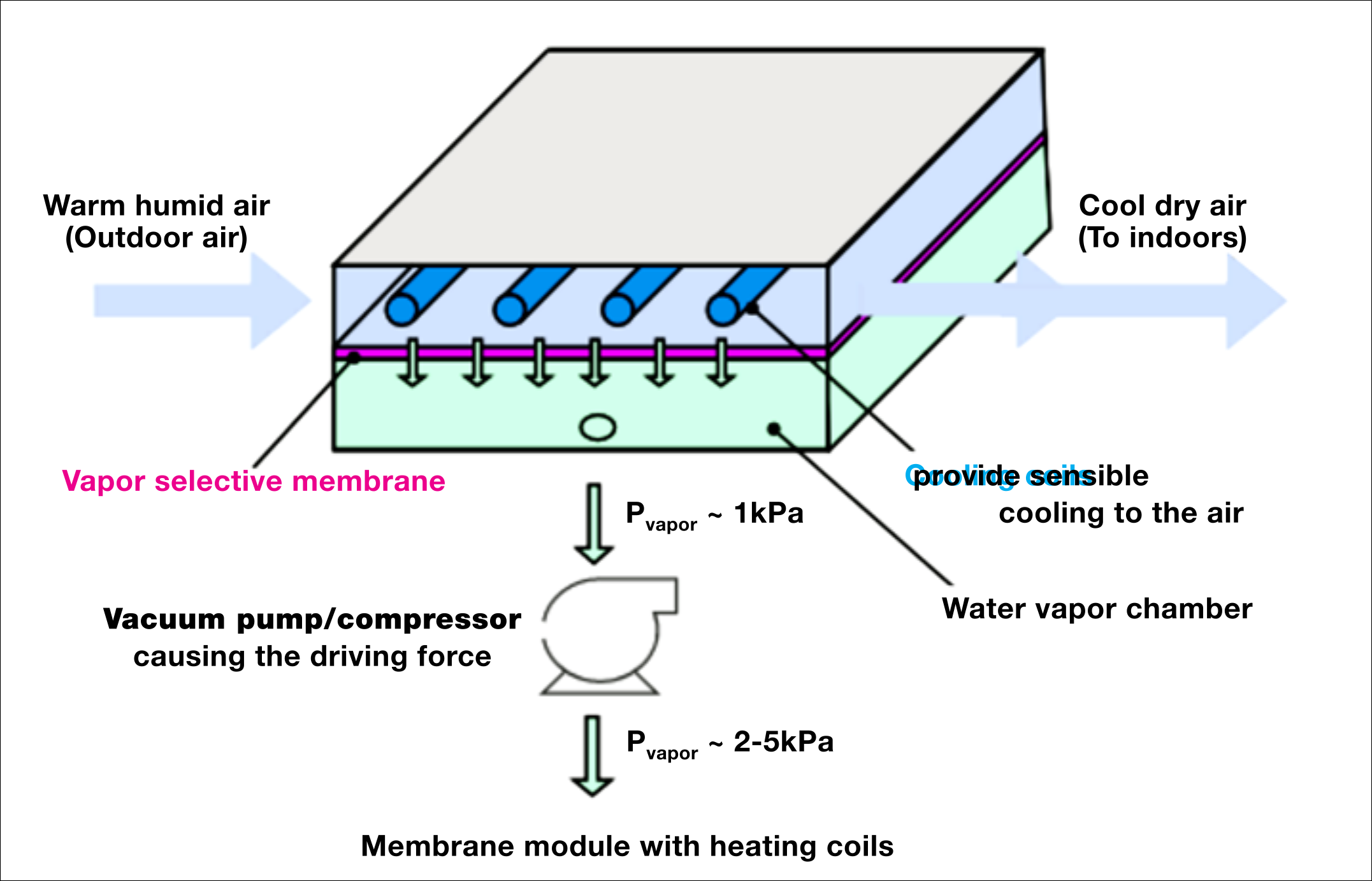
A vacuum pump on the permeate side creates the pressure differential that drives vapour across the membrane. The air is dehumidified without ever dropping below its dew point, and sensible cooling is handled separately by coils operating at higher, more efficient temperatures.
The decoupling of latent and sensible loads is the key insight. When cooling coils no longer double as dehumidifiers, they can be optimised purely for temperature control, the compressor works less hard, and the system’s coefficient of performance (COP) improves. Prior thermodynamic modelling of dual-module membrane systems has suggested COP values approximately twice those of conventional vapour-compression systems are achievable.
What the CFD analysis shows
Research published in Membranes (Chandrasekaran, Fix, and Warsinger, 2022) provides the first physics-based, component-level analysis of a novel design, called the Active Membrane Energy Exchanger (AMX) – a single unit integrating vapour-selective membranes with cooling coils. Using computational fluid dynamics (CFD), the study mapped heat transfer, mass transfer and concentration polarisation across a broad range of geometries and operating conditions. Inlet conditions of 27 degrees C and 70% relative humidity were chosen explicitly to represent warm, humid climates like those across the Gulf.
The findings offer several practically useful conclusions. An optimal channel length of 0.6-0.8 metres was identified, beyond which concentration polarisation diminishes returns. A coil-diameter-to-channel-height ratio of approximately 0.5, combined with mildly turbulent flow (Reynolds number 3,000-5,000), balances pressure drop against heat and mass transfer performance. A membrane permeance of 5,000-6,000 GPU – a range demonstrated by several commercially available materials – proved close to optimal; higher permeance yields diminishing area savings while worsening concentration polarisation. The study also confirmed that membrane area for moisture removal is roughly three times the cooling-coil surface area for sensible cooling, a useful ratio for system designers.

Implications for the region
The potential relevance of membrane dehumidification extends across several sectors important to the Middle East. In healthcare facilities, where humidity control is critical for infection prevention, a system that avoids condensate trays – a common source of microbial growth – offers real operational advantages. In pharmaceutical and food manufacturing, where humidity corridors are tightly regulated, conventional systems often require expensive reheat cycles that membrane dehumidification would eliminate. Data centres, one of the Gulf’s fastest-growing building segments, require independent control of temperature and moisture; the AMX’s decoupled approach offers exactly that.
For District Cooling networks – a technology where the region leads the world – membrane dehumidification could be integrated at the point of use, handling the latent load locally while centralised chilled water handles sensible cooling. This load disaggregation aligns well with energy efficiency targets under UAE Net Zero 2050 and Saudi Arabia’s Vision 2030.
Where things stand
Membrane dehumidification is not yet commercially deployed. Experimental validation of full-scale AMX prototypes is ongoing, and questions of long-term membrane durability, fouling under real operating conditions, and manufacturing scale-up remain to be answered. These are solvable engineering challenges rather than fundamental barriers, but they are real ones.
What the CFD work provides is a rigorous understanding of the design parameters that govern system performance, giving experimental and field-validation programmes a sound basis to build on. For an industry under sustained pressure to reduce energy intensity while expanding capacity, a technology that targets the single most wasteful step in the cooling process deserves close attention.
The latent load has long been the overlooked half of air conditioning. It may not remain overlooked for much longer.The writer is Thermal Engineer at NVIDIA. He may be contacted at <ajayc1160@gmail.com>.