Date & Time:
Oct. 12th, 2026
Location:
Riyadh, Saudi Arabia
Venue:
TBA
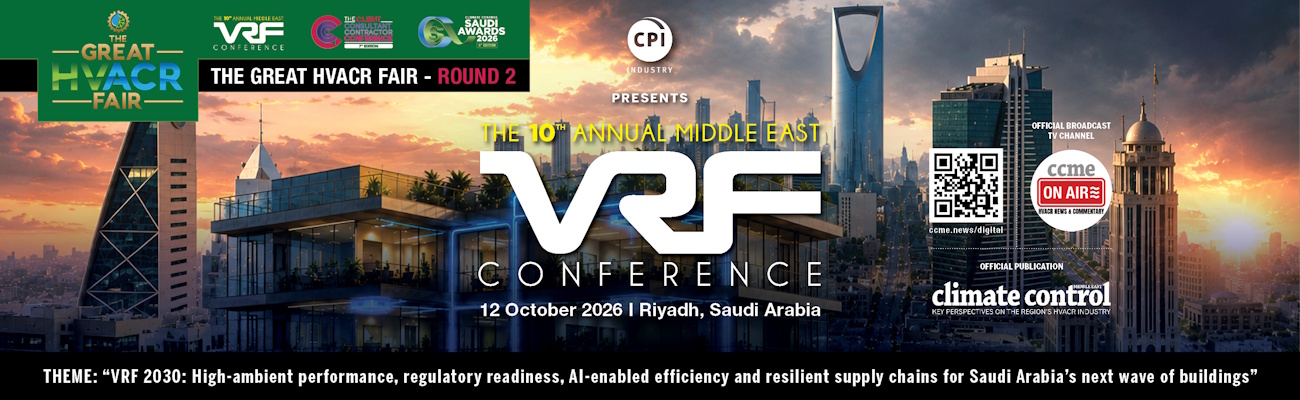
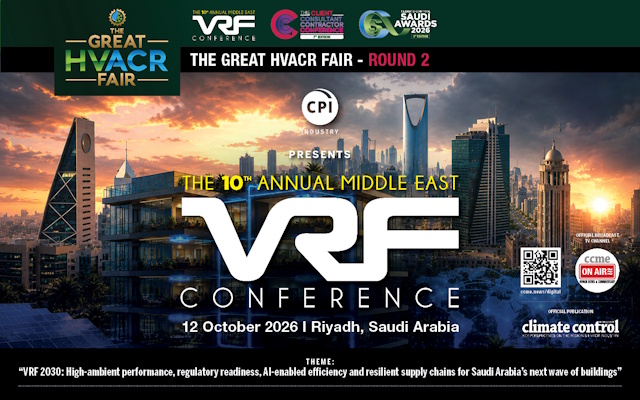
The 10th Edition of the Middle East VRF Conference is conceived as a Saudi-centric, commercially focused and technically rigorous forum for manufacturers, regulators, consultants, contractors, developers and end-users to address the next phase of VRF deployment in the Kingdom, characterised by higher performance, better installation quality, smarter controls, low-GWP-refrigerant readiness, more reliable supply chains and stronger alignment with Saudi Arabia’s energy-efficiency and climate objectives.
The 10th Edition of the Middle East Variable Refrigerant Flow Conference comes at an important moment for the HVACR industry in Saudi Arabia. The Kingdom is advancing a large and complex project pipeline across residential, hospitality, healthcare, education, retail, logistics, transport, smart-city and giga-project assets. At the same time, regulation is tightening around energy performance, refrigerant transition and product compliance; developers are reassessing first cost versus lifecycle value; and contractors are under pressure to deliver systems that perform in the field, not only in design documentation.
VRF technology is well positioned in this environment owing to its zone-level control, modulation capability, design flexibility and compatibility with increasingly digital building operation models. Yet, the next phase of market growth will not be driven by marketing claims alone; it will depend on measurable performance under high-ambient conditions, robust installation practices, brazing and commissioning competence, fit-forpurpose refrigerants, transparent performance data, after-sales support, spare-parts availability and better integration with BMS, IoT, AI and energy-management platforms.
The 2026 conference is, therefore, designed to move the discussion beyond generic advocacy. It will focus on the practical issues now shaping the VRF market in Saudi Arabia: Updated standards and MEPS, product certification, the transition to low-GWP refrigerants under the Kigali timeline, AI-driven predictive maintenance, autonomous buildings, the progress of mini-VRFs in villas and smaller commercial assets, project case studies, and the impact of regional supply-chain disruption on compressors, copper, electronics, refrigerants, components and delivery timelines.
The conference will be especially relevant to regulators and policy bodies, giga-project and PIF-backed developers, ministries, municipalities, real-estate owners, FM and O&M companies, MEP consultants and contractors, procurement heads, healthcare and hospitality engineering teams, and VRF manufacturers and suppliers looking to expand in the Kingdom.
THE conference will follow a structured format built around regulatory clarity, technical depth, commercially relevant discussion and meaningful networking. The format mirrors the established strength of previous editions while updating the agenda for 2026 priorities.
Regulation, Standards and MEPS: What the 2026 market must prepare for
This topic is aimed at providing clarity on the regulatory direction of the VRF industry in Saudi Arabia. The objective is to help manufacturers, suppliers, consultants, contractors and developers understand not only what is required for compliance but also how regulation can be used as a driver of quality, market credibility and energy savings.
VRF in the Saudi project pipeline: From giga-projects to everyday buildings:
Saudi Arabia’s VRF opportunity is not limited to iconic projects. The larger market may be in repeatable building typologies: Villas, townhouses, low- and mid-rise residential, schools, clinics, hotels, staff accommodation, retail units, malls, offices and mixed-use communities. This session suggests the repositioning of VRF technology as a solution that needs to be matched carefully to use case, lifecycle economics and operating capability.
Mini-VRFs: The untapped market for villas, small commercial assets and distributed developments.
Mini-VRFs deserve a dedicated 2026 discussion, because they could become an important part of the residential and smallcommercial cooling landscape. This topic aims to examine whether mini-VRFs can displace multiple split systems in certain applications by offering improved zoning, better aesthetics, easier serviceability and higher energy performance.
High-ambient performance: Moving from rated efficiency to real-world reliability.
The central technical challenge for VRFs in Saudi Arabia remains high-ambient performance. It is proposed that this segment should go beyond brochures and provide an opportunity to manufacturers to present measured field data, derating curves, reliability improvements and maintenance guidance specific to Saudi conditions.
Installation quality, brazing, commissioning and skills:
The critical make-or-break issue for the uptake of VRF technology A high-quality VRF system can underperform badly if the quality of installation is poor, leading to the need for emphasis on skills, because poor brazing, lack of nitrogen purging, improper evacuation, inadequate pressure testing, incorrect pipe sizing, poor insulation and incomplete commissioning can lead to refrigerant leaks, moisture contamination, compressor failures and energy waste.
and many more…

SURENDAR BALAKRISHNAN
Co-Founder & Editorial Director
CPI Industry

FRÉDÉRIC PAILLÉ
Co-Founder & Commercial Director
CPI Industry


Here's what participants, attendees and sponsors think of CPI Industry Conferences...
An interesting gathering of industry professionals with great insights
- Omnia Halawani, Co-Founder & Co-CEO, GRFN Global
Getting better every time with technology upgrades and innovative mindsets... connecting the giants in one platform
- Sathik Batcha, Sr. VP-Electrical, AG Engineering
CPI is always ahead of the curve when it comes to raising key topics that will promote fruitful discussions between various stakeholders.
- Azmi S Aboulhoda, CEO, EMergy