

IEQ and fertility

Quite simply, why isn’t air pollution research clearing the air?
The world is facing a severe health crisis caused by air pollution, which has a significant impact on human health, the environment and the economy. Scientific research links air pollution to respiratory and cardiovascular diseases, and the World Health Organization identifies it as a leading cause of premature death. Environmentally, it contributes to acid rain, ozone depletion and climate change, while economically it leads to lost productivity and healthcare costs amounting to billions of US Dollars. Equally important and overlaid with emotion is the fact that air pollution causes infertility.
Despite overwhelming evidence, air pollution is being addressed but not directly identified as a cause of infertility in the public realm. Economic barriers, such as industry resistance to regulations and fears of job losses hinder effective action. Politically, there is often insufficient support for environmental policies, while a lack of real-time air quality data hampers public awareness. The scientific community has documented the severe health effects of air pollution, including increased rates of diseases and impaired cognitive function. Air pollution impacts our health beyond respiratory and cardiovascular issues, also posing a risk to reproductive health due to poor outdoor and indoor air quality.
Given that air pollution affects human fertility, why is the topic not gaining the traction it deserves? Indeed, what are some of the challenges contributing to the slow acknowledgment of the issue?
There are four challenges, in my opinion that are preventing the topic from gaining momentum. The first reason is scientific challenges. Infertility has various genetic and lifestyle influences, making it hard to establish clear connections to specific pollutants. The second is the focus of existing research. Reproductive medicine has focused on clinical and genetic aspects, prioritising advancements in In Vitro Fertilisation (IVF) over environmental factors. The third is the competition for funding. Environmental reproductive health studies struggle for funding against more established research areas, complicating large-scale studies. And the fourth reason is awareness. Public discussions on air pollution usually revolve around immediate health issues, overlooking its potential impact on infertility. Addressing the correlation between air pollution and infertility requires interdisciplinary research, more funding and campaigns to raise awareness about the importance of clean air for reproductive health.
The impact of air pollution on human fertility can be seen as a quiet crisis. While growing scientific evidence highlights the adverse effects of airborne contaminants on our ability to conceive and raise healthy babies, there is a lack of public and political urgency to address the issue. Research on the respiratory and cardiovascular effects of air pollution has been extensive; however, the impact on fertility has received less attention. Pollutants like Particulate Matter (PM2.5), nitrogen dioxide and sulphur dioxide are increasingly linked to reduced sperm quality and count in men, as well as diminished ovarian reserve and lower IVF success rates in women.
Recent decades have seen a decline in sperm quality in industrialised countries, with air pollution suspected as a contributing factor. Research suggests that exposure to air pollutants can impact sperm motility, vitality, concentration, morphology, DNA quality and hormonal changes. The impact on female fertility ranges from Spontaneous Fertility to Hormonal Effects and to Fecundability, particularly in the case of women living in close proximity to major roads.
Could you clarify the connection between outdoor air pollution and issues related to human fertility?
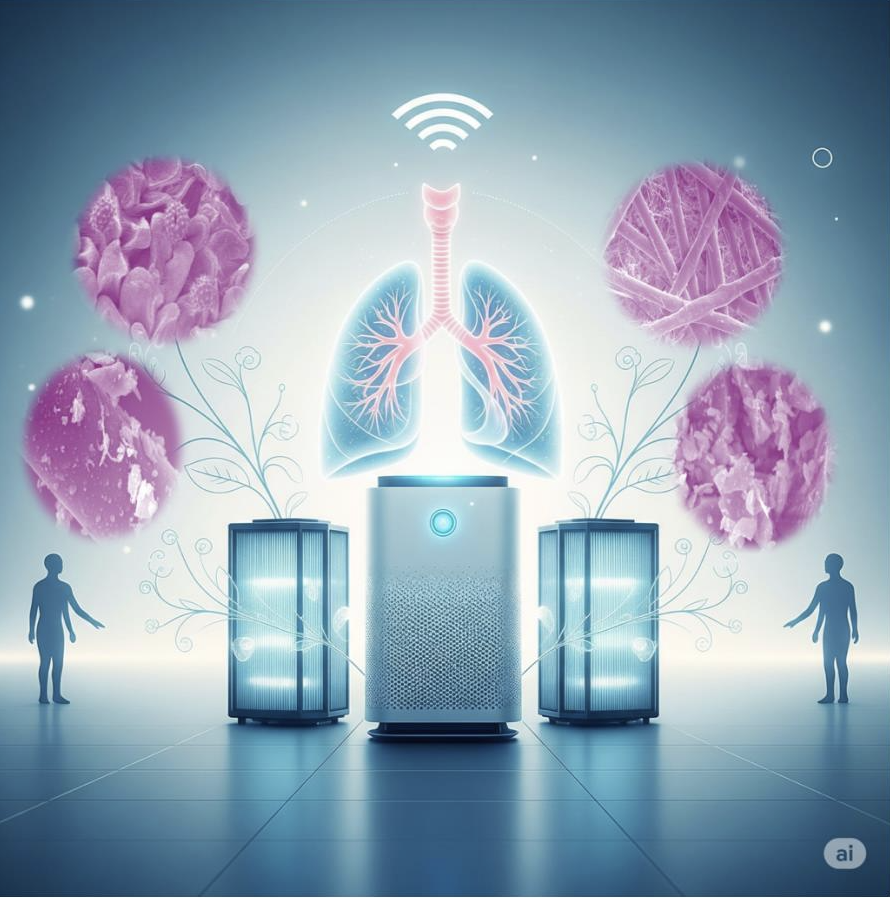
Scientific research has highlighted that exposure to air pollution can lead to decreased sperm count and motility, DNA damage, hormonal disruption and erectile dysfunction, further impeding conception. Pollutants can damage blood vessels, leading to reduced blood flow, which is necessary for an erection. Pollutants include silicate dust particles [Figure 1], Volatile Organic Compounds (VOCs), pesticides, phthalates and Heavy Metals. In essence, outdoor air pollution acts as a pervasive environmental stressor that can directly and indirectly impair various stages of human reproduction, from gamete development and quality to fertilisation and from implantation to successful pregnancy outcomes.
What can air filtration technologies do for IVF and Assisted Reproductive Technologies, or even preventatively, towards protecting the human race before conception of a baby?
The air we breathe is crucial for creating new life, especially for those undergoing IVF and Assisted Reproductive Technologies. The purity of air is increasingly being recognised as vital for reproductive success, with advanced air filtration systems acting as protectors against harmful pollutants that can impact sperm, eggs and embryos. On the IVF outcome front, a decrease in live birth rates has been associated with increased NO2 levels. Ozone exposure negatively impacts births, post-implantation. Furthermore, high PM10 concentrations during the follicular phase are linked to increased miscarriage risk. Animal studies suggest that exposure to PM2.5 affects embryo development and implantation. Pollutants such as NO2, CO, and PM2.5 are associated with increased stillbirth risks. Ultimately, research indicates that better air quality in IVF clinics leads to higher fertilisation rates, improved embryo quality and increased live birth rates.
Air filtration also benefits reproductive health at home by enhancing sperm quality and hormone balance. High-quality air purifiers can reduce exposure to toxins, supporting gamete health and healthy pregnancies. Investing in air filtration is crucial for ensuring cleaner air for future generations, particularly during pregnancy. Enhancing our understanding of filtration requires bridging the gap among fields such as building science, HVAC and filtration technologies. Filter acquisition often overlooks the physical and chemical properties of particles, as well as the importance of air filter media and the pleating process, all of which impact filter permeability, performance and circularity. A fundamental understanding of particle properties is essential for addressing challenges and for engineering air filters with optimal separation and retention capabilities.
We should emphasise the importance of a foundational framework for improving Indoor Environmental Quality (IEQ) in urban environments. Progress can be through phases.
Phase 1: Foundation – IEQ governance and IAQ monitoring Establish IEQ governance:
• Form a cross-departmental task force, develop a Municipal IEQ Code with health-based standards and mandate IAQ transparency for building owners
• Implement comprehensive IAQ monitoring: Deploy sensors to gather real-time data on indoor pollutants (PM2.5, CO2, VOCs, temperature and humidity) to identify pollution sources and track intervention effectiveness
Phase 2: Targeted action – HVAC and filtration upgrades
• Optimise HVAC systems: Ensure compliance with ventilation standards, use demand-controlled ventilation and maintain HVAC systems to avoid contamination
• Engineer air filtration requirements: Engineers must select filters based on a thorough physical and chemical characterisation of outdoor and indoor pollutants, moving beyond the simplistic approach of merely installing higher efficiency filters
• Continuous IAQ monitoring: Deploying IAQ sensors with the required spatial resolution to reveal the locations of pollution sources, enabling proper, objective and effective response to any IAQ variation and sending notification alerts for HVAC maintenance, based on monitoring data
If governance and monitoring are not the first priority, then a focus solely on technology will lead to failure as a result of wasted resources and a lack of accountability.
Can couples seeking refuge in air filtration technologies realise the dream of parenthood?
The protective power of air filtration plays a crucial role in preventative health, particularly in safeguarding fertility before conception. Pollutants that endanger embryos in labs can also affect reproductive health in individuals. For men, air pollution is linked to reduced sperm quality and increased DNA fragmentation.
For women, it can disrupt hormonal balance, adversely affect egg quality and lower ovarian reserves. Using high-quality air purifiers at home and in the workplace can help minimise exposure to harmful substances. For couples planning a family, this proactive measure can:
1) Protect gamete quality (filtered air improves sperm and egg quality)
2) Reduce inflammation (air pollution causes systemic inflammation that can harm reproductive function)
3) Support a healthy pregnancy (continued air filtration during pregnancy helps limit exposure to pollutants associated with complications like low birth weight and developmental issues)
Investing in fit-for-purpose air filtration systems promotes the health of future generations. However, challenges remain, including the difficulties in establishing universal thresholds for air contaminants due to variations in pollution sources and human tolerance. Logistical hurdles also exist in creating global standards, as the regulation of Assisted Reproductive Technologies differs significantly across countries. While some nations enforce strict laws, others rely on self-regulation, which complicates efforts to establish harmonised global standards. Also, these measures can be costly and governments may be unwilling or unable to allocate resources. Likewise, individuals might not be able to afford some of the equipment needed to cleanse indoor air.
You have spoken many times about widening the IAQ lens and embracing the IEQ perspective. What is your take on this?
While Indoor Air Quality (IAQ) primarily addresses the direct toxic effects of airborne substances on the reproductive system, Indoor Environmental Quality (IEQ) adopts a more holistic approach. IEQ recognises that human health, including reproductive wellbeing, is influenced by a complex interplay of physical factors, like lighting, noise, thermal comfort and space utilisation; psychological factors, like stress; and social factors within indoor environments. By comprehensively assessing and improving these interrelated elements, IEQ offers a broader strategy for enhancing reproductive health that extends beyond merely mitigating toxic exposures, ultimately contributing to healthier living and working environments.
Are you optimistic that change is imminent and can steer the course of our environmental challenges to a sustainable path?
I am hopeful; I can’t say I am optimistic. We are behind on most of our environmental promises, and the scale of our environmental challenges – driven by the way we live, generate and use power as well as pollute and heat our planet – can challenge an optimistic mindset. The rising tide of pandemics, wildfires and early signs of climate change reveal our vulnerability.
We must address the economic challenges surrounding outdoor air quality and indoor air quality issues. The cost-benefit dilemma often hinders progress, with the financial burden of cleaner technologies taking centrestage. Studies show that the long-term benefits of filtered air – such as lower healthcare costs, enhanced labour productivity and the creation of green jobs – outweigh initial investments. However, short-term economic concerns and corporate lobbying frequently overshadow these advantages, prioritising immediate economic anxieties over the proven benefits of clean air policies.
Political will for meaningful change is often weak, as politicians balance the interests of polluting industries with the demand for cleaner air. Concerns about job losses and public backlash make bold environmental action risky. The trans-boundary nature of air pollution further complicates efforts, requiring challenging international cooperation.
Public awareness of air pollution is increasing, but it often does not translate to pressure for change. In many low- and middle-income countries, limited access to real-time air quality data hinders understanding of risk. Even when people are aware, they may resist measures that disrupt daily life, like driving restrictions or fuel tax increases, as the perceived short-term inconveniences outweigh long-term benefits. Furthermore, research funding is limited and highly competitive, with studies on environmental reproductive health vying for the same funds as established infertility research. The high costs and logistical challenges of long-term studies on air pollution and fertility pose a significant obstacle to securing funding. Without dedicated funding and support from major health organisations, progress in this field is likely to remain slow.
Any final thoughts?
The growing scientific evidence on the adverse effects of air pollution on fertility demands urgent attention. While the challenges are substantial – encompassing scientific complexities, funding scarcity, economic resistance, political inertia and public awareness deficits – the potential of air filtration technologies offers a tangible pathway for protection. Therefore, I am proud to be addressing the IEQ and fertility nexus in collaboration with Climate Control Middle East (CPI Industry) through an upcoming focused campaign on this mission-critical topic, and I invite government organisations, research institutions, and industry leaders to join this timely initiative. This will require a global campaign that leverages interdisciplinary research, increased funding, robust governance, comprehensive monitoring, and sustained public awareness campaigns to avail fit-for-purpose filtered air for current and future generations.
