

Event speaks on future-proofing the cold chain
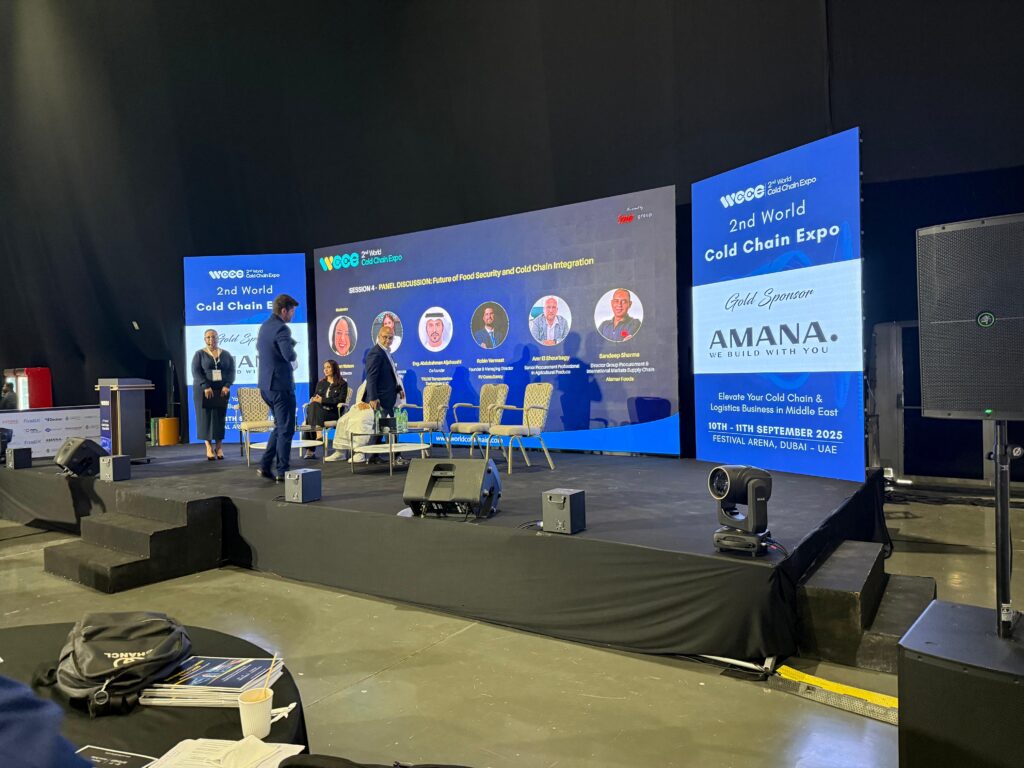
Organised by TAB Group, the 2nd World Cold Chain Expo 2025, on September 10 and 11 in Dubai, brought together representatives from logistics, food, pharma, technology and policy to discuss how innovation, sustainability and collaboration can reshape the region’s cold chain infrastructure.
Held under the theme, “Future-Proofing Cool Chain: Technology, Sustainability and Innovation in the Middle East”, the event witnessed speakers exploring ways and means to align growth with efficiency and responsibility. They – and delegates – converged around a single premise: Technology may drive the cold chain’s evolution, but its success will ultimately depend on collaboration, compliance and circular thinking. Across sessions, panelists and speakers examined the pressures facing the sector, including rising energy costs, population growth, tightening environmental expectations and the pathways towards a resilient, data-driven future.

Technology and automation: Backbone of transformation
The speakers widely recognised digitalisation, automation and artificial intelligence (AI) as catalysts for change. Gurumurthi Shankar, Chief Operating Officer, Global Shipping & Logistics, said the cold chain remains an energy-hungry and high-cost industry, where “transformation is being led by technology”. He described how automation and robotics have enabled near-manless warehouse operations, while advanced refrigerant systems are reducing energy consumption and emissions.
Jean De Bernardi, Technical Director, Honeywell – Europe, the Middle East, Turkey and Africa, expanded on this, highlighting developments in insulation and CO₂ management that allow greater efficiency and control. Echoing the technological optimism, Shashi Shekhar, Founder and Chairman, Supply Chain and Logistics Group (SCLG), said that in the coming years “there will be focus on automation”. He added that AI and real-time data collection would reshape the ability to track and trace goods, enabling more responsive logistics networks.
For Fabrice Panza, Global Head of Pharma Development, Etihad Cargo, the most significant technological disruption is occurring in the pharmaceutical sector. He pointed to precision therapy as a defining trend that demands new cold chain models and highly trained personnel. “High quality is possible only if you strive for a centre of excellence,” he said, underscoring that data integrity directly affects product integrity.
Collectively, the speakers described a sector moving towards smarter, leaner and more predictive operations, one that embraces robotics, modular construction and integrated monitoring systems to maintain reliability while cutting costs.
Sustainability and energy efficiency
Sustainability cut across nearly every discussion, with several speakers linking innovation to environmental responsibility. Shankar said Global Shipping & Logistics had embarked on an ESG journey to curb carbon emissions through automation and solar energy. He acknowledged the challenges of maintaining solar panels in dusty conditions but noted the company was testing robotic cleaners to improve safety and efficiency.
De Bernardi emphasised that lifecycle analysis is essential when comparing refrigeration technologies, remarking that “comparing one technology to another does not make sense” without examining full environmental impact. He added that operational excellence through reduced CO₂ output, water conservation and lower downtime must underpin sustainability goals.
From the food sector, Dina Mongy, Associate Director – Corporate Affairs and Sustainability, Nestlé, outlined the company’s regional approach. She said that all four of Nestlé’s UAE factories are powered by solar energy and that the organisation collaborates with NE’MA, the country’s first federal food waste management body. Mongy added that while these efforts reduce waste, their high cost can limit adoption until sustainability becomes mandated by law.
Praviin Bhuwaneshwar Kumaar, Regional Representative South Asia, GOGLA, and Consultant at IFC – World Bank Group, presented research showing that although 60% of food is refrigerated, wastage remains high. He said that renewable innovation – particularly the use of solar energy – and stronger regulatory backing were needed to unlock the cold chain’s full sustainability potential.
The shared message was clear: Cleaner energy and efficiency are no longer optional enhancements but core business imperatives for a sector under scrutiny for its carbon footprint.
Policy, standardisation and collaboration
Speakers repeatedly returned to the need for harmonised standards and coordinated policymaking. Shankar identified regulatory consistency as the foundation for quality, cost control and sustainability. De Bernardi advocated for shared standards and digital twins to model and improve system performance, while Shekhar warned that end-to-end standardisation remains a formidable challenge, given the complexity of global supply networks.
Shekhar further argued that policy feedback should “come from people on the ground”, who understand operational realities, urging regulators to consider such insights when shaping frameworks. Mohammed Nassar Al Refaee, Managing Director and Chief Executive Officer, NRTC Group, added that innovation and AI would define the new compliance landscape, as quality must “never be compromised”.
In a session dedicated to logistics, Andrea Cavalet, President of the HVACR association, Eurovent Middle East, said the association’s third-party certifications help bridge the gap between policymakers and industry by providing advocacy, education and technical validation. Cavalet called for certified technicians and better market awareness to strengthen enforcement.
Nissrine Elqobai, Chief Executive Officer, ENY Consulting, discussed the cost implications of implementing standards in hot climates, observing that last-minute compliance often proves more expensive than early adoption. Governments, she said, must enforce regulations in ways that encourage proactive industry participation.
The conversations revealed a sector eager for consistency across data protocols, equipment standards and regional policies, believing that regulation can become an enabler rather than a burden when well aligned with industry needs.
Food security and circular economy
Food security emerged as a central concern, linking technological and environmental priorities. Sandeep Sharma, Director – Group Procurement and International Markets Supply Chain, Alamar Foods, said that geopolitical conditions have added complexity to cold chain integration, reinforcing the need for temperature control and supply continuity.
Robin Vermaat, Founder and Managing Director, RV Consultancy, emphasised collaboration, arguing that “no cookie-cutter solutions” exist for such a diverse region. Instead, partnerships among policymakers, technology developers and operators are essential to design context-specific systems.
Mongy reiterated that sustainability in logistics cannot be separated from food waste reduction. She said that harmonising policies across the different GCC region entities, rather than maintaining fragmented regional regulations, would support road optimisation, digital traceability and, ultimately, blockchain-based control systems.
Interestingly, the Keynote Address, by Tariq Al-Suwaidi, Director, New Economy Department, UAE Ministry of Economy, reinforced these points. He said that through the Circular Economy Council, the UAE aims to halve food waste by 2031 and strengthen collaboration across federal, local and private sectors. Al-Suwaidi also cited business law reforms and the Golden Visa programme as factors attracting innovation and investment in sustainability.
Mira El Ghaziri, Managing Director, HealthyPath, connected food security to agricultural innovation. Working with the Dutch Ministry of Agriculture, she said her organisation promotes crop diversity suited to local conditions, and called for bridging “the gap between the economy and the industry” to position the UAE as a global leader in sustainable agriculture.
Innovation in design and operations
Several presentations showcased tangible innovations shaping the cold chain’s physical and digital infrastructure. Honeywell’s De Bernardi presented the company’s shift to ultra-low-GWP refrigerant, R1234ze and a new chiller design offering higher energy efficiency and water savings. And Mohannad Al Omar, Business Development Manager, Group AMANA, introduced DuPod modular construction, comparing it to “a car assembly unit” that moves much of the build process from site to factory to improve predictability and reduce time to market. Irina Albanese, Head of DHL’s Innovation Centre for the Middle East and Africa, outlined next-generation packaging solutions integrating real-time tracking, analytics and alerts, while Shankar detailed advances in dark warehouses, robotic arms and AI-based predictive maintenance. Siva Reddy, Founder, GND Solutions India, demonstrated smart sensors for temperature and humidity monitoring, claiming they could significantly reduce spoilage. Mohammed Salem Al Shamisi, Section Head – Dates and Goods Subsidy Program, Abu Dhabi Agriculture and Food Safety Authority, closed with an appeal to reduce post-harvest losses through cooling technologies and training farmers in handling and marketing.
Together, these innovations underscored the sector’s momentum towards intelligent, modular and sustainable systems that serve both business and environmental objectives.
Across panels and presentations, the 2nd World Cold Chain Expo 2025 highlighted a region-wide commitment to reimagining the cold chain as a smarter, cleaner and more cooperative ecosystem. Whether through AI-driven logistics, renewable power integration or unified standards, participants agreed that only a holistic approach, where technology, policy and sustainability advance in tandem, can future-proof the cool chain for the decade ahead.