

Copernicus reports fourth-warmest March globally with near-record sea surface temperatures
READING, United Kingdom, 10 April 2026: The Copernicus Climate Change Service (C3S), implemented by the European Centre for Medium-Range Weather Forecasts (ECMWF), reported that March 2026 was the fourth-warmest March globally on record, with temperatures reaching 1.48 degrees C above pre-industrial levels. C3S said March also recorded the second-warmest global sea surface temperatures on record, which it said reflected a likely transition towards El Niño conditions.
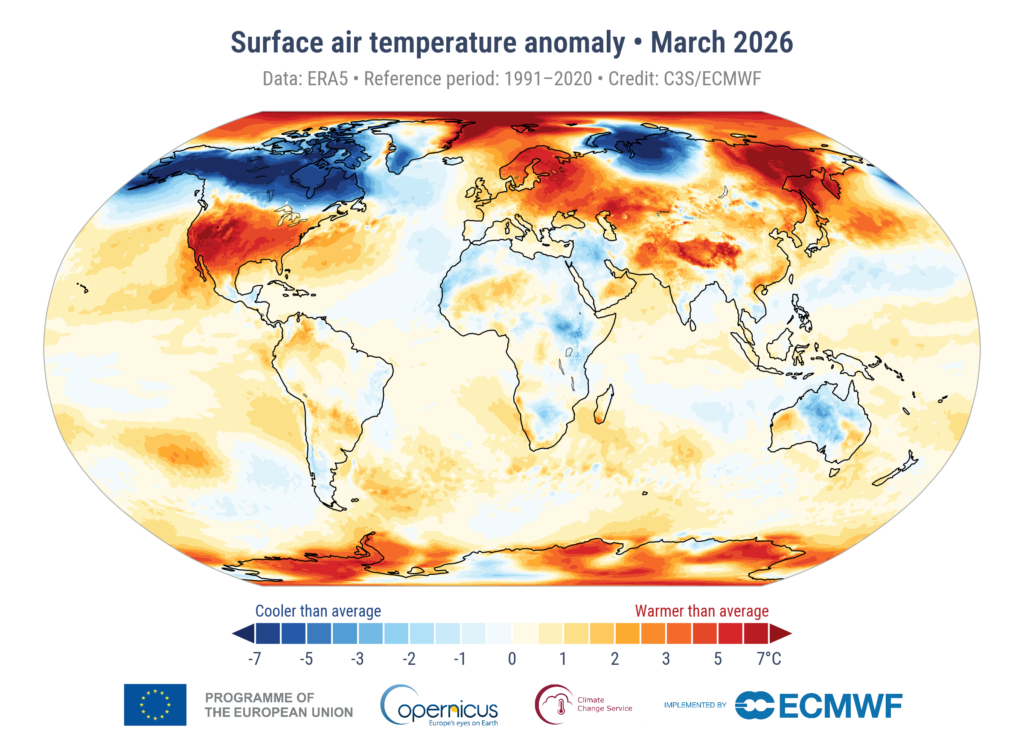
Data source: ERA5. Credit: C3S/ECMWF.
March 2026 – Surface air temperature and sea surface temperature highlights
C3S said the global average surface air temperature for March 2026 was 13.94 degrees C, which it said was 0.53 degrees C above the 1991-2020 average for the month. The service added that the warmest March on record occurred in 2024.
C3S said Europe experienced its second-warmest March on record, with an average land temperature of 5.88 degrees C, which it said was 2.27 degrees C above the 1991-2020 average. The service added that most of Europe recorded warmer-than-average conditions, with the most pronounced anomalies observed over northwest Russia, northern Fennoscandia and the Baltic States, while it said slightly cooler-than-average conditions were seen over Türkiye, southern Europe and most of Iceland.
C3S said severe heat and dry conditions were observed in other regions, including an early heatwave and drier-than-average conditions in parts of the United States and Mexico. The service added that warmer-than-average temperatures were also recorded across much of the Arctic, northeast Russia and parts of Antarctica, while it said unusually cold conditions were observed across Alaska, most of Canada, southern Greenland and northwest Siberia.
C3S said strong contrasts between warmer and cooler than average temperature anomalies persisted across the Northern Hemisphere, similar to February.
C3S said the average sea surface temperature for March 2026 over 60 degrees S to 60 degrees N was 20.97 degrees C, which it said was the second-highest value on record for the month. The service added that daily sea surface temperatures increased steadily throughout March and were approaching the record levels set in 2024, and it said many climate centres forecast a transition from neutral to El Niño conditions in the second half of the year.
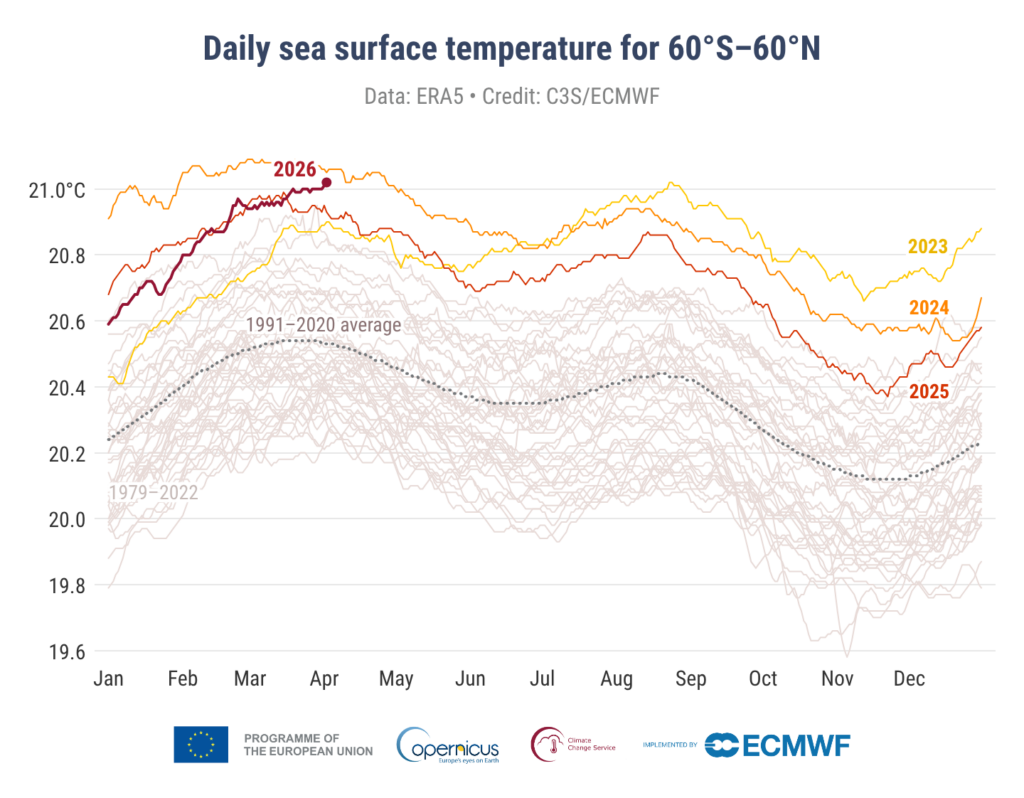
Data source: ERA5. Credit: C3S/ECMWF.
March 2026 – Sea ice highlights
C3S said that in the Arctic, both the annual maximum sea ice extent and the monthly average for March were the lowest on record. The service added that Arctic sea ice extent in March was 5.7% below average, which it said was marginally below the previous record set in 2025.
C3S said the daily Arctic sea ice extent reached its joint lowest winter maximum, tied with March 2025. The service added that regional sea ice deficits were most pronounced in the northern Barents Sea, the Svalbard region and the Sea of Okhotsk.
C3S said Antarctic sea ice extent was 10% below the March average, which it said placed it outside the ten lowest on record for the month, following several years of larger negative anomalies.
March 2026 – Hydrological variables highlights
C3S said March followed a colder-than-average and exceptionally wet February in Europe, which it said had widespread flooding and ranked as the third coldest February for the continent in the last 14 years. The service added that much of continental Europe experienced drier-than-average conditions during March, while it said Iceland, the northern UK, much of Scandinavia, parts of the Mediterranean and the Caucasus recorded wetter-than-average conditions, with some areas experiencing flooding linked to storm activity.
C3S said wetter-than-average conditions outside Europe were recorded in regions including eastern and western USA and Canada, parts of Australia, southern Chile, eastern Brazil, parts of the Middle East, and parts of eastern Asia and southeastern Africa. The service added that drier-than-average conditions were observed in southern USA and northern Mexico, southeastern China, parts of South America and western Australia.
Carlo Buontempo, Director, C3S, ECMWF, said: “Copernicus data for March 2026 tells a sobering story: 1.48 degrees C above pre-industrial levels, the lowest Arctic sea ice extent on record for March, and sea surface temperatures again approaching historic highs. Each figure is striking on its own – together, they paint a picture of a climate system under sustained and accelerating pressure. Reliable data, produced operationally from billions of measurements across satellites, ships, aircraft and weather stations, is no longer a scientific luxury. It is the essential foundation for any serious climate adaptation and policy response.”