

IIR releases new technical brief on dehumidification technologies
PARIS, France, 14 July 2026: The International Institute of Refrigeration (IIR) has published Dehumidification in Air Conditioning, the 62nd in its Technical Brief series on refrigeration technologies.
The brief offers a comprehensive review of the technologies used to remove moisture from air in cooling systems, IIR said. The process is central to the indoor environment and the energy performance of air conditioning, worldwide, IIR added.
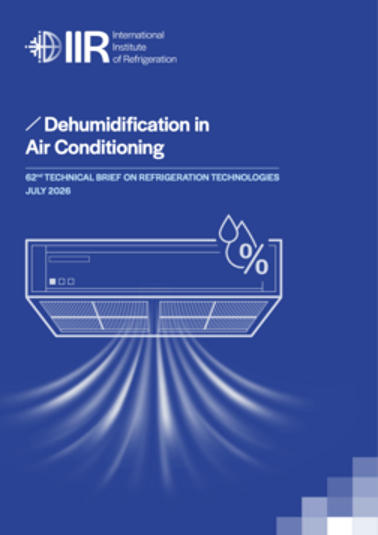
In hot and humid climates, HVAC systems can account for more than half of a building’s total energy use, and more than half of that load comes from removing moisture from the air rather than lowering its temperature, IIR said. As demand for air conditioning accelerates across Southeast Asia, Africa, Latin America and other hot, humid regions, how well systems handle humidity, not just temperature, will be decisive for energy demand, emissions, and grid stability in the years ahead, IIR said in the brief.
Authored by a team of IIR experts, led by Baolong Wang, Vice President of IIR Commission E1, Air conditioning and President of IIR Working Group on Dehumidification in Air Conditioning, the brief maps the full landscape of dehumidification technologies, including:
- Condensation dehumidification: The mature, widely used approach behind most vapour-compression and thermoelectric systems today
- Liquid desiccant dehumidification: Which can run on low-grade waste heat and is increasingly used where deep, precise humidity control is critical, such as in hospitals and laboratories
- Solid desiccant dehumidification: Including desiccant wheels, which can reach dew points as low as –70 degrees C and are used in industries like pharmaceuticals, electronics and battery manufacturing
- Emerging technologies: Including electrolyte membrane and hollow-fibre membrane dehumidification, compact and electrically driven approaches, still in early stages of commercialisation
Based on this analysis, IIR called for:
- Prioritising humidity control to allow air conditioning systems to operate at higher, more efficient chilled-water or evaporating temperatures
- Accelerating deployment of efficient dehumidification in hot-humid regions, where cooling demand growth is concentrated, and the energy, emissions and grid-stability stakes are highest
- Increased support for emerging dehumidification technologies, through technical alliances, research funding and international collaboration
The brief also sets out recommendations for policymakers, including embedding humidity-control metrics into global air-conditioning test standards. In this area, current standards focus mainly on temperature and encourage closer collaboration between international standards bodies such as ISO, CENELEC, ASHRAE and JSRAE.
Wang said: “Humidity control is a critical factor in maintaining a comfortable and productive indoor environment. Advanced dehumidification technologies can substantially lower the energy consumption and carbon footprint of air conditioning systems, thereby advancing global initiatives for low-carbon cooling”.