

Copernicus: ‘June 2026 was the warmest June on record for western Europe’
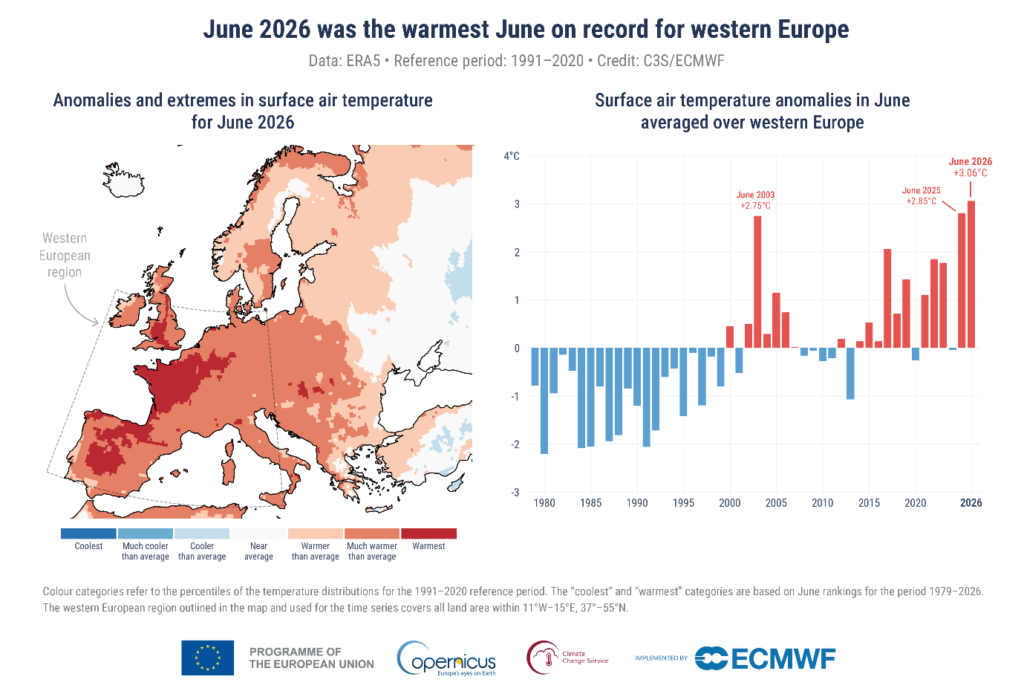
Data source: ERA5. Credit: C3S/ECMWF.
READING, United Kingdom, 9 July 2026: June 2026 was the hottest June recorded for western Europe and the second warmest globally, Copernicus Climate Change Service (C3S) said through a Press Release. It saw near-record temperatures driven by the highest sea surface temperatures (SSTs) on record for the month, Copernicus said. The European Centre for Medium-Range Weather Forecasts (ECMWF) implemented the study.
The month saw Europe hit by extreme heat over land and sea, with much of western Europe experiencing a record-breaking heatwave and marine heatwaves across the western Mediterranean and along the Atlantic coasts, Copernicus said. Globally, the monthly average SST for the extra-polar ocean (60 degrees S – 60 degrees N) was the highest for June, exceeding the previous record set in June 2024 by just 0.01 degrees C, partly reflecting the development of strong El Niño conditions in the equatorial Pacific.
According to Copernicus, the heatwave that hit much of Europe during the second half of June came only a few weeks after a particularly intense heatwave in May, with another heatwave emerging in early July. The June heatwave broke monthly and all-time temperature records across several European countries and contributed to severe health impacts, including heat-related deaths, Copernicus said. The succession of heatwaves illustrates the growing challenge posed by increasingly frequent and intense heat extremes across Europe and the globe, Copernicus said.
Europe also saw widespread dryness that together with extreme heat, contributed to wildfire activity, particularly in the Iberian Peninsula and southern France, and heightened drought risk in parts of eastern Europe, Copernicus said. The June heatwave occurred against a backdrop of increasingly dry soils across western and central Europe, further exacerbating drought conditions that had begun to develop during May’s heatwave, Copernicus added.
Samantha Burgess, Strategic Lead for Climate, ECMWF, said:“June 2026 underscored how profoundly the climate is changing. Western Europe recorded its warmest June on record, and continued record warmth in the global ocean. Together, these records reflect a climate system continuing to accumulate heat. The result is increasingly intense heatwaves, a persistently warm ocean, and growing risks for people, ecosystems and infrastructure across Europe and beyond.”
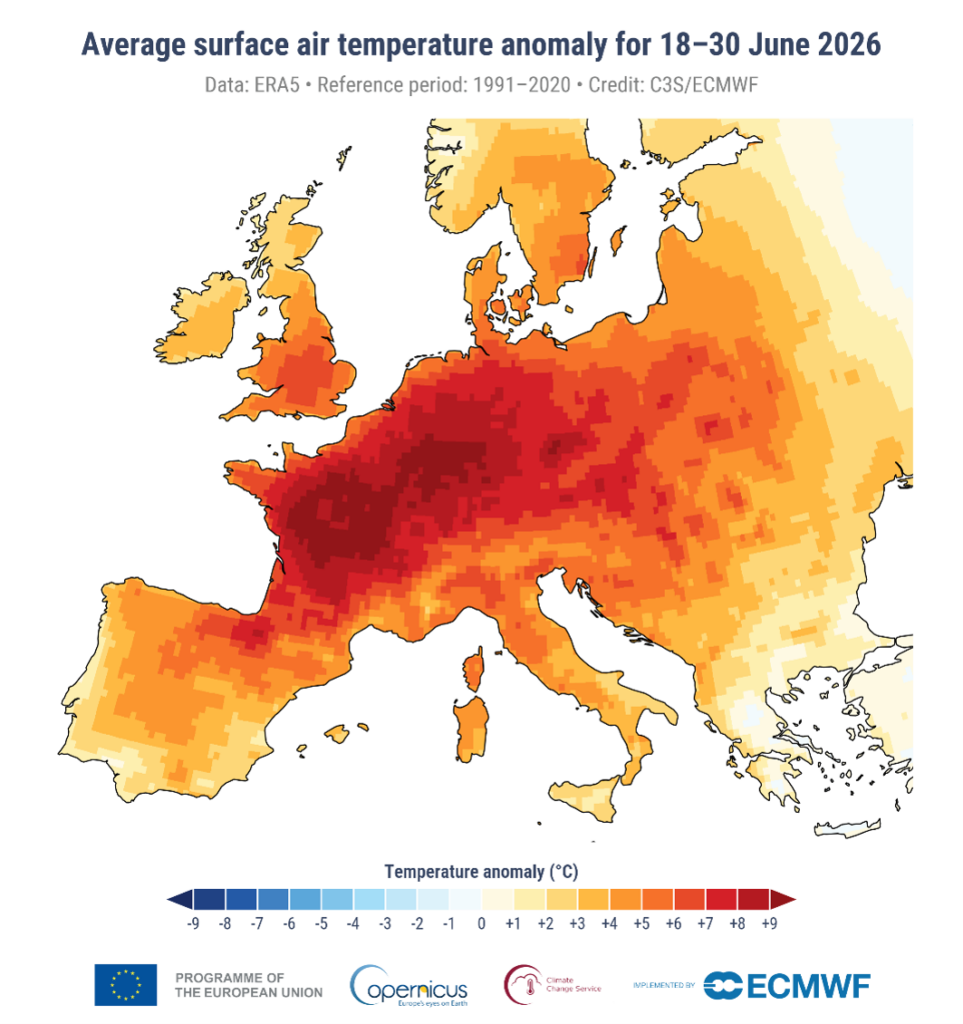
Data source: ERA5. Credit: C3S/ECMWF
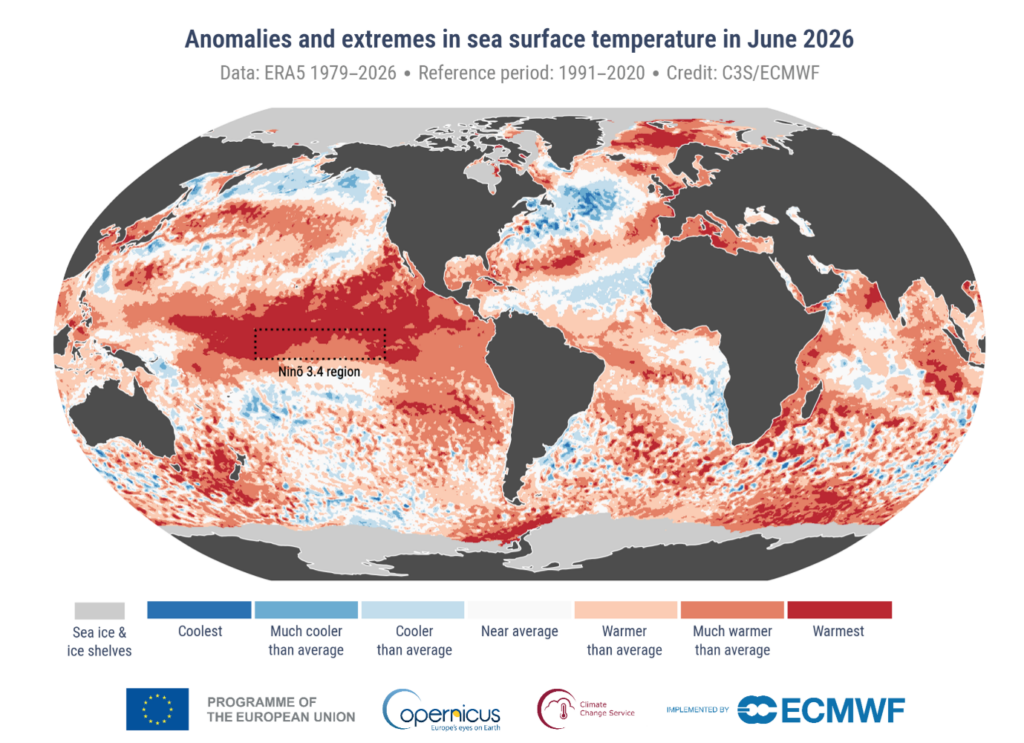
Data source: ERA5. Credit: C3S/ECMWF
June 2026 – surface air temperature and sea surface temperature highlights
Global temperature
- June 2026 was the second-warmest June globally in the ERA5 dataset, with an average surface air temperature of 16.54 degrees C, 0.56 degrees C above the 1991-2020 average for the month, behind June 2024.
- June 2026 was 1.39 degrees C above the estimated pre-industrial 1850-1900 average.
Sea surface temperature
- The average SST for extra-polar oceans (60 degrees S – 60 degrees N) in June 2026 was the highest on record for the month at 20.86 degrees C, but only marginally higher (by 0.01 degrees C) than June 2024.
- SSTs remained at exceptionally high levels across a large portion of the tropical Pacific, where El Niño conditions are present and forecast to strengthen rapidly in the coming months.
Europe
- The average temperature over European land in June 2026 was the second-highest on record for the month, at 19.14 degrees C, 1.78 degrees C above the 1991-2020 average for the month, behind June 2019.
- During the second half of the month, an intense heatwave affected much of western and central Europe, with many June and some all-time records for daily maximum temperature being broken in several countries.
- Western Europe, the region most affected by the heatwave, experienced its warmest June on record, with an average temperature of 20.74 degrees C, 3.05 degrees C above the 1991-2020 average for June, surpassing the previous record set in June 2025.
June 2026 – hydrological variables highlights
- In June 2026, much of western continental Europe, including Italy, large parts of central and eastern Europe, and southern United Kingdom experienced drier-than-average conditions, associated with persistent high-pressure and heatwave conditions.
- Dry conditions increased drought risk across parts of eastern Europe and contributed to wildfire activity, particularly in the Iberian Peninsula.
- Consistent with the widespread drier-than-average conditions and extreme heat, river flow was below average across Europe, affecting large parts of France, much of central and eastern Europe, and parts of north-eastern Europe.
- Conversely, Iceland, Ireland, much of the UK, the North Sea coast, Fennoscandia, the Baltic States, Greece and a large region north of the Caspian Sea were wetter than average. In some areas, heavy precipitation led to localised flooding and associated impacts.
- Above-average river flow occurred only in relatively limited areas in June, mainly in Ireland, northern parts of the UK, parts of southern Iberia, southern Greece, Türkiye, and parts of the Baltic States and Scandinavia.
- The global extra-tropical regions that experienced wetter-than-average conditions included parts of North America, easternmost Asia, southern Africa and Australia, with flooding reported in several regions.
- Drier-than average conditions were seen in parts of the United States and Canada, parts of South America, the Middle East, Central Asia and Russia.
June 2026 – sea ice highlights
- In the Arctic, monthly average sea ice extent in June was about five per cent below average, ranking sixth-lowest for the month.
- Regionally, the Arctic sea ice cover was below average in most marine sectors, particularly in the northern Barents Sea around Svalbard and Franz Josef Land.
- In the Antarctic, monthly average sea ice extent in June was about eight per cent below average, ranking sixth lowest.
- Sea ice cover was much below average in the Bellingshausen Sea, while it was above average in the Amundsen and eastern Ross Sea.